
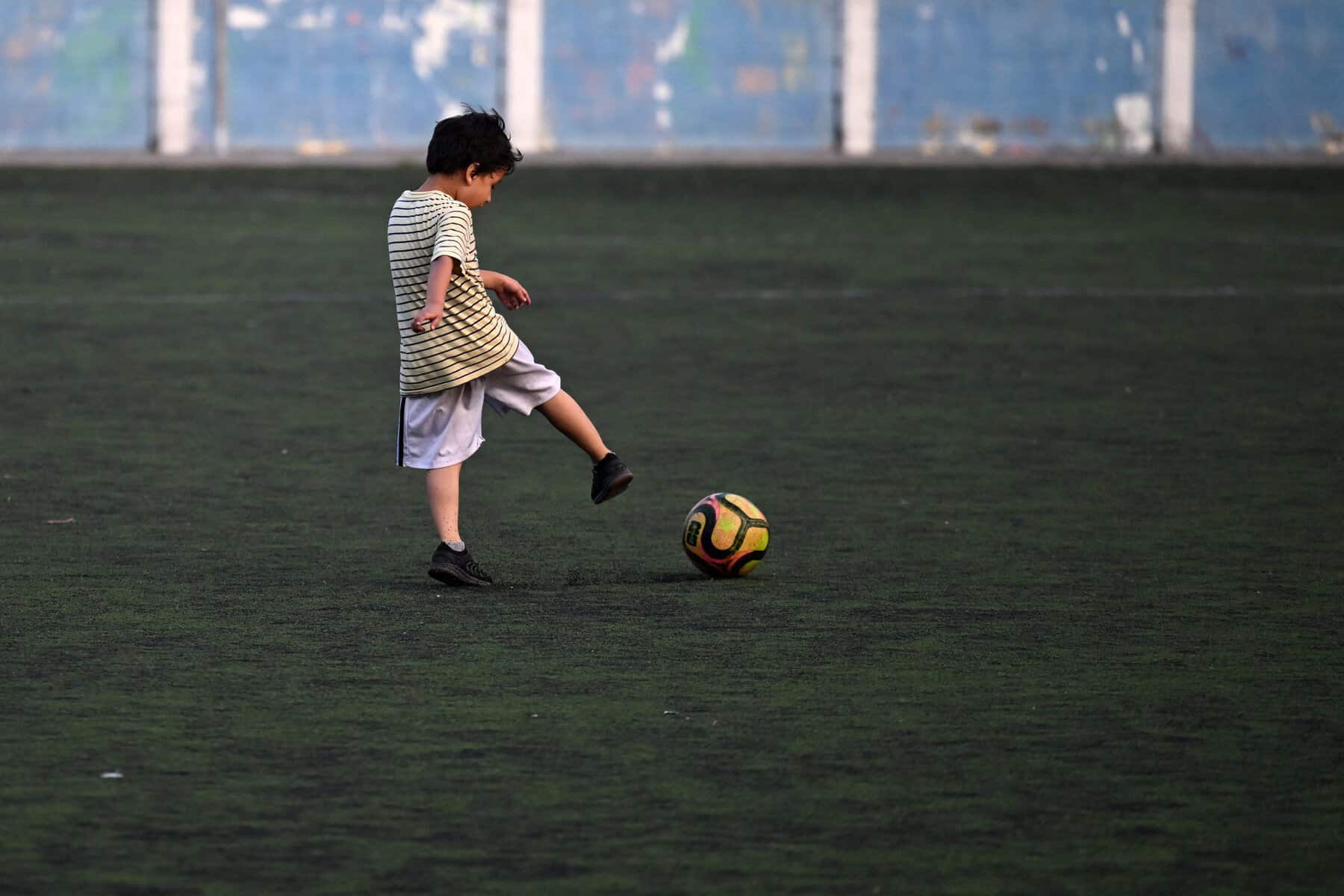
Bryan Oliva, 12, runs across a field of yellowing, overgrown grass in a densely populated neighborhood of San Salvador. He dreams of becoming a professional soccer player, but talent alone is not enough to make that happen in a Central America where the sport is moving backward. Eleven-year-old Darixon Rivas of Honduras shares that dream. Every afternoon, he trains on a muddy field, but first he must work on his family’s ranch in La Abisinia, a remote village in the northern department of Colón. “You make a lot of money as a soccer player, but I don’t feel like it’s possible for me,” Bryan admits in Zacamil, a neighborhood of apartment buildings in the Salvadoran capital. Hoping to help his family financially, he believes it is “really difficult” for young people from poor communities like his to get noticed by scouts, since the few opportunities available tend to reach more privileged areas. Poverty touches almost everything in Central America, where roughly half the population lives in those conditions. But soccer’s problems go further: with few exceptions, investment in infrastructure and player development is scarce. “We have a long way to go,” Salvadoran Soccer Federation President Yamil Bukele recently acknowledged. He is promoting a plan to strengthen the youth divisions. Moving Backward The consequences are plain to see: only Panama and Guatemala qualified for the Concacaf Nations League quarterfinals, which begin Thursday. In fact, Panama was the only Central American team at the recent World Cup in North America, where Caribbean nations Curaçao and Haiti also represented Concacaf. El Salvador last appeared at a World Cup 44 years ago, during the rise of striker Jorge “Mágico” González, considered Central America’s best player of the 20th century. More than 40 coaches have led the team since then. The job is currently held by Colombia’s Hernán Darío Gómez, who has coached at the World Cup. Honduras, led by Spain’s José Francisco Molina, has also spent years living on memories. Its last World Cup appearance was in Brazil in 2014. That tournament was also where time stood still for Costa Rica, which has never again fielded a team like the one that stunned the soccer world by reaching the quarterfinals. Guatemala, Nicaragua and Belize have never played at a World Cup. “There has been a regression,” Argentine coach Diego Vázquez, who led Honduras from 2022 to 2023, tells AFP. “Youth leagues need to be organized, and governments need to invest too,” he adds. Former Panama international Víctor René Mendieta says El Salvador, Honduras and Costa Rica “neglected” the development of new talent. Costa Ricans and Hondurans in particular “think the coaches are to blame, when the reality is that their talent pool (…) has been drying up, and they can’t compete with the emerging forces in the Caribbean,” Salvadoran journalist Bruno Porzio said. No One Taking Responsibility With nearly 50 million inhabitants, Central America has around 4,400 professional soccer players, most of them spread across 68 teams, according to FIFA figures from 2024. Yet domestic competitions, lacking stars or prominent coaches, are of a modest standard, and only a handful of players earn more than $5,000 a month. Most teams lack youth affiliates and training centers. Many clubs also play in small stadiums with artificial turf. “In El Salvador, major business owners stopped taking an interest in soccer,” and club officials have no interest in “leaving a legacy,” Porzio says. In Honduras, meanwhile, executives “want to stay for life,” Honduran coach Reynaldo Tilguath tells AFP. Central America also lacks players in major leagues who could raise the standard of its national teams, unlike Haiti, Suriname and Curaçao, whose squads are filled with players developed in Europe. Panama is “doing a better job” of developing players, while “the rest of us are falling behind,” Tilguath says. Meanwhile, high in the mountains of La Abisinia, Darixon and his friends share their field with horses and cows, trying to score in goals made from rusty metal posts. One wears a Lionel Messi jersey, while another sports clothing covered in images of Cristiano Ronaldo. “Honduran soccer is broken (…). Look at the state of this little field. Our fathers used to come and play here too,” Darixon says.
Central America – Where Soccer Is Stuck in Time
Full Article
Original Source
Read the full article at Ticotimes →KhanList aggregates and links to publicly available news content. We do not host full articles from third-party sources. Always verify important information with original sources.