
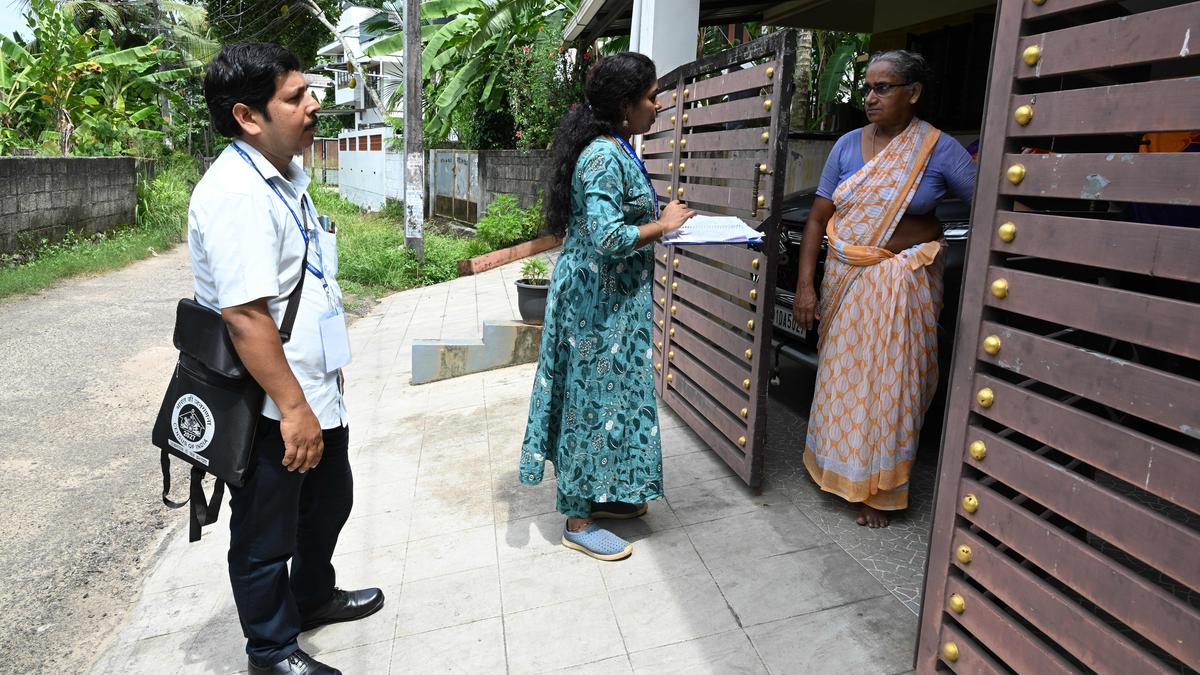
A census enumeration team visits homes in Vattiyoorkavu locality. | Photo Credit: NIRMAL HARINDRAN The census questionnaire is perhaps the most comprehensive manuscript of a nation’s social, economic and political evolution. Far from being a neutral statistical exercise, it is also a record of the state’s priorities and anxieties at a given moment. Every new question added, and every old one dropped, offers clues about what a society values, what policymakers seek to measure, and how governments perceive their citizens.The evolution of census questionnaires across the world reflects this intimate relationship between statistics and statecraft. The population enumeration phase of the Census, scheduled to begin next month, will have 13 new or modified questions compared with the 2011 Census, including details of a person’s father and mother and their places of birth. These questions were also part of the National Population Register schedule notified in 2020, sparking a political debate, with opposition questioning the government’s motive.Australia, which conducts a census every five years, included eight questions on heritage and migration backgrounds in its latest census, completed in August 2026. The emphasis is unsurprising in a country where immigration remains one of the defining political debates and where over a third of the population was born overseas. The questionnaire reflects not merely demographic realities but also contemporary political concerns.India’s census forms tell a similar story. As “Population Census in India: A Futuristic Perspective” by Seema Jain and Madhav Shyam shows, changes in the census schedule over the past century and a half mirror India’s transition from a colonial possession to a developmental state, and later to a society increasingly concerned with welfare delivery, urbanisation, financial inclusion and social identity.Popularly, 1872 census is considered to be the first for the Indian subcontinent, though it covered only the tracts that were under British rule. The questionnaire framed by the imperial government was shaped by colonial imperatives. Religion, caste and community formed the backbone of enumeration because understanding and categorising Indian society was critical to colonial governance. Educational qualification, taken for granted in modern surveys, appeared only in the 1941 census.One of the most significant shifts occurred after Independence with the rise of planning. The demands of the Five-Year Plans exposed major gaps in information about housing, infrastructure and living standards. Until 1951, states followed their own houselisting formats, making nationwide comparisons difficult. The introduction of a uniform houselisting schedule in 1961 represented more than administrative standardisation; it reflected a state increasingly interested in measuring the material conditions of its population.The evolution of the houselisting schedule over subsequent decades maps India’s development trajectory. The 1961 schedule focused on basic housing characteristics such as building material, tenure status and number of rooms. By 1991, it had expanded to include drinking water, electricity, sanitation and cooking fuel, reflecting a growing focus on basic services and rural infrastructure. The shift became even more pronounced in 2001 and 2011, when questions on bathrooms, kitchens, drainage connections, household assets, electricity sources and access to banking facilities moved the census beyond counting houses to assessing quality of life. The census was increasingly measuring developmental outcomes rather than merely recording demographic facts.The treatment of work in the census offers another window into changing economic thinking. Early censuses employed relatively narrow definitions of work. By 1991, unpaid labour on family farms and enterprises was recognised as work, signalling a broader understanding of economic contribution in a largely agrarian society. The introduction of categories such as main workers, marginal workers and non-workers reflected the state’s growing concern with labour participation and underemployment rather than simple occupational classification.Migration provides a similar example. From 1981, the forms started recording birth and the last place of residence, to capture the data on migration.The evolution of questions relating to family and gender also reveals changing social attitudes. Marital status classifications gradually expanded from a simple distinction between married, unmarried and widowed persons to include separated and divorced persons. The introduction of age at marriage in 2001 reflected increasing policy attention to gender, reproductive health and social development. Likewise, the recognition of a category other than male and female in 2011, and the subsequent adoption of the category “transgender person”, marked an acknowledgement of identities that earlier census frameworks had erased.Urbanisation emerged as another major concern. The dedicated enumeration of slum populations in 2001 and the expansion of such coverage in 2011 reflected growing awareness that India’s urban story could not be understood without accounting for informal settlements. The decision to collect more detailed slum data was itself a recognition that urban poverty had become a central development challenge.Seen in totality, the history of the Indian census questionnaire is the history of the Indian state itself. Published - August 31, 2026 12:22 pm IST
Census 2027: Statistics and Statecraft
Full Article
Original Source
Read the full article at Thehindu →KhanList aggregates and links to publicly available news content. We do not host full articles from third-party sources. Always verify important information with original sources.