
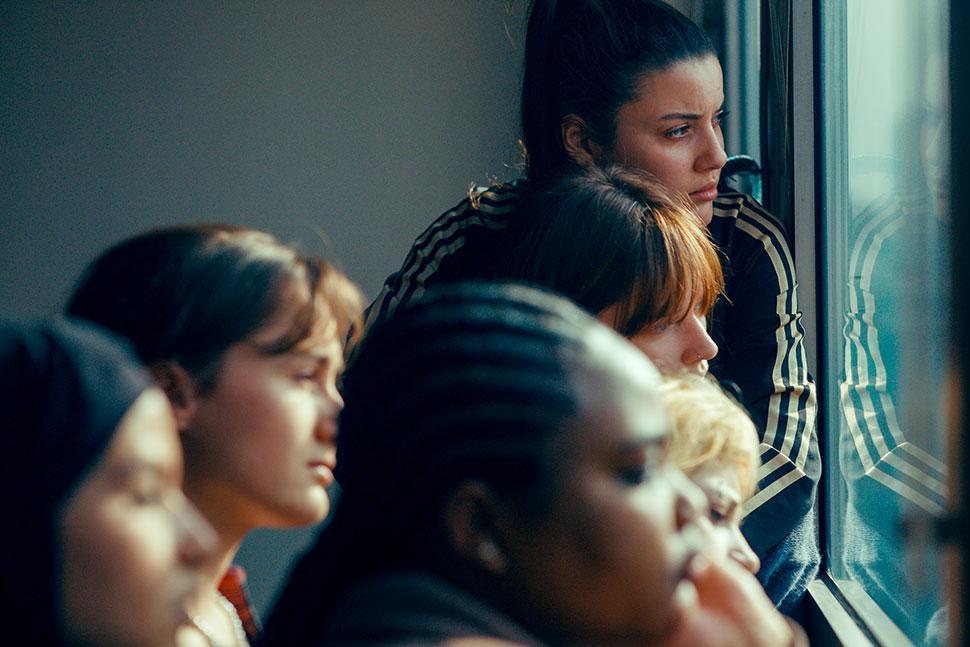
French director Cédric Kahn hits the Venice Film Festival’s this evening with Golden Lion contender A Place To Heal (15/18) set against the backdrop of an adolescent psychiatric ward. It promises to be one of this Venice’s most youthful red carpets as the director is joined by the dozen young actors at the heart of the production in which he also co-stars as the head psychiatrist of the unit. “They’re all very excited and I’m very happy about it because I’ve attended a lot of films festivals in my time but to experience a festival through their eyes will be a pleasure,” says Kahn, who has a long history with Venice having shown his first feature Railway Bar in its parallel Critics’ Week sidebar in 1992, returning in 2023 with Making of in its official selection. The youthful excitement will be an antidote to a tough but hopeful film digging into the issue of adolescent mental health issues. The young subjects include Lucia (Malou Khebizi) a tough-talking runaway, old beyond her years, who was abused by a stepfather as a child; Éloïse (Zoé Monpart), a seemingly privileged kid, suffering from eating disorders and depression who gradually opens up about the cause of her pain; Marvin (Daoud Gary), who is interned after a sudden psychotic episode, and Enzo (Kenji Peyran), a streetwise tearaway with a history of abandonment as a child, whose arrival on the ward upsets its fragile equilibrium. Deadline can reveal a first clip below giving a sense of the ward and its highs and lows, as the staff sets about the task of healing their young patients.“I’ve wanted to make a film about psychiatry for a very long time. It was a date with destiny for me. I’ve often explored mental fragility in my previous films; so, to make a film on this subject was a long-standing appointment,” explains Kahn about the origin of the film. The director had false starts as he tried to figure out how to explore the subject on the big screen. “I worked on an initial project a few years back that focused more on adult psychiatry, specifically from the perspective of the medical staff,” he recounts. “The film’s protagonist was a psychiatrist, but I wasn’t happy with the script, so I completely changed my approach to the subject; approaching it through the lens of adolescents felt more positive to me… there’s more hope with adolescents.” The young psychiatric patients in A Place to Heal are based on research carried out by co-writer Kahina Le Querrec, who spent six months immersed in a child and adolescent psychiatry unit, while Kahn also gained personal insight through three weeks spent in a unit in Paris. “She gathered the children’s accounts and spoke with the psychiatrists and medical staff, and we wrote the screenplay based on that material… they are all true stories, re-enacted by other adolescents.” Kahn acknowledges that one of the themes running through the drama is the role parents in their children’s mental health issues. “There are many contexts, but obviously, family and parents play a major role in children’s dysfunction,” says Kahn. “I know that for parents, the film can create a sense of unease or guilt… I have friends who saw the film who told me they were asking themselves throughout the film whether they were bad parents.” The film comes at a time of reports of a growing health crisis amongst youngsters, in the wake of the Covid-19pandemic and the rise of smart phones and social media. Kahn questions whether is a rise in mental health problems, suggesting rather than it has become more acceptable to talk about mental health issues openly, adding the supposed trend was not at the heart of his intentions for the film. “I wanted to show that when it comes to psychological or psychiatric issues, it’s actually a very democratic experience. We’re all on equal footing. And then, there are also issues that are truly timeless,” he says. “While I do somewhat call out the role of parents, I’m not really criticizing a specific era in the film. I don’t dwell much on eco-anxiety or Covid. We tried to make a film that feels fairly timeless. It’s not a judgment on the times, not at all, but it is a judgment on the family; that’s for sure.” “The issue of family is something that runs through all my films. The topic of parent control, I’ve addressed it in every film; it’s a continuation of that theme. So, I’d say that’s more my personal subject matter than the topic of psychiatry itself.” The film is produced by Ad Vitam Films, which will release the film in France on November 18, in coproduction with Kahn’s Trop de Bonheur Productions and France 2 Cinéma. Charades handles international sales.
Cédric Kahn Talks Exploration Of Youth Mental Health Issues In Venice Contender ‘A Place To Heal’ + Trailer: “There’s More Hope With Adolescents”
Full Article
Original Source
Read the full article at Deadline →KhanList aggregates and links to publicly available news content. We do not host full articles from third-party sources. Always verify important information with original sources.