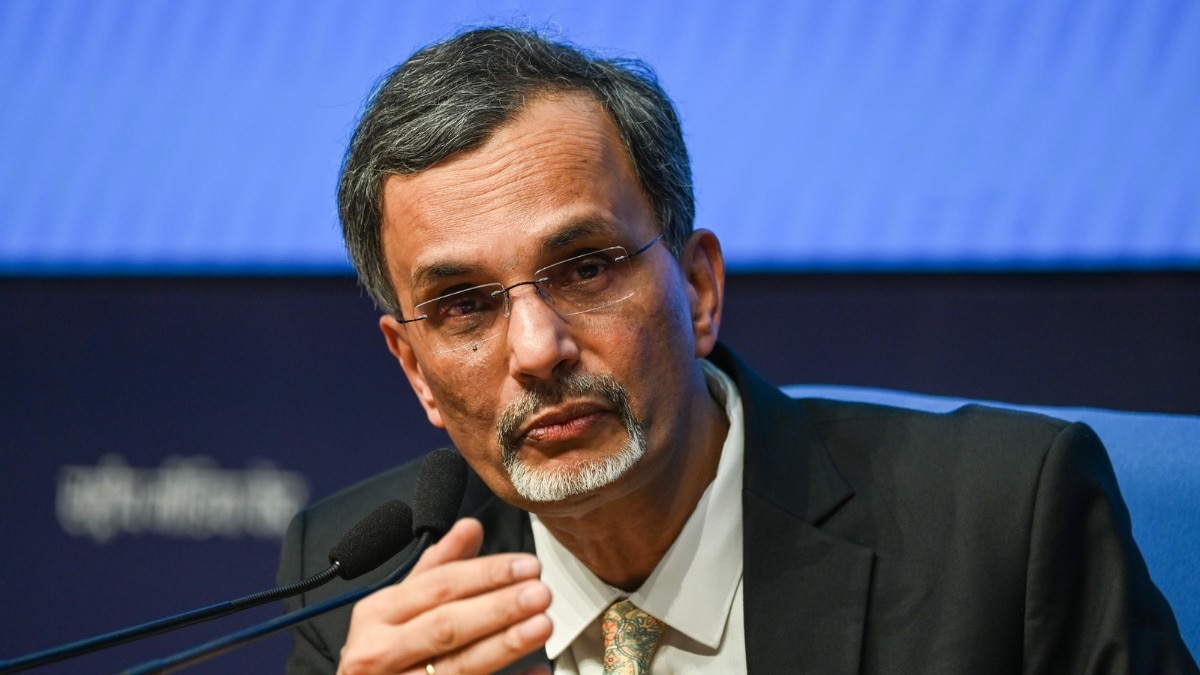
Chief Economic Adviser V Anantha Nageswaran and Akash Poojari have proposed restoring E10 petrol for older vehicles alongside E20. They said India should weigh food, feed and water trade-offs before considering higher ethanol blends.Chief Economic Advisor V. Anantha Nageswaran addresses a press conference on Economic Survey 2024-25 in New Delhi on January 31, 2025. Photo by Chandradeep KumarAmid the ongoing debate over E20 petrol and the pushback from owners of older vehicles, Chief Economic Adviser V Anantha Nageswaran and Akash Poojari have suggested bringing back E10 petrol for older two-wheelers and, more importantly, urged India to examine the food-versus-fuel trade-off before pushing ethanol blending beyond 20%.In a column published in The Indian Express on Monday, Nageswaran and Poojari, a consultant with the Department of Economic Affairs, argue that the question facing India is no longer simply whether E20 works in older vehicles. It is also about what India will have to grow, how much land and water it will have to commit, and what agricultural uses could be displaced as the country demands more ethanol.The authors point to possible future blends such as E27 and E30 and caution against moving further without accounting for these costs. Their argument is that while some policy decisions can be reversed relatively easily, changing cropping patterns and committing land and water to fuel production can be much harder to undo.This puts the food-versus-fuel question at the heart of India's ethanol policy. THE FOOD-VERSUS-FUEL QUESTIONIndia's ethanol programme has expanded rapidly, with the country reaching its 20% blending target much earlier than originally planned. The government has defended the programme on the grounds that it reduces crude oil imports, saves foreign exchange and creates an additional market for farmers and ethanol producers.But higher blending requires more ethanol, and more ethanol requires more feedstock. India produces ethanol from sugarcane as well as maize, rice and other grains. As demand for ethanol grows, these crops acquire another major buyer in the form of distilleries.That creates a basic economic trade-off. The same crop can be used to produce fuel or serve food, feed and other industrial markets.The CEA's column focuses particularly on maize. Greater demand from ethanol producers can push up its value as a fuel feedstock, potentially influencing what farmers choose to grow and how much land is devoted to it. Maize is also an important input for poultry and livestock feed, meaning changes in its price and availability can ripple through the food economy.The authors argue that these competing uses need to be part of the calculation when India assesses the benefits of ethanol.The question becomes even more important if India moves beyond E20 petrol. A higher blending target would mean a larger and more sustained demand for agricultural feedstocks.Nageswaran and Poojari make the concern clear when they discuss moving from E20 towards E27 or E30, arguing that “fuel begins to crowd out food”.The sugarcane trade-off is already visible. News agency Reuters reported earlier this month that the government was considering restricting the use of sugarcane for ethanol in the next season as it seeks to increase domestic sugar supplies and address high sugar prices. Around 3 million tonnes of sugar, or about 10% of annual output, was diverted towards ethanol in the current season, according to the report.If less sugarcane is diverted to ethanol, maintaining E20 could increase pressure on alternative feedstocks such as maize and other grains.That is precisely the kind of knock-on effect the CEA column asks policymakers to consider before going further.THE WATER QUESTIONThe food-versus-fuel debate is also a water debate.The benefits of ethanol are generally measured through crude oil substitution, foreign-exchange savings, emissions and farmer incomes. Nageswaran and Poojari argue that the water required to produce the feedstock must also be considered.The relevant question is not simply how much water an ethanol plant uses. It is how much water is needed to grow the crop that eventually becomes ethanol — and what that water could otherwise have been used for.This is particularly significant for sugarcane, a water-intensive crop, but the authors extend the argument to agricultural feedstocks more broadly.Their concern is that once land and water are committed to fuel production, reversing those choices can become difficult.“Once land and water are committed to fuel, and distilleries and cropping patterns are built around it, pulling back can be painful,” the authors write.It is this argument that gives the column significance beyond the current E20 controversy. Nageswaran and Poojari are essentially asking whether the gains from greater energy security could come with less visible costs elsewhere in the economy.THE CASE FOR BRINGING BACK E10 PETROLThe immediate recommendation in the column concerns older vehicles. Nageswaran and Poojari estimate that around 75 million to 80 million older two-wheelers built before BS-IV and equipped with carburettors remain on Indian roads.They distinguish these vehicles from the wider fleet and cite testing in India and abroad to argue that fears of widespread engine damage from E20 are not supported by evidence.But they identify a specific problem with carburettor-equipped vehicles. A carburettor cannot sense the additional oxygen associated with a higher ethanol blend and adjust the fuel-air mixture accordingly, the authors say. This can leave the engine running with too little fuel for the air entering it and potentially make it run hotter.They also flag older rubber components that may not have been designed to withstand ethanol.Retrofitting these vehicles with ethanol-compatible components is possible and relatively inexpensive, the authors argue. The problem is the sheer scale of the fleet and the time it would take to retrofit tens of millions of vehicles.Their solution is to restore E10 alongside E20 for this older fleet.They argue that this would give older vehicle owners a lower-blend option while retrofits take place. It would also reduce total ethanol consumption compared with making the entire fleet run on E20.E20 remains the government's policy. The government has defended the fuel after extensive testing and has said there is currently no decision to move beyond the 20 per cent blend. It has also rejected calls for a nationwide choice between different petrol blends, citing the additional logistical and distribution costs.THE WIDER ETHANOL DEBATEThe broader food-versus-fuel argument has been made before. Concerns have been raised over whether the headline benefits of ethanol adequately account for the land, water, agricultural inputs and competing uses of crops that go into producing it.In a July 10 piece titled “The ethanol statistics that cannot stand up”, Teen Taal’s Tau, columnist and satirist Kamlesh Singh, questioned headline claims around ethanol, including foreign-exchange savings, farmer benefits and the wider costs of producing the fuel.He argued that calculations of the programme's benefits need to account for inputs such as fertiliser and energy, water requirements and the competing uses of crops diverted towards ethanol.The argument is similar to the concern raised by Nageswaran and Poojari: the benefits of ethanol need to be weighed against the cost of producing it, including the land, water and crops that go into making the fuel.GOVT DEFENDS E20 PETROLThe government, for its part, has consistently highlighted the benefits of ethanol blending, including lower crude imports, foreign-exchange savings and additional demand for agricultural produce. It has also defended E20 on technical grounds, saying extensive testing has not found widespread engine damage.The CEA column does not reject those benefits.Instead, it asks whether India should chase further ethanol gains without first calculating what those gains may cost elsewhere.For older vehicle owners, the answer proposed by the authors is E10. For India's broader ethanol policy, their message is more cautious: stay at E20 for now, examine the food-versus-fuel and water trade-offs, and be careful about making changes to land use and agricultural incentives that may be difficult to reverse.The authors ultimately frame the choice in terms of what India is willing to commit to fuel production. Their concern is “what we choose to grow, and what we will not be able to take back.”That makes the E20 debate much larger than a question of mileage or engine life.- EndsPublished By: Koustav DasPublished On: Aug 17, 2026 09:42 IST
CEA wants E10 petrol for older vehicles, questions ethanol's food trade-off
Full Article
Original Source
Read the full article at Indiatoday →KhanList aggregates and links to publicly available news content. We do not host full articles from third-party sources. Always verify important information with original sources.