
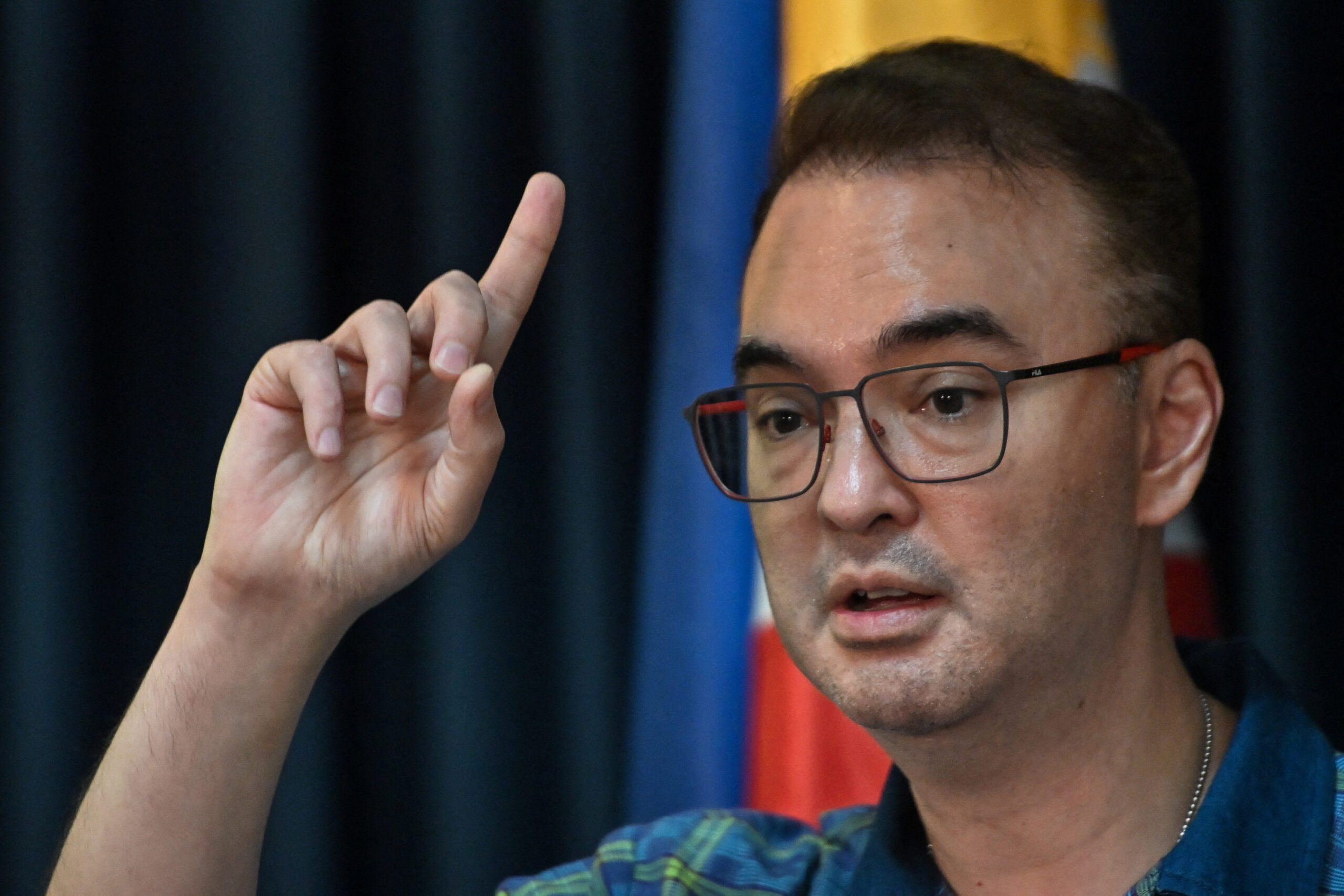
ALAN CAYETANO. Senator Alan Peter Cayetano gestures during a press conference concerning Senator Ronald 'Bato' dela Rosa, who is wanted by the International Criminal Court and who has reportedly fled, a day after gunfire rang out at the Senate, on May 14, 2026. Noel Celis/Reuters 'If I want to be a good citizen and pay my share, P170,000, where do I go?' Cayetano asks, apparently keen to 'go beyond' paying his taxes to help settle the national debt Senator Alan Peter Cayetano proposes a mechanism for individual taxpayers to contribute their share of the national debt, calculated at over P170,000 per Filipino. During Senate discussions, Cayetano expressed his desire to pay this amount directly, highlighting a historical example from South Korea's 1997 financial crisis where citizens contributed gold to help their country. This is AI-generated. Read the article for full context. Report any errors. Senator Alan Peter Cayetano is concerned about the national debt. So concerned, in fact, that he wants the government to set up a mechanism so that even you — yes, you, individual taxpayer — can directly pay your share of more than P170,000. That’s P170,598.03, to be exact, which Cayetano calculated as each Filipino’s share of the country’s enormous debt. It’s not money you owe or any citizen personally owes the government, of course, but if you’re feeling particularly generous, the senator thinks you should have a way to chip in. Are you game? During Senate deliberations on the proposed 2027 budget, Cayetano asked economic officials where exactly he could hand over his contribution. “If I want to be a good citizen and I want to pay my share, P170,000, where do I go?” he asked. For a moment, Senator JV Ejercito, who chairs the Senate finance committee, seemed perplexed. He grinned, turned to the economic team for help, and suggested that perhaps the best contribution Filipinos could make was simply to pay the right taxes. “That’s not true because I’m already paying the right taxes. I want to go beyond that,” Cayetano responded. “I want to pay my P170,000 — and you won’t accept it?” The senator went on to paint a vision of how wealthy businessmen might wish to pay for themselves and their families. “What if they’re feeling generous, and they have one or two kasambahay and they want to pay for it?” he added. Even overseas Filipino workers might contribute smaller amounts over time — a few hundred dollars here and there, he imagined. And if you’re wondering where this sudden wave of generosity might come from, Cayetano made an appeal to divine intervention. “If we pray but we do not act, the Bible says faith without action is dead. So we cannot keep praying for a miracle without doing anything to open the door for that miracle,” he said, hoping the government would pave the way for a little divine intervention and a flood of donations. As unusual as the proposal sounds, Cayetano does reference a historical example. During the 1997 Asian financial crisis, millions of South Koreans famously gathered their gold jewelry to help their country overcome a severe foreign currency shortage. Around 3.51 million citizens contributed some 227 metric tons of gold, either donated or sold, to raise much-needed dollars. Of course, South Korea’s campaign was about easing a foreign currency crisis, rather than paying off government debt, and it was only one part of the country’s economic recovery. “Why can’t it happen to us?” Cayetano asked. “If our debt were low and our debt payments were small, I wouldn’t be proposing that we bayanihan our way out,” he added in Filipino. Of course, the good senator’s proposal, however well-intentioned, takes a few liberties with how national debt actually works. But let’s indulge the thought experiment. Can Filipinos really bayanihan their way out of debt? Philippine government debt had reached P19.66 trillion as of end-September and is projected to reach P21.48 trillion by end-2027. Even if one million generous Filipinos each contributed P170,000, that would raise P170 billion, less than 1% of the projected debt. Interest payments alone are programmed to reach P1.114 trillion next year, eating up more than 15% of the proposed P7.2-trillion national budget. Economists previously told Rappler that the country’s debt remains manageable for now, although its rising size and cost are becoming concerning, especially as economic growth slows. And besides, even Cayetano himself acknowledged what is perhaps the bigger problem with his proposal. Why would Filipinos voluntarily give the government more money when so many already distrust how it spends what they pay in taxes? “The sentiment now is that everyone in government is a thief, that you’re all thieves, that we’re all thieves, and that no one wants to donate,” he said in a mix of English and Filipino. And with a sitting vice president on trial for unexplained wealth, a proposed national budget riddled with red flags — roads whose coordinates lead straight into the sea and an overabundance of multi-purpose buildings — who exactly would be lining up to fork over another P170,000? – Rappler.com How does this make you feel? Loading
Cayetano wants to let ‘generous’ Filipinos cover gov’t debt. Any takers?
Full Article
Original Source
Read the full article at Rappler →KhanList aggregates and links to publicly available news content. We do not host full articles from third-party sources. Always verify important information with original sources.