
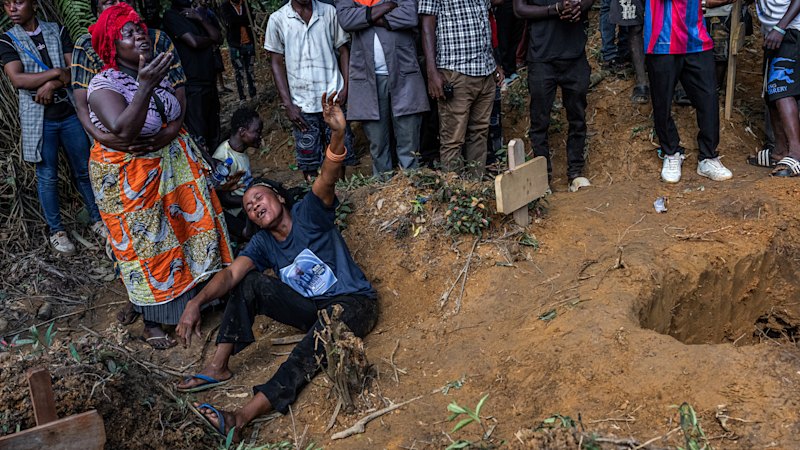
Biakato, DR Congo: Six months on, Ebola continues to hack a deadly trail across the eastern part of the Democratic Republic of Congo. When the outbreak was first detected in May, it resembled a single, giant blaze, with infections concentrated in a handful of towns in one province.It has since morphed into a far bigger, more elusive foe, creeping into eight provinces and splintering into numerous hotspots as it moves through one of the world’s great rainforests. Instead of one big fire, there are many now, scattered across a vast area about the size of Britain.Health workers have corralled the virus where it was first detected, but infections are soaring elsewhere. Biakato, a small town deep in the rainforest, suddenly accounted for as many as one-quarter of new cases nationally. Yet its beleaguered residents were left almost entirely on their own, with dangerously little to defend themselves against the fastest-growing Ebola outbreak in history.A relative mourns as Red Cross volunteers buried Mose Kalindera, a Biakato shopkeeper.Daniel Berehulak/The New York Times“We see the same mistakes as before,” said Dr Jean-Jacques Muyembe, who helped discover Ebola in 1976 and now heads the country’s National Institute for Biomedical Research. “It’s as if we were starting from zero. It’s very disappointing.”And if that were not enough, the campaign to contain the epidemic has run into a terrifying new threat: the Islamic State militant group.Ebola was already swamping Biakato when I got to the town in mid-October with photographer Daniel Berehulak. Exhausted health workers reported 300 cases in the span of a month, up from 20 the month before. But there were only two doctors; they had not been paid in months, and they felt utterly abandoned. The aid workers who would normally pour in and set up an Ebola treatment centre were being scared off by rebel fighters who have been terrorising the region for years.In recent days, their fears were tragically realised when the rebels, who are affiliated with Islamic State, killed 106 people in a series of attacks across the region, United Nations officials said. One of the deadliest episodes occurred 40 kilometres south of Biakato, where militants torched homes, shops and health facilities, forcing Ebola patients to flee their beds. Thousands of residents also fled in an exodus likely to further spread the disease.Even by the standards of eastern DR Congo, where conflict has raged for three decades, the fighters – from a group called the Allied Democratic Forces, or ADF – are considered especially brutal. They roam the sprawling forests, periodically springing from their hiding places to mount attacks. Civilians are beheaded, mutilated and abducted. Children are forced to fight with the group. Mass killings have taken place at funerals and churches.In 2019, the group pledged allegiance to Islamic State, and by one recent estimate, it is the world’s second-deadliest group for civilians. Now, its terror tactics are hobbling the fight against Ebola.A casket holding an Ebola victim is transported by motorbike for burial in Biakato.Daniel Berehulak/The New York TimesA tentative effort to rescue Biakato is under way. Aid groups are using helicopters to fly over the perilous forests and have begun to build a treatment centre. Even so, the volunteers battling to hold back the tide of infections say they are in an impossible bind.“We’ve got the ADF on one side and Ebola on the other,” said Jean-Lefranc Sakara, head of a Red Cross team that collects the Ebola dead from their houses. “We are well and truly caught in the middle.”Since May, more than 5500 people have died in this outbreak, and experts fear the number is growing so fast that it may surpass the devastating West Africa epidemic of 2014-16, the largest on record, which killed more than 11,000 people. As recently as September, experts thought they were getting a handle on this one, but in recent weeks the transmission rate has risen again, according to official figures, meaning it is still out of control.Until recently, violence was the most pressing concern in Biakato. In May, fighters with the Islamic State affiliate stormed into the town, killing 21 people. Soldiers from nearby Uganda began patrolling the streets, under an agreement with the DR Congolese government, to ward off attacks. But the upheaval continues just outside town.Germain Kanyungu (right) is helped at a makeshift treatment centre.Daniel Berehulak/The New York TimesAt first, it seemed that Ebola might bypass Biakato, said Job Bakwata, the town’s chief medical officer. The first recorded case was a gold miner who returned from the town of Mongbwalu in June, then died. But in the following months, as the virus ravaged other areas, Biakato had only a dribble of cases: one more in June, 14 in July, 20 in August. Then in mid-September, infections surged, overwhelming the battered town.Sakara threw himself into the response. A one-time seminarian, he had moved to Biakato four years earlier seeking safety. The rebels had attacked his home in the mountains of North Kivu, killing a sister and three brothers. “My grandfather told me to get out,” he said. “We came here to start over.”After Ebola hit, he dropped everything to lead a small team that collects and disinfects the bodies of Ebola victims. Working that close to the virus was daunting, he said. The volunteers had protective suits but little training, and he felt terrified in the homes of Ebola victims who had just died.His team also faced hostility from the people they were trying to save. Mourners hurled stones as they tried to bury the dead, showering them with insults and accusing them of somehow profiting from the outbreak. “They call it ‘Ebola business’,” he said.The World Health Organisation, which is leading the effort to get help to Biakato, has its own painful history in the town. During the last outbreak in this area, in 2019, armed men attacked its guesthouse in Biakato, killing three Ebola responders. Officials blamed the violence on the Mai-Mai, a term for local militias.A Sunday mass in Biakato. The town now accounts for as many as one-quarter of the DR Congo’s new Ebola cases.Daniel Berehulak/The New York TimesUgandan soldiers help patrol Biakato.Daniel Berehulak/The New York TimesThat leaves health officials walking a tightrope. Proceed too slowly, and Biakato could become a deep reservoir of Ebola, spreading infection across the region. Move too quickly, and they risk an attack, like a killing or a kidnapping of aid workers, that could collapse the entire effort.Mistrust among residents is also a problem. After decades of war, faith in the government had collapsed, officials said. The same Congolese soldiers who are supposed to protect the community also prey on it, seeking bribes or profiting from gold.“They don’t trust outsiders,” said Julien Harneis, the UN Ebola co-ordinator in DR Congo. “Experience has taught them not to.”As infections began to rise in September, a WHO team returned to Biakato to see how they might help. The health workers woke one morning to find a headless sheep dumped outside their hotel – a sign they were not welcome, said Dr Steve Ahuka, the head of the country’s Ebola response.But within weeks, Ebola had become so overwhelming that Biakato’s distrustful leaders were pleading for help.Jean-Lefranc Sakara, a onetime seminarian who now leads a volunteer Red Cross team trying to cope with Ebola victim burials in Biakato.Daniel Berehulak/The New York TimesOn October 12, Ahuka and Catherine Smallwood, a senior WHO official, returned to Biakato to a very different reception. Town leaders formed a circle around Smallwood and, after apologising for the 2019 killings, implored her to send help.“They asked me to put the past in the past,” she recalled. “It was an extremely touching moment.”Since then, the WHO has deployed officials and revamped the chaotic health centre. The DR Congolese government set up a lab to test patients. Medair, a Swiss aid organisation, has sent medics. And yet, even that may not be enough.To stamp out the virus, health workers need to trace every known contact of an infected person. That kind of investigative work is impossible in the countryside while the ADF still threatens it.Muyembe, the Ebola expert, urged his government to consider what was once unthinkable: reaching out to Islamic State.“You absolutely have to find a way to get in touch with these people,” he said. “You have to tell them, ‘This is a risk you face, too’.”Such an approach, even if exploratory, would be difficult, he admitted. Congo’s government officially refuses to negotiate with the ADF, a group the United States has designated as a terrorist organisation.“But we have to do it,” Muyembe urged. Otherwise, he said, Ebola “will be impossible to contain”.This article originally appeared in The New York Times.Get a note directly from our foreign correspondents on what’s making headlines around the world. Sign up for our weekly What in the World newsletter.
Caught between killers: An epidemic on one side, terrorists on the other
Full Article
Original Source
Read the full article at Smh →KhanList aggregates and links to publicly available news content. We do not host full articles from third-party sources. Always verify important information with original sources.