
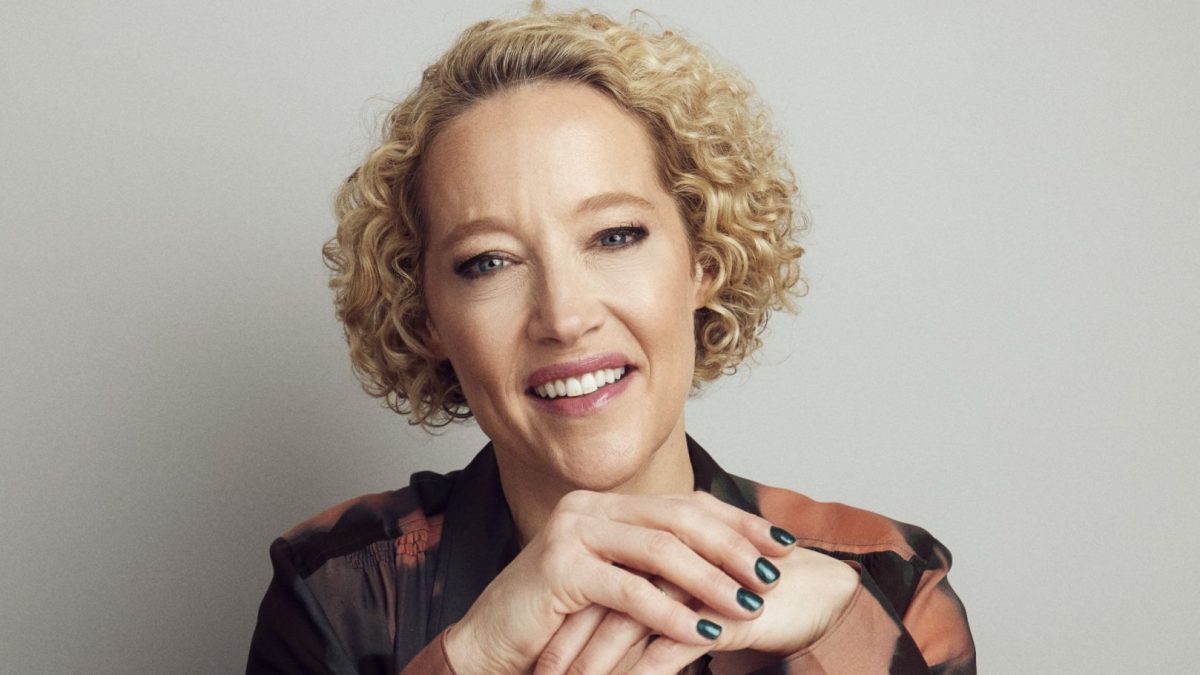
Tears rolled down Cathy Newman’s face last week as she read aloud messages from viewers sharing their #MeToo experiences on her new podcast, Backstory. It was an arresting show of vulnerability from a woman we became used to watching retain a steely neutrality during the 20 years she spent grilling politicians for Channel 4 News before her move to Sky News this year. “You’re used to seeing TV presenters suppress any emotion,” agrees Newman today. Curly blonde bob smashed against the breeze-block wall of the Sky canteen as she uses her phone to FaceTime, the 52-year-old journalist’s demeanour is likeably matter-of-fact. “We debated whether to edit out my tears,” she explains, “but this is about an honest conversation that so many women are having with each other. Reading the terrible experiences that listeners described was really upsetting. I think it’s really important that we all talk about how we feel and share those vulnerabilities.” Her guest that week was Zelda Perkins – the PA who broke an NDA to accuse her former boss Harvey Weinstein of raping another employee – and the podcast had explored the history and ongoing impact of the #MeToo movement (which went viral in 2017) and how it has led to the conviction of Russell Brand and the publication of accusations against David Walliams this month, which he denies. A clip of her interview with Walliams whistleblower Lucy Beaumont had already gone viral. Ahead of recording, Newman had reached out to the public to see how women had been affected beyond the headline cases. “I deliberately hadn’t read any of the messages listeners sent in,” she says. “I wanted to see the videos and read the messages at the same time as people listening to the podcast, so I wasn’t prepared at all.” Their accounts of the impact of rape, assault and harassment struck a deep chord with Newman. “Like many women, I have things in my past,” she says. “I’ve been followed home many times, and one incident in particular was quite terrifying.” Newman has spoken before of the distress caused when one of her daughters – then aged 14 – stumbled upon a pornographic meme that had been made of her mother. Earlier this month, 76-year-old Christopher McKeever pleaded guilty to stalking Newman between July 2024 and April this year. She wrote a furious article for The Times, calling out the sluggish police response in her case. Newman’s podcast revisits the biggest news stories of our lifetime (Photo: Sky News) She had reported an “obscene, violent” letter from McKeever in November 2025. He had previously posted her packs of underwear. Then his correspondence took a darker turn. “See you in heaven,” he wrote. He had “love for the victim”. Although Newman went to the police and had the weight of her then employer, ITN, on the case, there was a three-month delay (storeroom access and data transfer issues) before McKeever was arrested. In an email to her, Essex police confirmed not only that he’d had “similar contact with another female public figure relating to journalism” but that “more frequently he has done this to people that he physically knows from his day-to-day routine”. He has two past convictions for a similar offence. For her own part, Newman says “my primary feeling was one of frustration at the time and energy I have had to expend on dealing with stalkers. It’s an additional thing that my male colleagues don’t have to go through.” As with her tears on camera, Newman was clear in print about the “fear” she had felt while the police dallied. “I don’t live my life in fear,” she tells me. “But I am vigilant. I do look over my shoulder.” It can be hard for women in professional roles to say we’ve been frightened by stalkers because, historically, that very valid emotion has been used against us to imply we might not be up to the strains of the job. Lucy Beaumont told Newman that she had not been offered any TV work since speaking up about Walliams. The comedian felt her honesty could be career-ending. Newman sighs and nods. She’s got long experience of breaking abuse stories. As the first female main presenter of Channel 4 News, she broadcast a string of scoops including an eight-year investigation unmasking the most prolific abuser in the Church of England, barrister John Smyth. That story led to the Archbishop of Canterbury being forced out of office for the first time in history. She has also broadcast an investigation into a British sex offender, Simon Harris, which saw him jailed for 17 years. Today she is keen to clarify that “what I went through was nothing compared to what some of the women we’ve been talking about have experienced… but it gives me an inkling.” She was one of many women in the public eye to tweet at the original MeToo moment. Newman presented Channel 4 News for 20 years (Photo: Channel 4/YouTube) “I remember putting out a post on X in 2017,” she says, “with words to the effect of: yeah, me too. At school, at university, in my first job, in subsequent jobs, in print, in broadcasting…” She shakes her head. “I’m no different from anyone, any other woman in the industry. I’ve had to deal with my share of senior men who have behaved inappropriately. I have my own fears about reporting some of what’s happened to me. I made one anonymous report about someone. I wouldn’t have wanted to go public on that because I would have been fairly sure that it would damage my career. So I get why Lucy Beaumont was so nervous about speaking out.” In her interview with Beaumont – who had heard reports that David Walliams had behaved inappropriately but had witnessed nothing herself – Newman sat back and gave the comedian space to unpack her thoughts. In doing so, she allowed viewers into the way the dilemma spins in the mind of somebody who has been informed of alleged bad behaviour but has no evidence. We were let into the tender heart of Beamont’s decision-making process. “I think empathy is one of the most important qualities in an interviewer,” says Newman. “Having had a few experiences in that area does, I think, help you to listen better and to want to have a determination to put things right.” Initially inspired to become a journalist after watching the BBC’s courageous Kate Adie broadcasting from Tiananmen Square in 1989, young Newman once imagined she’d become a war correspondent. But “politics is my Achilles heel”, she laughs and she was more drawn to the drama at Westminster. “I’m fascinated by the personalities and the stories and the dysfunction that makes it endlessly fascinating.” In her early days of reporting from Parliament, misogynists labelled her the “Mata Hari of Westminster” and accused her of using “feminine wiles” to coax stories from politicians. She acknowledges there were times being a woman could help her cut through the press pack, recalling a Labour Party conference event she attended where Bill Clinton was speaking. When she approached she found he “ignored all the men surrounding him and sort of reeled me in”. A tut. Does Westminster take women more seriously now? She nods. “It definitely has changed. There are a lot of senior, outspoken women who have climbed to the very pinnacle.” Newman remembers that “the first time I was invited into lunch with the PM at No 10, I pinched a sign. I think I was the only woman round the table, which wasn’t unusual in those days. When people were filing out, I took the little cardboard place name saying ‘Prime Minister’ and I thought to myself ‘I wonder when Labour will have a female Labour prime minister?’ We’re still waiting. The Tories have had three… I’ve still got the place marker.” Newman has heard ‘terrible stories’ about Westminster (Photo: Richard Baker/In Pictures) I’m not surprised when she tells me Westminster has its own reckoning coming. “I think there’s still a lot of that that goes on there,” she says. “You hear some terrible stories, so I think that is something that we probably need to look at again.” What sort of stories? “It’s all anecdotal, but it’s the same thing we’ve seen in the media industry where there are a lot of senior men in positions of power. Those same power structures still exist in Westminster.” Having highlighted corruption within the church, the media and the government, Newman is gripped by “the failure of institutions”. She says it will be a running theme of her Backstory podcast. “In another episode, I’ll be talking to Jo Hamilton” – a subpostmaster who was a victim of the Post Office Scandal. I was so interested in her perspective on that because, God, her life was ruined by that.” Does Newman think people feel they’re more likely to get justice by going to the press than following traditional routes? “Yeah,” she says. “I really wanted to celebrate investigative journalism in the podcast. We’ve really seen the value of that with Russell Brand, with the allegations against David Williams, which he denies. You know, these are hugely difficult stories to tell.” She suspects that the public often underestimate “the painstaking volume of work” and the “battles in terms of court injunctions” that go into bringing these stories to light. In the age of largely unregulated social media, “where so many are just mouthing off online”, Newman stresses the importance of “all the checks and balances that quite rightly” are applied to traditional media. “We can’t just make these allegations without giving the people you’re reporting on the right to reply. That’s why a properly funded investigative journalism is more valuable than ever, I believe.” Helping to break the Church of England abuse scandal left Newman feeling “gutted that the victims never got justice while John Smyth was alive”. But she did feel “satisfied that I could help give them a voice and help them get some kind of accountability from the church itself, although even that fell far short of what we hoped for.” A sigh. “As a result of good investigative journalism, Russell Brand was convicted in court. That was a rare example of the justice system working for women rather than against women.” But Newman believes things are improving. Following her tears on Backstory, she says she has “had so many incredible messages from women telling me about things that happened in their past. It’s an extraordinarily open conversation that we should have had long ago. It’s struck a chord because the vast majority of women will have experienced something like this, and that’s certainly not an exaggeration.” ‘Backstory with Cathy Newman’ releases new episodes every Thursday
Cathy Newman: ‘I’ve been followed home many times – one incident was terrifying’
Full Article
Original Source
Read the full article at Inews →KhanList aggregates and links to publicly available news content. We do not host full articles from third-party sources. Always verify important information with original sources.