
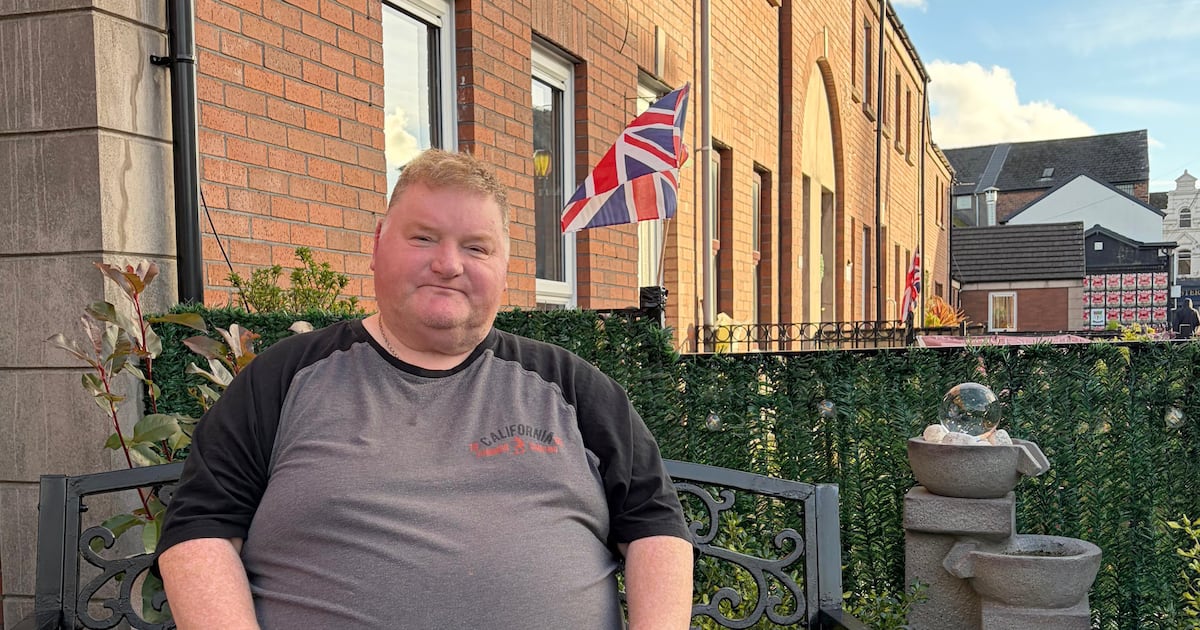
Noel Liggett’s days of marching in Orange Order parades are long behind him, following a football injury decades ago that has left him now with severe arthritis. But the order still means everything to him.“In my knees, it is. Now I can’t walk, I need to sit down all the time,” the former baker tells The Irish Times in his sittingroom, “but I’m still out four or five nights at lodge meetings.”“I first walked the Ormeau Road when I was age four. In 1969, on the way back from the old field up at Finaghy – after my ma got sick and tired of listening to me saying I wanted to walk,” he goes on.Liggett is the District Master of Ballynafeigh Loyal Orange Lodge, No 10, whose Orange Hall stands on the Ormeau Road in south Belfast – once one of the most contested Orange routes.READ MORELast December, he was awarded an MBE award for demonstrating “outstanding determination, tenacity and drive in promoting good relations and community cohesion in south Belfast for 30 years”.The last time the Ballynafeigh lodge marched the full length of the Ormeau Road to mark the Twelfth of July, including the sharply-contested lower stretch of the road, was in 1998.From 1999, the Parades Commission formally banned the lodge from crossing the Ormeau Bridge into the Lower Ormeau, a restriction that has been followed every year since.“After 2000, we really couldn’t solve the parades issue. We had a decision to make: that we basically retreat behind our doors of the Orange Hall, or we go out and be part of the wider community.“We decided to go out. We had various people in. We do a tour of the Orange Hall, we explain the history of the Orange Order, and then we let them ask any questions that they like.”[ Jamie Bryson: Northern Irish unionists ‘must go on the offensive’Opens in new window ]“There was even a pensioners’ group from the Garvaghy Road that came up to visit us,” Liggett says, chuckling.The Ormeau Bridge confrontations in the 1990s, like those in Drumcree, had drifted into history, but the core of the issue had never been dealt with: “Everyone believed the Ormeau Road’s been settled. It’s never been settled.” Between the course of the Troubles and today, the Ormeau Road area has gone from being overwhelmingly Protestant to being majority Catholic, he says.“The Protestant community on the road is now very clearly in a minority. Every other group on the road can enjoy its rights to the full, bar the Protestant community,” Liggett says.In addition, the area has gentrified and many “middle-class Prods” look down on the Orange: “Some of our main problems now is with the middle class who believe they own the Ormeau,” he goes on.“If you drive down the Ormeau Road in a bit of sunshine, you’ll see the coffee shops, all the guys sitting sipping their coffees. The older Prods will be down the side street, not really taking part. They look on us with contempt.”[ Culture wars in the NorthOpens in new window ]Now, the Ormeau is in the headlines because the Belfast Walkers’ Club, which represents Apprentice Boys members of the Ballynafeigh lodge, has sought permission to march over the bridge on November 7th, in advance of Armistice Day.However, the application is the same one lodged for the last 15 years that has been refused by the Parades Commission, so “it has nothing to do with Drumcree”.“Because of what happened in Portadown, people are scouring the internet and the Parades Commission website and will start reading into it a lot more ... ” Liggett goes on.Questioned about Drumcree, Liggett shrugs, exasperated: “Boil Drumcree down, it was about 35 elderly men on a road. Yet it met with a universal response from the nationalist republican community, north and south.”Noel Liggett, the District Master of Ballynafeigh Loyal Orange Lodge, No 10. Photograph: Mark Hennessy “Two communities suffered. Is there a hierarchy of suffering? I was never involved in that, unlike others on the other side. There, there are convicted bombers who set out to kill people. There’s nothing in my record.”Pointing to the MBE that sits proudly on a shelf, a parchment copy of his citation from the British king Charles and a book holding letters of congratulations, he says: “I don’t like being in the spotlight, but, yes, I am very proud.”Uncomfortable with questions about Portadown, he says he does not want to talk about matters that should be best left to members of the lodge in the Co Armagh town who are closer to the details.[ Leo Varadkar thinks we should apologise to northern nationalists for partition. Why?Opens in new window ]However, he has a wider criticism of the Orange Order itself: “And this is not specific to Portadown; we have allowed this to be portrayed as an institution against a poor, suppressed community.“When in essence, it’s one community with two different parts in it, and it’s about what rights they should be able to enjoy – two communities that [have] been dumped on for years by others, yes.”He had, he said, thought for a day for a word to describe the impact of Drumcree this year on the Protestant community. Not wanting to sound pompous, he says he believes the word is “clarity”.“It’s a moment of clarity for the unionist community. The whole nationalist republican community in the North, and the Taoiseach, political parties, cultural figures in the South all came together,” he said.Questioned about the belief of many that the Orange Order is a bitter, sectarian organisation, Liggett is perplexed: “It’s an organisation for Protestants. Does that make us sectarian? The Catholic Church is an organisation for Catholics. Does that make them sectarian? “I don’t believe there’s anything wrong in having societies for the benefit of the community it represents. But Catholics seem to see the Orangeman as the bogeyman.“They have this visceral hatred of the Orange Order, thinking that we spend hours thinking, ‘how can we annoy Taigs?’ Well, we’re not. Half the time we’re worried about where we’re getting our sandwiches on the Twelfth, or our sore feet.”[ PSNI feared gun use by dissident republicans if parade went down Garvaghy Road, court toldOpens in new window ]This year’s Drumcree controversy will cast long shadows, he believes: “No unionist will look at any assurances that will be offered by the South, or by Sinn Féin and say, ‘maybe, it’s worth considering’.“There was a lawful decision that the parade could take place. There were lawful decisions in past years that said it could not take place, and that was accepted by the Orange.”In time, he believes sharper people in Sinn Féin will realise that they went too far at Drumcree: “There must be some thinking that. If your aspiration is truly a united Ireland, this is not the way to go about it.”Despite their talk, he does not believe the people in the Republic, in their hearts, want anything to do with either community in Northern Ireland, and they certainly do not want to pay for it.[ Many loyalists are desperate to leave – the only thing stopping some is a £5,000 ‘exit fee’Opens in new window ]In any event, they do not see a place for unionists in such a unified state, he believes: “One of the things I took out of a trip to the Dáil years [ago] is that Irish history basically starts in 1916. There’s 700 years missing. “You can’t peddle this line that Irish history starts in 1916, and if you don’t buy into that then you’re not Irish. I’m Irish. But I’m British and an Ulsterman, and Orange.”
‘Catholics seem to see the Orangeman as the bogeyman. They have this visceral hatred’
Full Article
Original Source
Read the full article at Irishtimes →KhanList aggregates and links to publicly available news content. We do not host full articles from third-party sources. Always verify important information with original sources.