
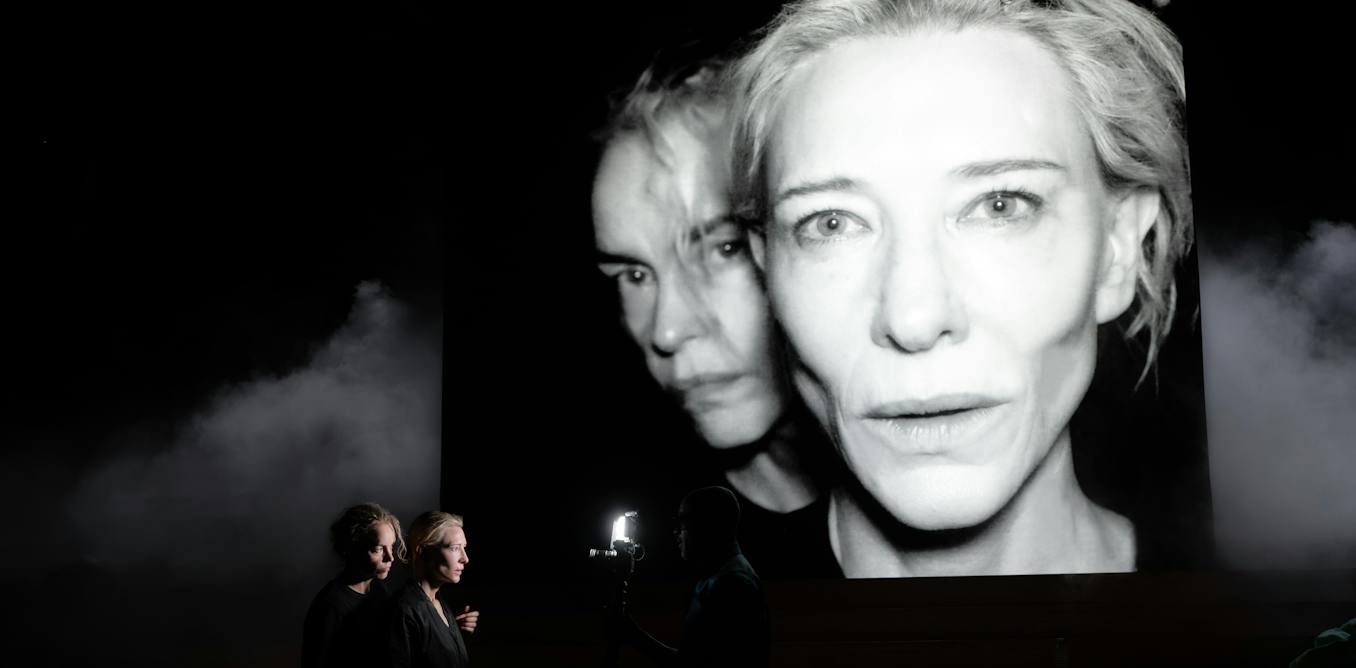
Written and directed by Benedict Andrews, Electra/Persona is two plays conjoined. The first is a version of Sophocles’ ancient Greek tragedy Electra, and the second is a stage adaptation of the 1966 Ingmar Bergman film Persona. In Sophocles’ play, Electra seeks vengeance for her father, Agamemnon, who upon returning from war was murdered by her mother, Clytemnestra. Clytemnestra feels justified in the killing because Agamemnon sacrificed her first-born daughter, Iphigenia, to win the gods’ favour in war. Electra and her other sister, Chrysothemis, wait for the return of their brother, Orestes, whom Electra hopes will enact the revenge. At the start of Persona, the famous actress Elisabeth Vogler has stopped speaking entirely after performing onstage as Electra. In hospital, a doctor assigns a young and talkative nurse, Alma, to help in Elisabeth’s recovery. Alma accompanies Elisabeth when her convalescence is transferred to a house in the country. Filling the silence, Alma begins to share her deepest secrets. When she discovers that Elisabeth has been writing letters to the doctor about her confessions, a confrontation ensues. Linking these two narratives brings to the fore a range of complex meanings. Instead of driving a particular message home, Andrews happily trusts the audience to draw their own connections. The play stars Cate Blanchet and Nina Hoss, who take turns at the roles of Electra/Elisabeth or Clytemnestra/Alma depending on the toss of a coin. This sets up the continued themes of blurring image, appearance and personas, which draw on the dreamlike quality of the Bergman film – or films influenced by Bergman, such as David Lynch’s surrealist masterpiece Mulholland Drive (2001). Before the play begins, Blanchett, Hoss and Ella Lily Hyland (playing Chrysothemis/doctor) enter the theatre from the audience, who applaud. At the performance I attend, Blanchett quips: “We haven’t done anything yet.” Upon instruction, an audience member flips a coin and Hoss calls “heads”. It is tails. Blanchett says: “Fuck it, I’ll do Electra.” Hoss and Hyland sit in the front row facing the stage, while Blanchett moves to a container of white face paint, puts some on her hands, then rubs it onto her face and clothes, thus becoming Electra – and the play begins. The white face paint each actor puts on before joining the scene recalls the masked performance of tragedy in antiquity. Ancient Greek actors wore masks with exaggerated features to be projected out to a large audience . In contemporary mask work, the donning of a mask is an embodied transformation from actor to character. As persona is Latin for mask, this choice serves as a subtle connection to the second narrative, and lays foundations for the production’s investigation of both performing and blurring identity. Between stage and screen Throughout the Electra story, the actors don multiple costumes of other characters from Sophoclean inspiration. They play as Agamemnon, Orestes, the sacrificed daughter Iphigenia, and sometimes even versions of themselves. This heightens the mixing of roles established in the opening coin toss. In my research into casting practices, I have explored the potential meanings made when different actors play the same role within a production. In ancient tragedy, actors would play more than one character by exiting and returning in a different mask. Within Electra/Persona, this use of casting and costuming contributes to ideas about the performance of self, and the risk of getting lost in being someone else. By the end of the Electra story, it is unclear precisely who is the one exacting revenge. Hoss and Blanchett alternate the roles of Electra/Elisabeth and Clytemnestra/Alma in the play. Monika Rittershaus / National Theatre There is then a transition into the Persona narrative. Still on stage, the actors remove their white make-up and prepare for their new roles. Blanchett transitions into Elisabeth and Hoss into Alma. A screen comes down in the centre of the stage which displays live-feed video footage from a camera Blanchett carries around the stage with her throughout. One of the main differences between stage and screen acting is that the former is a telling medium and the latter a showing medium. Stage actors often assess the size of their role by how many lines they have. Screen actors count the amount of time they have on screen, as there are often reacting shots and close-ups which reveal the character’s inner monologue. By having non-speaking Elisabeth displayed on the screen and Alma on stage with all of the lines, this artistic choice capitalises on the strengths of both mediums while asking questions like: who is the one really performing? Is the theatrical or the filmic image more authentic? As the second narrative draws to a conclusion, the blurring of persona and medium becomes more complex and surreal. Who is who? Who is taking advantage of whom? The relationship between the two women results in a powerful and permanent blur. Magda Willi’s set also plays on these ideas of blurring and mirroring. At the edge of the stage is a 23-step staircase of bleached wood, running from stage left to right and almost to the top of a proscenium arch. The play blends live film of the two actresses with action on stage. Monika Rittershaus / National Theatre It recalls the seating in an ancient amphitheatre. And by having us face a large empty audience space, it almost puts us in the position of being the show. This is amplified in the transition from Electra to Persona, when the screen first descends and shows a live-feed of the audience. Not only are we facing another audience, but that other audience is ourselves. In ancient Athens, Electra was not presented as a standalone play, but accompanied by two other tragedies and a satyr play (a bawdy, satirical drama). The other tragedies may have been connected by a continued narrative, as with the only surviving tragic trilogy, Aeschylus’s Oresteia. But they may also have been connected thematically, allowing the audience to draw connections for themselves. Electra/Persona taps into this ancient tradition, allowing the audience to think through these complex stories and performance aspects. This is an evocative and artful play, driven by two powerhouse performers. Electra/Persona is on at the Lyttelton Theatre, London, until October 10.
Cate Blanchett’s Electra/Persona at the National Theatre is a surreal triumph
Full Article
Original Source
Read the full article at Theconversation →KhanList aggregates and links to publicly available news content. We do not host full articles from third-party sources. Always verify important information with original sources.