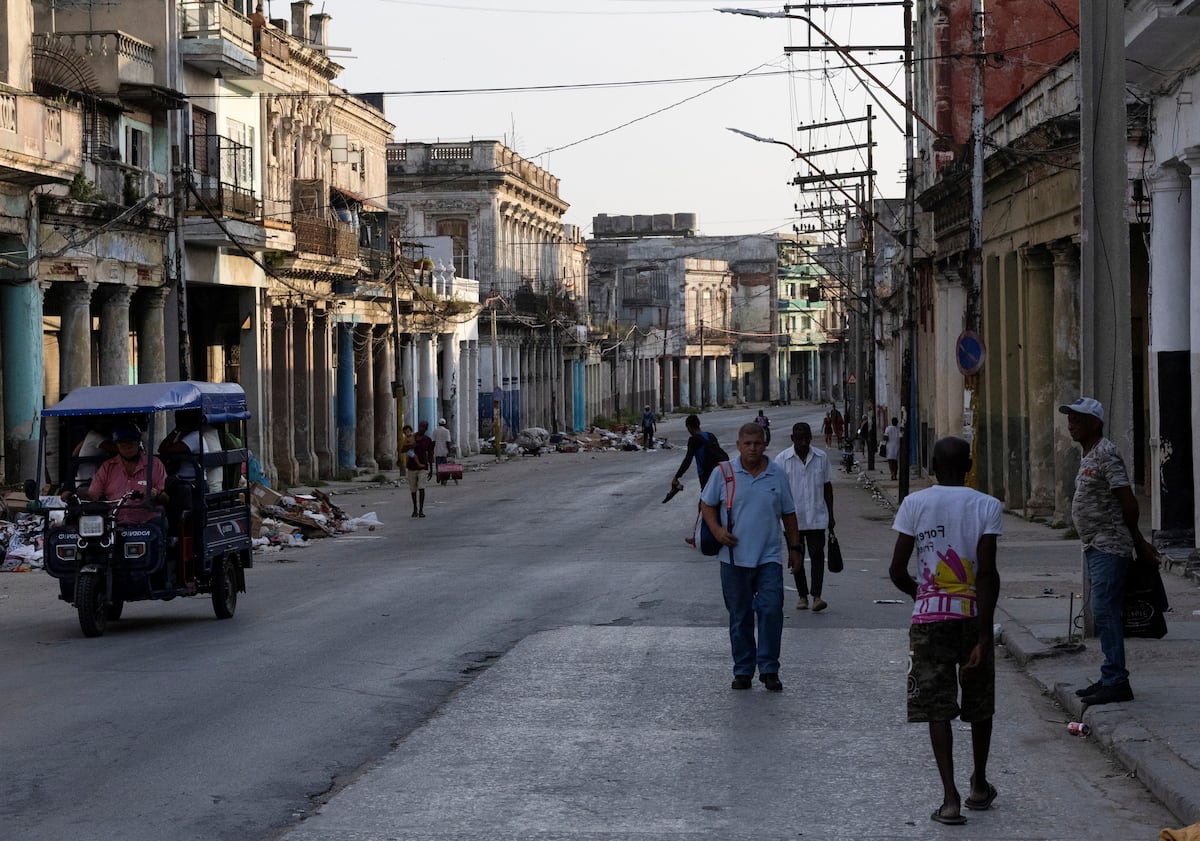
It looked like a force vanquished by history, announcing the news of its own failure. Cuba is “living through the most difficult period of this century,” Cuban President Miguel Díaz-Canel told members of his government in June. “Reality demands urgent and necessary changes.”The moment they had avoided for decades had finally arrived. They had weathered multiple crises, more than one wave of mass emigration and growing public discontent, postponing until now the admission that Cuba would, inevitably, have to open itself to the market. Díaz-Canel later confessed that the decision had been painful.“Of course it pains me,” he told the Russian state broadcaster RT en Español when asked about plans to restructure the country’s economy. It hurt, he explained, because the new measures went “against the concepts with which one was formed, educated.” The president was aware that they had, at least publicly, compromised one of the central tenets of Cuban socialism.According to Díaz-Canel, Fidel Castro was forced in the 1990s to accept “practices typical of capitalism” amid the economic crisis euphemistically dubbed the Special Period. Far beyond what he would have liked, Castro had to decriminalize the use of the dollar, open the country to tourism and foreign investment, and even allow small private businesses under the label of cuentapropismo (self-employment). Later, these ventures were rebranded with euphemisms such as the “non-state sector,” and eventually their owners became known as “entrepreneurs.” For the liberal world, the specter was communism; for the Castro regime, it was private property.Cuba is facing unprecedented pressure from the United States government, while the country is in a state of profound decline. Even before the White House intensified its pressure on Havana at the start of the year, daily life had become nearly unbearable: patients were dying from a lack of medical care; beggars had become a common sight on the island’s streets; workers earned little more than $15 a month while trying to buy food at prices inflated by soaring inflation; and repeated blackouts drove people to lose patience and bang empty pots in protest in their neighborhoods.The renewed U.S. pressure, however, acted as a catalyst. Following the tightening of the energy squeeze, Cuba was left with even less electricity, fewer tourists than before (just some 30,000 visitors in 2025), less transportation, and dwindling supplies of food and medicine. Government sources say survival rates among children with cancer have fallen from 85% to 65% since Washington stepped up its restrictions. They also claim that around 100,000 children under the age of seven no longer receive the daily liter of milk once provided by the state.According to Díaz-Canel, they had to “save the Revolution,” even though for many Cubans the Revolution had already ended long ago. There was also a need to appease Washington, however much officials insist that none of the changes have come in response to pressure from the White House.The government unveiled a package of 176 economic measures, the most sweeping since 1959. The reforms grant greater autonomy to state-owned companies; allow foreign investment in the private sector without government intermediaries; give companies more flexibility in setting wages; authorize the creation of private banks; end universal subsidies; and, among other measures, open the country to domestic and foreign private capital in sectors such as energy.More than half a century after Fidel Castro declared the socialist character of the Revolution, headlines around the world proclaimed that Cuba was opening itself to capitalism. According to economist Ricardo Torres, a former researcher at the Center for the Study of the Cuban Economy and a professor at American University in Washington, the reforms amount to “genuine symbolic and practical breaks with key pillars of the traditional socialist model.”“If implemented as proposed, they will substantially change the configuration of the Cuban economic model: there will be more private property and market, along with quite notable shifts in the conception of social policy,” he explains.But Cuba’s leadership maintains that the reforms are intended, above all, to “preserve socialism.” Government officials have repeated the point time and again. Prime Minister Manuel Marrero Cruz recently stressed: “This is not a turn toward capitalism, but an update of the socialist model.” Díaz-Canel also insisted: “There is no betrayal of socialist construction, neither in principle, nor in conviction, nor in action.” And Josefina Vidal Ferreiro, Cuba’s deputy foreign minister, said in an interview with La Jornada: “Property will remain in the hands of the Cuban people and that is essentially socialist.”The prospect of meaningful change for Cubans is caught between two centers of power: Havana, unwilling to negotiate anything that could jeopardize the stability of the Castro system, and Washington, demanding change while keeping in place the web of sanctions that continues to squeeze the country.Economic changes without political changeFor some observers, Cuba is not opening itself to capitalism because, in a sense, it always was, says economist Miguel Alejandro Hayes. “The socialist magnate has operated as a great capitalist with political and repressive power. Lenin was honest when he called his own project [socialist] state capitalism,” he insists.Indeed, the government has long run the country as though it were its own estate: restricting freedoms, exercising power and control over the population, preserving privileges for itself, and establishing the military-run conglomerate Grupo de Administración Empresarial S.A. (GAESA) to concentrate revenues from tourism, imports and telecommunications.That is why Hayes argues that “Cuba has not moved from socialism to capitalism, but from Soviet-style state capitalism to a more classic form of private-property capitalism, with some reproduction mechanisms that were previously blocked.”The abandonment of Cuba’s own socialist project had begun long before, with the collapse of the pillars that had once made the Revolution a national promise. Education, healthcare and social security were no longer guarantees in a country where schools function only partially, staffed by the few teachers left behind after waves of emigration and departures to other professions. Little remains of the medical powerhouse Castro once showcased to the world, and social security scarcely exists on an island where pensions are no longer enough for older people to get by.Cuba slipped from the grasp of the Castro regime, but the Castro regime has shown no willingness to relinquish power. What is changing now, with the new economic measures, are the legal mechanisms through which what Hayes describes as “that despotic and authoritarian form of state capitalism” is exercised.More than a month after the reforms were announced, the main concern is that Cuba’s leadership has made no mention of any change to the political system. Any move toward “capitalism” or economic “liberalization” would take place under the rules of the regime.“The question is: if property is in the hands of the government, what kind of capitalism is that?” Hayes asks. “Cuba is not liberalizing its economy. ‘Liberalize’ refers to real rights, not permits. In Cuba, private ownership of a business is totally reversible and arbitrary: a commission approves your activity, the authorities authorize it, audit you, and can take it away whenever they want, for political or personal reasons. The holder of the rights over economic activity remains the state; what it grants is the right to use and benefit from it, never the power to dispose of it. They let you produce and keep the profit, but reserve the right to revoke you, subject you to conditions and reclaim what was granted at their discretion,” the expert adds.Other issues concern economists and Cuban businesspeople alike in a country where the greatest privileges are often enjoyed by those with the closest ties to the ruling elite. Looking ahead, who will receive licenses, sign deals with joint ventures, import goods from abroad and obtain government approval to operate if the state intends to retain full control?“I call it Castroist liberalism: it adopts certain formal aspects of a liberal state, but keeps the authoritarian logic of power intact,” says Hayes. “If the same elite occupies the positions that generate wealth, the economic actors and political actors are one and the same.”Distrust of reformsThis is not the first time Cuba has announced economic reforms that have attracted investors or raised hopes among the island’s private sector.In 2011, under then-president Raúl Castro, the so-called Guidelines (Lineamientos) proposed an “updating of the Cuban economic model,” in which the socialist state enterprise would remain the central pillar of the economy while allowing the island to open itself, albeit cautiously, to market forces. Following the restoration of diplomatic relations with the United States, promoted by Barack Obama’s administration in 2016, many believed that the last communist bastion in the Western Hemisphere was finally opening up to the world. Instead, the process was reversed.The 2019 Constitution formally recognized new forms of ownership, including private property. Then, in 2021, the Ordenamiento reform package also promised transformation in a country already mired in economic decline and further devastated by the COVID-19 crisis.Yet none of these changes has guaranteed that business owners will not end up in prison, have their assets expropriated or find themselves under the watchful eye of the Cuban state.That is why engineer Yulieta Hernández Díaz, CEO of the construction services firm Grupo de Construcciones Pilares, has no confidence in the government’s proposals. “This package reminds me of other moments of expectation in Cuba,” she says. “I don’t feel secure, nor would I recommend any entrepreneur invest capital. I am greatly worried about the discretion and lack of transparency in this.”Only two days after the measures were announced, some foreign investors had already begun expressing interest in Cuba. Businesspeople from Qatar and Egypt made no secret of their plans to invest in tourism, aviation, pharmaceuticals, mining and fertilizers. Guyanese President Irfaan Ali encouraged entrepreneurs from his country to look for opportunities on the island.Meanwhile, social media has seen a growing number of listings for houses and dilapidated buildings in prime areas of Havana. Many of these nearly abandoned structures are being offered for laughably low prices by global standards, attracting investors who see them as future business opportunities.To Hernández Díaz, it feels as though the government is selling the country off piece by piece. “It would be terrible if Cuba were to lose the great asset it still has today. Cuba is one of the countries in the world with the highest proportion of homeowners actually living in their properties.” “Can you imagine if real estate developers with large amounts of capital came in?” she asks. “Homeowners in need of money would start selling and end up renting. And there are ways to carry out real estate development while protecting citizens, but unfortunately, I don’t see these measures as being designed to protect citizens or local businesses. These measures aren’t designed for them.” The diaspora is another key group the government hopes will help revive an economy in deep crisis. Although the regime has spent years denouncing Cuban exiles, Díaz-Canel recently had a message for them that sounded almost like a plea: “At this moment, this country cannot afford to lose a single good Cuban.”Yet there are still no guarantees that would give exiles confidence today. Carlos Saladrigas, a 78-year-old Cuban American businessman from South Florida and chairman of the Cuba Study Group, argues that “without political change, the measures lack seriousness and credibility.” “Without a significant change in the judiciary so that the judicial system is truly independent from politics, it won’t work. Without fundamental changes in the structure of the system, constitutional changes that clearly state Cuba will open up, nothing will work,” he argues.In a country where the government has repeatedly said the socialist state enterprise will remain the main economic actor, experts’ other concern is the legal guarantees for those who choose to invest in Cuba. “Cuba’s recent history shows that the problem was never announcing reforms,” says Cuban jurist Eloy Viera, who sees the root of the issue in the nature of the system itself. “The government has deliberately resisted modifying the Constitution. That means it is also unwilling to transform what truly conditions the functioning of any modern economy: the political system and the country’s institutional architecture. That is the real obstacle. The problem has been that, when political priorities change, those same reforms can be slowed down, reinterpreted or even reversed. As long as there is no genuine separation of powers, as long as all institutions remain subordinate to political authority, there will continue to be enormous legal uncertainty.” Washington’s role in the changeFollowing the announcement of Cuba’s economic reforms, the United States imposed new sanctions on individuals and entities linked to GAESA, the military-run conglomerate that has been a primary target of Secretary of State Marco Rubio’s pressure campaign against Havana.The package of reforms was not what Washington had been looking for. It wanted more. The State Department dismissed the measures as “gradual,” “modest,” and “long overdue,” arguing they amounted to “superficial smoke signals from the Cuban regime.” Rubio himself wrote on X that the regime continued to “prioritize its own total control over the freedom, opportunity and basic well-being of the Cuban people.”Since late January, Cuba has become increasingly dependent on the United States. Remittances from exiles remain one of the main pillars of the island’s economy; the limited amounts of oil reaching Cuba now come from the United States; and shipments of food, vehicles and other consumer goods have increased in an effort to alleviate the crisis. The Cuban government has repeatedly said it is willing to engage in negotiations, not one that comes with conditions attached.Many agree that there will be no meaningful economic change in Cuba without political transformation, but also without an easing of Washington’s policies toward Havana.“Without resolving the conflict with the United States, big capital will not arrive, neither from the U.S. nor from other countries, although we could see small-scale flows,” says Torres. “All of this today is overshadowed by the energy crisis; resolving it requires restoring fuel supplies and making multi-million-dollar disbursements, because without energy there is no viable recovery. Added to that is the need to restructure Cuba’s external debt and reintegrate the country into multilateral financial institutions such as the IMF and the World Bank, which are currently the only sources of stabilization financing at the scale required.”Sign up for our weekly newsletter to get more English-language news coverage from EL PAÍS USA Edition
Castro-style capitalism: Havana promises economic changes without relinquishing political control
Full Article
Original Source
Read the full article at English →KhanList aggregates and links to publicly available news content. We do not host full articles from third-party sources. Always verify important information with original sources.