
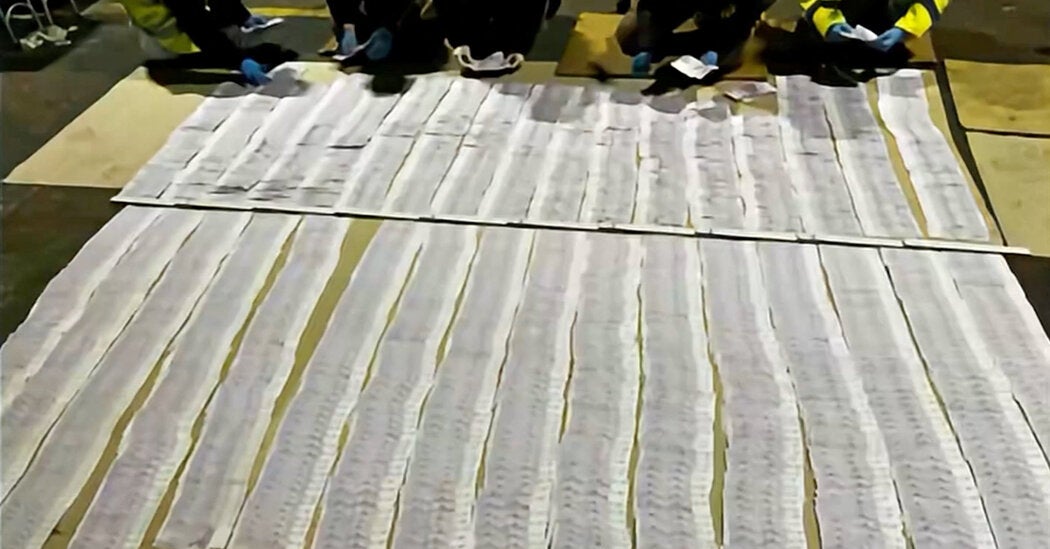
AdvertisementSKIP ADVERTISEMENTThe new government says $20 million worth of bank notes uncovered in farmhouses and woods are the “tip of the iceberg.” Allies of Viktor Orban, the former prime minister, call it a witch hunt.A still image from a video released by the Hungarian National Asset Recovery and Protection Office shows agents laying out bank notes on a warehouse floor.Credit...Hungarian National Asset Recovery and Protection Office, via ReutersNov. 17, 2026, 11:00 a.m. ETHungary’s new anti-corruption agency made an eye-catching splash last week when it released photographs of a table piled with bank notes worth nearly $20 million. The money, the agency said, had been found hidden in forests and farm buildings during a hunt for funds stolen during the long tenure of the country’s former prime minister, Viktor Orban.This week, Hungary’s new leader, Peter Magyar, announced that the stacks of cash photographed by the National Asset Recovery and Protection Office, a new agency set up as part of what he calls “operation cleansing fire,” were just the “tip of the iceberg.”To display the full volume of money ransacked by corrupt officials before Mr. Orban lost a general election in April, Mr. Magyar told Parliament on Monday, “You would have to put 10,000 tables next to each other.”In his telling, the total amounts to more than 60 trillion Hungarian forint (more than $180 billion) — a staggering, and so far unproven, sum in a small Eastern European country whose total spending on defense last year was around only $5 billion.While Mr. Magyar is prone to exaggeration by character and political calculus, his angry denunciations of Orban-era corruption resonate with many Hungarians and helped his party win the April election.Mr. Orban and his die-hard supporters have dismissed the photographs of recovered cash and a rash of detentions as hollow political theater aimed at discrediting and destroying opposition to Mr. Magyar, who was sworn in as prime minister in May.Two former ministers; the former head of the central bank; Mr. Orban’s younger brother, Aron; and many other less prominent figures have been detained in recent weeks in connection with investigations by the police and the new anti-corruption agency, which was established in July to uncover past misuse of public assets and recover unlawfully obtained money and property.Mr. Orban, a close ally of President Trump who was hailed, until he lost power, as a model by right-wing politicians in the United States and Europe, scorned the anticorruption drive as a “dirty political game.”ImageViktor Orban, then the prime minister of Hungary, speaking at an election rally in Szekesfehervar, Hungary, in April.Credit...Sean Gallup/Getty Images“This is not justice. It is political persecution,” Mr. Orban declared last week after the detention of his brother, who is accused of involvement in an illegal migrant labor scheme that allowed workers from Vietnam, Nepal and other countries to buy visas and residence permits under the table.“I am the real target,” Mr. Orban said. “My brother is simply being used to get to me.”Mr. Magyar insists he is simply delivering on promises he made during the election campaign, which largely revolved around the issues of bribetaking, sweet deals for cronies and other forms of graft by Mr. Orban’s then governing party, Fidesz.Mr. Magyar’s party, Tisza, won in a landslide. Fidesz, traumatized by its defeat after four thumping election victories in a row, has struggled to regain its footing. It has been knocked off balance by Mr. Magyar’s anti-corruption drive, which opinion polls indicate has strong public support.An opinion poll published this week showed that Tisza’s popularity stood at 68 percent among likely voters, up 6 percentage points from September, before the anti-corruption drive went into high gear. Fidesz’s popularity slumped to 24 percent, according to the poll.Relations between the former and current governing parties are so venomous that a Parliamentary session on Monday, called to discuss the budget but frequently interrupted by shouting between rival lawmakers, dragged on for 16 hours.Aware that the fight against corruption is generally popular, some Fidesz lawmakers have called for a cleansing of the ranks to distance the party from what they see as a few rotten apples.Others have counterattacked, accusing the speaker of Parliament, Agnes Forsthoffer, an ally of Mr. Magyar, of misstating her assets in a declaration of worth required of all legislators.The Fidesz party leadership has mostly followed Mr. Orban’s lead and denounced the work of the new asset recovery office as an evidence-free political witch hunt.Under Mr. Orban, who served four successive terms as prime minister from 2010 until this year, Hungary sank steadily in an annual corruption ranking compiled by Transparency International. Last year it ranked as the most corrupt country in the European Union.Friends, family members and cronies of Mr. Orban and others in his party, many of whom had no previous aptitude for business, acquired large fortunes while he was in office. They secured low-interest loans from government-controlled banks and regularly won construction and other contracts funded by the state.Lorinc Meszaros, a former boiler fitter from Mr. Orban’s home village, became one of Hungary’s richest men thanks to government contracts.Mr. Orban’s son-in-law, Istvan Tiborcz, who became a wealthy tycoon with interests in banking and real estate, left Hungary before the April election. So did the son of the recently detained central bank governor, Gyorgy Matolcsy. Mr. Orban has frequently traveled abroad since the election but has insisted he will not flee.The cash found buried in forests and hidden in barns and other locations was discovered as part of an investigation into bribetaking by Miklos Sesztak, a former minister of national development under Mr. Orban, according to the new anticorruption agency. Mr. Sesztak, who was detained on Sept. 26, has denied any wrongdoing.The cash was so voluminous, Hungary’s finance minister said, that it took a dozen officials from the national treasury eight hours to count it using five bank note-counting machines.Mr. Orban has described Mr. Sesztak as “impeccable” and, in an interview last week with a nationalist media outlet, said: “I would put my hand in the fire for every one of my ministers.”Anna Unger, the head of the asset recovery office, said in a television interview last week that investigators were still trying to piece together who had hidden the cash found in the forest and to whom it belonged.Allies of Mr. Orban and pro-Fidesz media outlets seized on that as proof that the new government was persecuting right-wing politicians without evidence.Janos Boka, the leader of the Fidesz caucus in Parliament, said that Ms. Unger had “exposed, ridiculed and discredited the political theater of Peter Magyar.”Mr. Magyar, for his part, trumpeted the discovery of the buried cash as a death knell for Mr. Orban’s political camp.“Fidesz, as a political party, has ceased to exist,” he said on social media. “From today, it is officially nothing more than an organized criminal group.”Janos Arva contributed reporting.Andrew Higgins is the East and Central Europe bureau chief for The Times based in Warsaw.Related ContentAdvertisementSKIP ADVERTISEMENT
Cash Hidden in Forests? Hungary Goes After Corruption Under Orban
Full Article
Original Source
Read the full article at Nytimes →KhanList aggregates and links to publicly available news content. We do not host full articles from third-party sources. Always verify important information with original sources.