
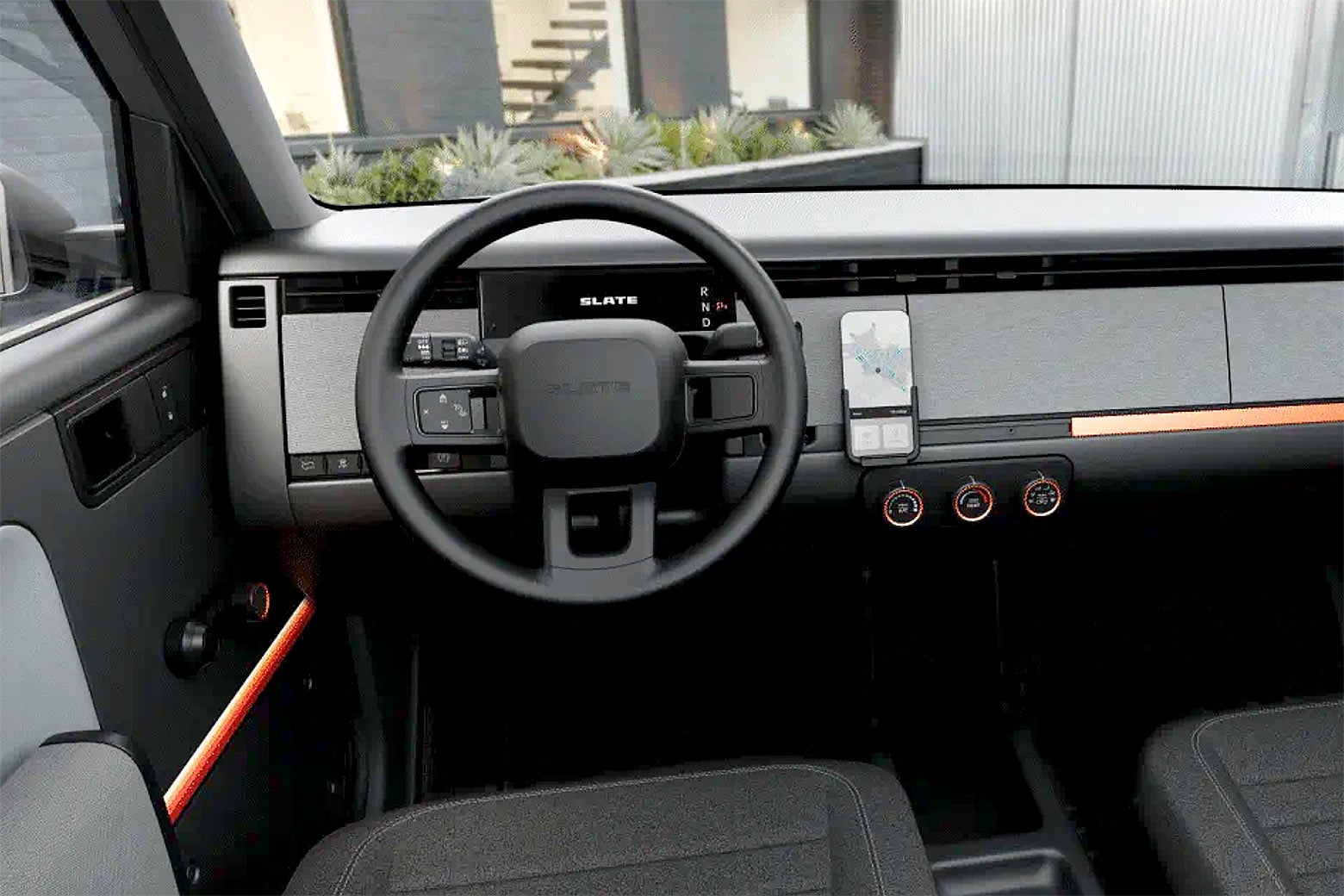
Metropolis Bring Back the Dumb Car Touch screens, subscriptions, and rising prices have made new cars frustrating. Can automakers win drivers over with cheaper, simpler vehicles? Slate Auto Sign up for the Slatest to get the most insightful analysis, criticism, and advice out there, delivered to your inbox daily. My 16-year-old son recently obtained his learner’s permit and is starting to have ideas about what he wants behind the wheel. In our driveway, we have a 2023 Fisker Ocean, which is an all-electric SUV with a solar panel on the roof, an enormous rotating center touch screen, and the ability to roll down all the windows and open the sunroof at the flip of a switch. There’s also a 2005 Honda Element, which can do none of those things. If it weren’t for an aftermarket audio unit, it wouldn’t even have Bluetooth capability. My son always goes for the Element. In fact, he has elaborate plans for tricking it out down the road, with things like a wooden plank for sleeping on campouts. I should point out that he is part of what is supposed to be the first truly digitally native generation, yet his contempt for in-vehicle tech is something of a badge of honor. He’s actually part of a significant trend. If you’ve driven a car produced in the past 20 years, you’ve definitely faced some struggles: fumbling through a complicated infotainment interface just to connect your phone, dealing with the annoying bings and boops if you’re maneuvering through a crowded parking lot or briefly drift out of a highway lane, wondering how much of your personal data that fancy new SUV is sharing with companies that want to sell you stuff. Automobiles have been “smart” for decades, and with self-driving technology and more advanced onboard computers, they’re getting smarter. Cue the backlash. Like those tech-averse consumers who have ditched iPhones for flip phones, installed apps such as Blank Spaces that offer a stripped-down experience, or swapped their Apple and Android mobiles for minimalist alternatives from Light Phone or Punkt, an emerging cadre of drivers crave simple, throwback cars. Some of it is about price, some is sheer neurological overload. There’s also a paranoid fringe that sees high-tech vehicles as instruments of the surveillance state. Tucker Carlson brags that he ditched his modern Chevy pickup because it was spying on him. He now drives a defiantly disconnected model from 1987. But it’s actually hard to find a reliable analog used car—one that rocks only an AM/FM radio and that might not even be equipped with AC. Automakers largely stopped making rudimentary vehicles back during the Clinton administration, mostly because an improved economy led customers to demand more features, and because larger and more profitable SUVs became popular. Precious few super-basic vehicles have survived, and the ones that have have usually racked up plenty of miles and have the scars to prove it. So buyers have a simple question: Can’t the engineering and marketing geniuses of the auto industry make a new dumb car that’s also cheap? The auto industry is aware of my son’s opinions. Tucked in a 2026 report from QNX (a division of BlackBerry, which yes, is still around) analyzing “software-defined vehicles” is a surprising nugget: The report asked, could a “deliberately minimalist, low-tech vehicle, designed to limit digital features and connectivity” succeed? Almost 80 percent of the SDV experts surveyed said yes. “I think it definitely points to some sentiment out there,” John Pelliccio, global product marketing director at QNX, told me. “Sometimes the tech is so in-your-face that it becomes difficult rather than supportive. I don’t want to go through seven different submenus to roll down my windows.” He cautioned that the report surveyed views among SDV developers and wasn’t focused on consumers. QNX is also in the business of innovating with software platforms so that automakers can offer simpler and more intuitive user experiences. But he also acknowledged that consumers believe tech is making cars more expensive, a tricky issue to negotiate at a time when affordability is an issue that can swing national elections, and Silicon Valley is confronted by a public with torches and pitchforks. The disconnect is real: Automakers are contending with a cranky, financially stressed-out public that wants to smash everything from GOP political careers to dashboard touch screens. Why, they ask, has crappy tech taken over the driving experience? The backstory is less straightforward than you might think. For decades, car companies installed unpopular technology largely because they didn’t want to surrender the data business to Apple CarPlay and Android Auto. Struggling to attract the best interface designers, they ended up lost in a forest of ornate decision trees (BMW, for one, was often criticized for creating an infotainment system that sent befuddled users into seemingly endless submenus). But a hard pivot may be on the way, just as Gen Z and their craving for old-school cars comes of age. A company that’s going all-in on low-tech is Jeff Bezos–backed Slate Auto, an EV startup that broke cover in 2025 and expects to start delivering a $25,000 EV pickup by the end of this year (the pickup can also be converted to an SUV for an additional $5,000 to $7,000). The “Blank Slate” base vehicle has two seats, hand-crank windows, no infotainment, no speakers, and no exterior paint. If you want a red truck, you’ll have to get the polymer exterior wrapped in red. The vehicle has attracted a lot of attention for its no-frills philosophy and rock-bottom sticker price. The company says it has more than 180,000 reservations. This contrasts dramatically with what carmakers were pushing just a few years ago. Inspired by Tesla, high-speed connectivity and over-the-air software updates were all the rage for a while there. Tesla owners boasted that they could go to sleep as an OTA update started and wake up to a new car the next morning. Auto-industry executives were dreaming of fresh business models that leveraged the massive amounts of data vehicles generate to offer lucrative subscription-based products. But it hasn’t always gone according to plan. Not to gang up on BMW, but in 2022 the company infamously experimented with charging owners to activate seat heaters. Customers revolted. If the Slate truck takes off, it could create a dumb-car boom. YouTube influencer Marques Brownlee has already told his 1 million–plus subscribers that he likes the thing and considers it a good choice as a starter EV. Former Top Gear presenter James May took it out for a spin and offered an approving verdict. Motor Trend believes it could validate a niche. There’s no question that in short order, Slate has generated more positive buzz for a cheapskate pickup than Ferrari did when it rolled out a widely ridiculed first crack at an EV, the $615,000 Luce (designed by the man behind the iPhone, Jony Ive, no stranger to minimalism). Not everyone is taking such an either-or approach. Ford thinks it can offer the best of both worlds. Earlier this year, the carmaker debuted a new EV pickup, the Fathom, designed to offer affordability without compromising on technology features. Kay Hart, general manager of Ford’s Model e electric division, told me that the company had to put itself in the mindset of a buyer concerned about affordability who thinks that a cheaper car equals one with fewer features. “Our approach was to find out what our customers valued and figure out how we could bring that to the vehicle,” she said, pointing out that even the sub-$29,000 version of the Fathom is equipped with Ford’s hands-free, driver-assist tech, called BlueCruise. But she also said that Ford is aware of driver frustration when it comes to screen-based interfaces. “They are not looking to learn a new experience” when they slip into the driver’s seat, as she put it. Ford sees the Fathom pickup as a way to offer cheap and nonannoying without having to lean into dumb. It helps to have enough industrial might to build the new pickup on a new EV engineering platform that is designed to reduce complexity and significantly lower costs. Slate, meanwhile, is subtracting by necessity and making that the core part of the marketing pitch. The critical question is whether Slate’s approach will be so successful that the big guys decide it’s worth abandoning decades of investments in automated paint shops, power windows, autonomous-driving systems, and dashboard-dominating touch screens that control everything from AC to interior lighting. For the auto industry as a whole, making money on modest, “de-contented” vehicles is tough. That’s why Detroit favors large, fully loaded pickups and SUVs. Since the financial crisis, Ford and General Motors have reinvented themselves to be consistently profitable rather than chase market share; they’ve abandoned the sedan segment, where consumers have typically looked for starter vehicles like Toyota Corollas and Honda Civics. Automotive News reports that the average transaction for a new car has topped $50,000, a whopping $2,500 increase from a year ago. A better bottom line is nothing to dismiss, but if it comes at the cost of losing first-time buyers, a carmaker has a long-term vulnerability. The classic example, of course, is the barebones Volkswagen Beetle. It first hit the U.S. in the late 1940s and early 1950s, when massive tailfinned cars ruled the roads (those flamboyant Chevy Bel Airs and Caddy Eldorados were the luxury SUVs of their era). The Beetle caught on, becoming a countercultural icon, selling more than 21 million units globally and reviving the German postwar economy. It isn’t just curmudgeonly car enthusiasts jonesing for the raw thrill of driving an old Porsche who are setting the tone. Basically, what Gen Z wants is the right to get into a car, rev the engine, put on some music, and drive. The auto industry used to serve that more elemental desire quite well. If it can learn to embrace cheap and tolerate a bit more dumb, it could again. Cars Electric Vehicles
Cars Have Gotten Worse in One Particularly Odious Way. We Need to Go Back to the Basics.
Full Article
Original Source
Read the full article at Slate →KhanList aggregates and links to publicly available news content. We do not host full articles from third-party sources. Always verify important information with original sources.