
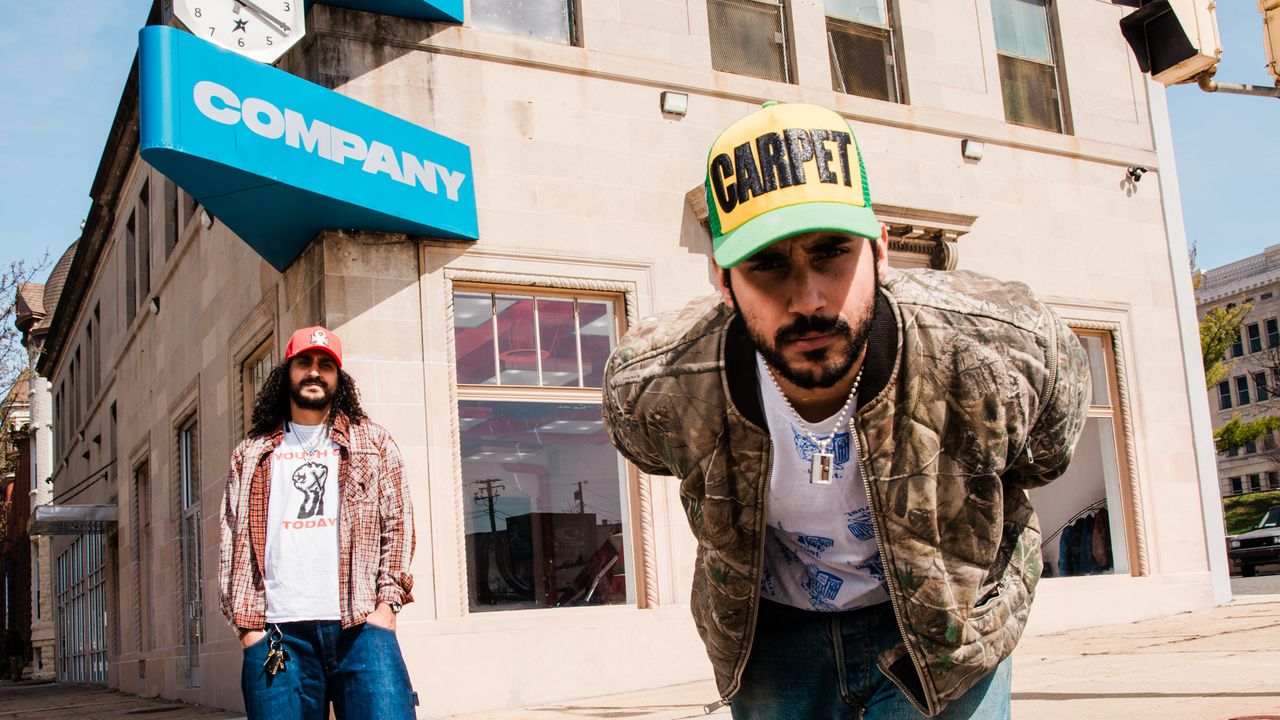
Before an impish monkey named Julius—emblazoned on everything from T-shirts and sweatpants to lunchboxes and handbags—became virtually inescapable in the early 2000s, there was just a sewing machine, a stack of vinyl, and a makeshift workshop in Paul Frank Sunich’s Southern California garage. Those homemade experiments would eventually grow into Paul Frank, a global brand that turned Sunich’s cartoon monkey into a pop-cultural touchstone for an entire generation.Ayman and Osama Abdeldayem got their start in a similarly DIY fashion. When the brothers behind the Baltimore skate label Carpet Company wanted to print their own T-shirts, they bought a used screenprinting press off Craigslist and set it up in a friend’s grandmother’s basement. They cobbled together the rest of the setup: a lamp to expose screens, a bathtub to wash them out. “It was really bad,” Osama remembers. “But it was fun for us to learn.”Courtesy of Carpet CompanyA couple of decades and a few thousand miles separate those two DIY experiments, but next week they officially collide: Carpet Company is releasing a collaboration with Paul Frank, which has lately found new life amid the Y2K revival. For Carpet Company, called simply Carpet by its many fans, the partnership is the latest turn in a decade-long project to see how far two brothers can take a simple idea without losing sight of where it all began.Carpet’s chaotic, experimental sensibility took shape long before the brand did, when Ayman and Osama stumbled across a VHS tape their older brother had left behind. They assumed it was a porno, but it turned out to be Welcome to Hell, Toy Machine’s landmark 1996 skate video. “The mayhem that we had inside of us immediately connected to it,” recalls Osama. They were restless kids, fans of late nights, fireworks, and paintball guns, and their parents, Egyptian immigrants raising five boys in Maryland, were often stretched thin. The eldest looked after the younger ones, and the rest sorted themselves out.Skateboarding gave that mayhem a direction. It also taught the Abdeldayem brothers how to succeed and fail repeatedly without losing momentum—hurling yourself to the ground over and over in pursuit of a single trick tends to have that effect. Years later, that same persistence would become fundamental to Carpet.At first, they printed images they liked on T-shirts, simply to see if they could. Eventually, they moved on to skateboard decks, which proved significantly harder. Months went by without success, but because there was no timeline, no pressure to turn anything into a business, it didn’t matter. What started as something closer to an art project slowly crystallized into a skateboard company and a clothing brand. That unhurried approach is tied, in part, to geography. “If Carpet started in New York or LA, we’d either be really big or dead,” Ayman says. “Because we’re in Baltimore, we’re blessed with being able to do what we want at our own pace.”Ayman attributes the brothers’ unconventional approach to product design in part to skateboarding, which trained them to obsess over details most people never notice. Because boards break and sneakers wear out, skaters are forced to replace them often, and over time, those choices become instinct. “You’re always thinking: What’s the best graphic? Why do I like this more than that?” he says. “I’ve never once grabbed a skateboard that I didn’t care about the graphic.”“Carpet is constantly manifesting what feels like childhood dreams,” says Brendan Yates, a longtime friend and frontman of Baltimore hardcore outfit Turnstile, who has been collaborating with Carpet since 2017. The brothers, who met Yates and bassist Franz Lyons through skating, remember attending an early Turnstile show in D.C. “Me and Osama are standing right where the mosh pit is about to happen, not knowing how crazy it’s going to get,” Ayman recalls. “Then the first guitar strum hits, and a Doc Marten flies into Osama’s eye.” Osama retreated to the club’s bathroom to wash off the blood and assess the damage. “I ran into two guys with broken noses talking about how crazy the show was,” he remembers. That was one side of their lives. The other was considerably more buttoned-up.Courtesy of Carpet CompanyBefore Carpet became a full-time pursuit, the brothers worked as engineers. The same year Ayman started at NASA, they bought their first screenprinting press. Osama worked in the field for Maryland’s largest utility company, quietly running Carpet on the side while hoping his coworkers wouldn’t discover his extracurricular life. Even after their first Nike Dunk collaboration arrived in 2021, both still juggled full-time jobs and squeezed Carpet into the remaining hours of the day, but the growing company gradually pulled them further away from the stable, immigrant-parent-approved careers they had worked so hard to secure. “I asked my parents if I could quit for three years,” Osama says.From a distance, Carpet Company can resemble a typical skate-adjacent streetwear label—graphic-heavy, full of T-shirts and sweatshirts—but unlike most brands in that space, Carpet rarely repeats graphics. “We’ve had designs that probably could’ve sold forever, but once it’s done, it’s done,” Osama says.“Our parents always tell us to go on Shark Tank, but they would kick us out in a millisecond. We’re the kings of wasting money,” Ayman chimes in, laughing.Ayman gravitates toward operations and business, while Osama focuses more on design, though they still make major decisions together. Not every rogue idea makes money. Carpet often produces items that seem almost intentionally difficult to sell: lacquered leather purses, “Habibi” nutcrackers, fiberglass stools inspired by skateboard hardware. Some consume absurd amounts of time. “We understand numbers enough to know when we’re making bad financial decisions,” Osama says. “But if we really like the product, that’s all that matters.” The company recently hired a friend as an accountant. But as long as they can pay the bills and make payroll for their small team, that’s enough.The brand’s aesthetic, likewise, is a product of the brothers’ wide-ranging tastes. As teenagers, Osama and Ayman cycled through sartorial phases: from dressing like “tight pants Baker skater kids” to more street-fashion obsessions like Evisu denim and Bapesta sneakers. “They’re very different from anything we’ve seen,” says Atiba Jefferson, a veteran skate photographer and friend of the brand. “I don’t think either of them went to fashion school, but skateboarding’s DIY ethos has really paid off.” He compares Carpet’s creative sensibility and guest board program to ’90s skate touchstones like Girl, World Industries, and Hook-Ups. “That’s what stands out to me about Carpet. They’ve run their company like the most unique board company that’s not a board company.”Courtesy of Carpet CompanyIf Carpet Company has a strategy, it’s patience and persistence. “We’re definitely playing the long game,” Osama says. Over the past decade, the brothers have watched countless streetwear brands explode and disappear just as quickly. Carpet has tried to sidestep that cycle by refusing to depend on any single logo, trend, or repeatable hit. Their retail network leans heavily on independent skate shops and boutiques, including Dover Street Market and Supreme. They’ve repeatedly turned down opportunities to scale through mall retailers. Every Carpet skateboard is still printed by hand.Nowhere is the distance Carpet has traveled more apparent than its flagship, which opened earlier this year in Baltimore’s Station North neighborhood. A long line formed for the grand opening, and shoppers have kept coming in the months since. “Sometimes I walk in on a Monday afternoon and think, ‘Dude, there are people shopping in here right now. This is crazy,’” Ayman says. “We’re not used to operating on a day-to-day basis like this.” He pauses before adding: “Foot traffic in Baltimore shouldn’t feel shocking, but sometimes it does.”The block, once a thriving shopping district, sat largely dormant for decades, but Carpet has turned an old bank building into a destination. An attached café features custom Egyptian tiles, with an upstairs art gallery coming soon. Giant windows flood the revamped retail space with daylight. Skate decks featuring Osama’s artwork hang in a comically oversized frame, as if plucked from Pee-wee’s Playhouse. At the center, a mirrored pyramid catches and distorts it all, turning the store into a funhouse reflection of itself—part boutique, part hangout spot.The brand straddles skateboarding, clothing, design, and whatever else captures the brothers’ attention. But one of the most unexpected things about opening a permanent space has been watching that world expand beyond them. “The craziest thing is seeing people walk in who have no connection to the brand at all,” Osama says. “Then they leave excited. It’s like you converted someone into a Carpet person in ten minutes.” Ayman has heard stories of customers meeting at previous pop-ups and forming friendships and groups that now span different states. Some made the trek for opening day. “It’s cool seeing people make friends in such an old-school way,” he says.Earlier this year, the brothers released another dream project: a guest board with Ed Templeton, founder of Toy Machine and one of the skaters featured in Welcome to Hell. They asked Templeton if he’d consider redrawing Toy Machine’s “Devil Cat” logo as a sphinx, a nod to the brothers’ Egyptian heritage. It felt like a long shot. An hour later, Templeton sent over a rough sketch on a napkin. “I was like, ‘That’s it. That’s the one. Please send me that napkin!’” Ayman says. “To think Carpet might not exist if we never watched that video—it’s kind of a crazy thought.”Courtesy of Carpet Company
Carpet Company Is Playing the Long Game
Full Article
Original Source
Read the full article at Gq →KhanList aggregates and links to publicly available news content. We do not host full articles from third-party sources. Always verify important information with original sources.