
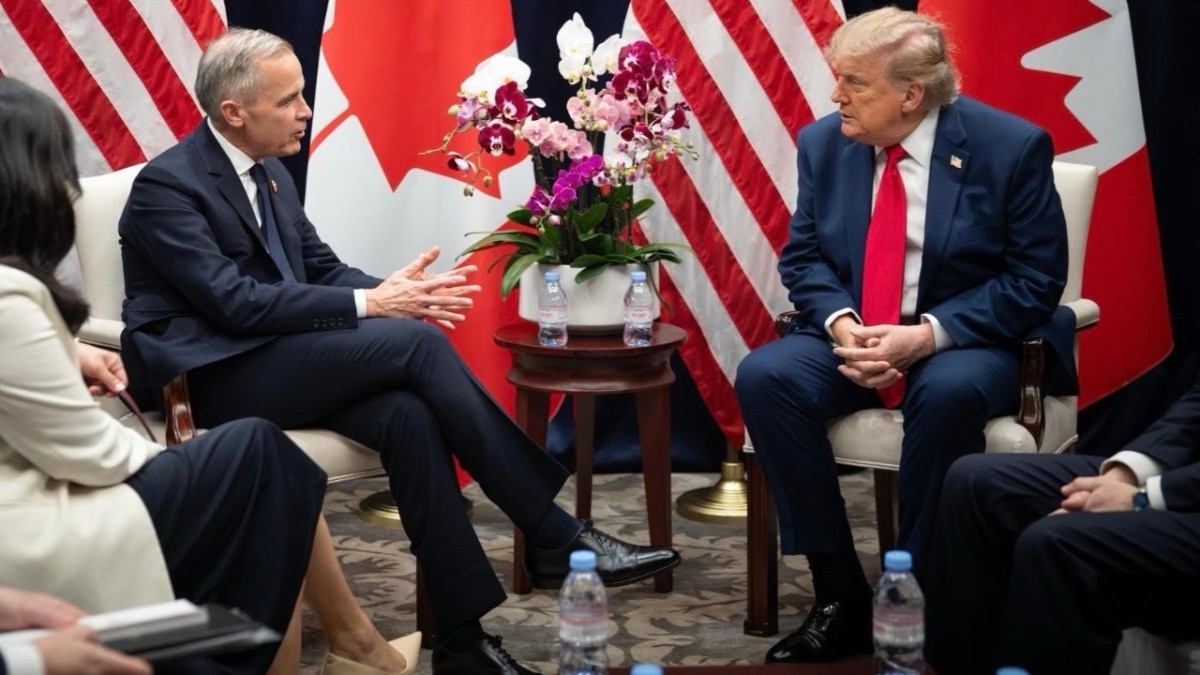
Canadian Prime Minister Mark Carney said US President Donald Trump is not particularly concerned about Canada's expanding trade relationship with China, as Ottawa works to rebuild economic ties with Beijing and separately negotiates a new trade agreement with Washington.Carney made the remarks after meeting Trump for about 20 minutes on the sidelines of the Asia-Pacific Economic Cooperation (APEC) summit in Shenzhen, China, on Wednesday. The meeting was held shortly before the leaders' dinner. According to CBC, Carney said Trump had sought to understand where Canada's relationship with China was heading but suggested it was not high on the US president's list of priorities."In my conversation with the president, he's tried to understand where we are with China, where we're going with China," Carney said. "I shouldn't speak for him, but in his hierarchy of issues, it's not the top issue at all."CANADA'S US TRADE TALKS HIT A STOP-START RHYTHMCarney's meeting with Trump focused largely on the trade negotiations between the two North American neighbours. According to the Carney's office, the two leaders discussed talks that are "underway to reach a mutually beneficial trade agreement" between Canada and the US. Ottawa said such an agreement should "create good jobs, boost affordability and fully respect Canada's languages, culture and sovereignty."The meeting brought together senior officials from both sides. Foreign Affairs Minister Anita Anand and Carney's chief of staff Marc-Andre Blanchard attended for Canada, while Trump was accompanied by chief of staff Stephen Miller, US Trade Representative Jamieson Greer, Commerce Secretary Howard Lutnick and Secretary of State Marco Rubio. Despite the high-level meeting, there is still no formal trade deal on the table. CBC reported that Canadian Trade Minister Dominic LeBlanc has not travelled to Washington for face-to-face negotiations with Greer or Lutnick since talks resumed earlier this month. Instead, the two sides have continued discussions through phone and video calls.Carney described the negotiations as a stop-start process."We have been making progress -- I would say with some 'two steps forward, one step back' type thing -- but we have been making progress," he said. He added that he still believed an agreement was possible, but only if it was "in the interest of Canadians."CHINA TRADE CREATES TENSION WITH WASHINGTONHis comments about Trump came after criticism from White House trade adviser Peter Navarro over Canada's efforts to deepen economic ties with China. Navarro objected in particular to the possibility of Chinese automakers expanding their presence in Canada."Are u really threatening to play China off the US? This is offensive in the extreme," Navarro wrote on X. "You should be far more worried China is going to eat Canada alive."Carney has repeatedly said negotiations with Washington remain his priority. But he has also made clear that Canada is prepared to look for other economic opportunities if the US talks do not deliver what Ottawa considers an acceptable outcome.That issue has become particularly important for Canada's auto industry. Asked whether potential Chinese investment in Canada's automotive sector was being used as leverage against Washington, Carney rejected that description."It's not leverage. But action, reaction," he said on Monday. He argued that Canada could not simply wait indefinitely if its autoworkers were not being fully employed within the North American market."If autoworkers in Canada are not fully utilised in a North American context, that provides other opportunities Canada is going to move forward either way."WHY CHINA IS A DIFFERENT ISSUE FOR CANADACarney's argument is that Canada's economic relationship with China should not be viewed through the same lens as the much more strategically sensitive rivalry between Washington and Beijing. Canada exports commodities to China, including agricultural and seafood products, rather than relying primarily on the kinds of advanced technologies that have become central to US-China tensions."We are exporting canola, we are exporting pork. We are exporting halibut," Carney said, also pointing to liquefied natural gas and oil. "These are important industries. These are not cutting-edge semiconductors."That distinction is central to Ottawa's attempt to expand its trade options without presenting the move as a challenge to Washington.Carney said rebuilding commercial ties with China could also open opportunities in areas beyond traditional exports, including "financial services, clean energy and technology."- EndsWith inputs from agencies
Carney says China trade is not Trump's top concern after APEC meeting
Full Article
Original Source
Read the full article at Indiatoday →KhanList aggregates and links to publicly available news content. We do not host full articles from third-party sources. Always verify important information with original sources.