
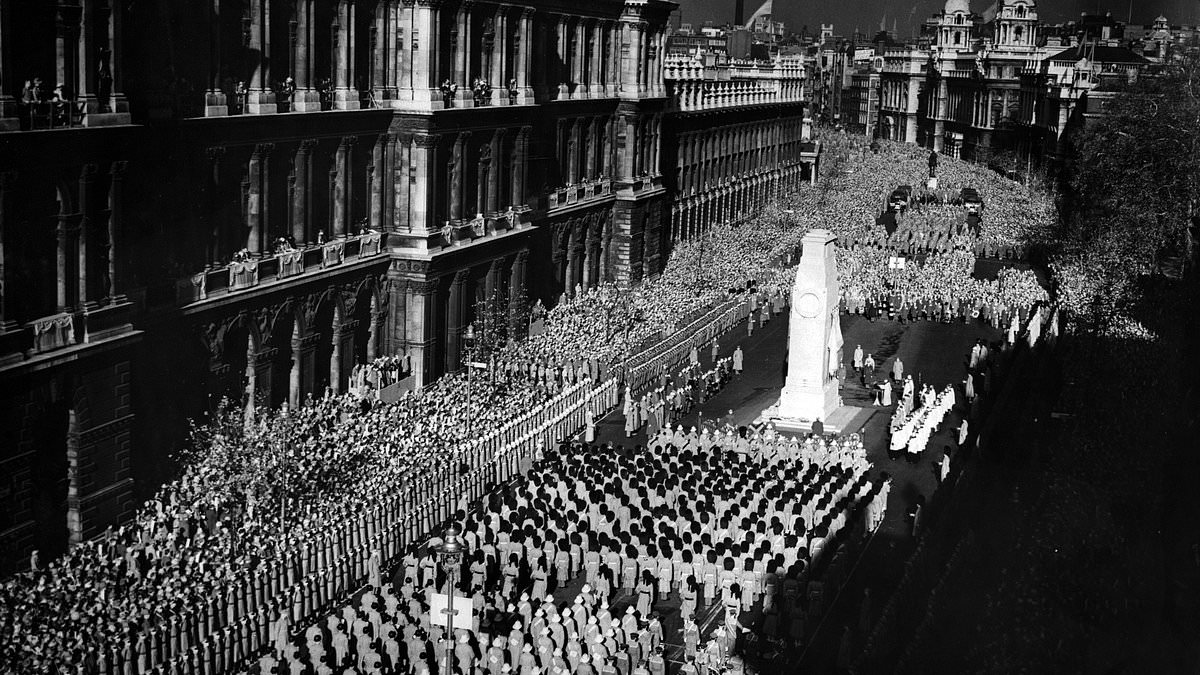
What does it mean when we wear a Remembrance Poppy? On Friday I laid mine aside, having – as usual – managed to sing that granite-like hymn O God Our Help In Ages Past on Sunday. I also attended a moving gathering on Platform One at Paddington Station in London, on the 11th day itself.At that station, there is a fine memorial, by the superb sculptor Charles Sargeant Jagger. It depicts a soldier – not striding with weapon in hand, but quietly reading a letter from home. It always makes me choke up slightly when I walk past it (as I often do).Jagger fought in the Great War, at Gallipoli and amid the mud of the Western Front. He was wounded and awarded the Military Cross. He knew what and who he was remembering. He’d seen them die. And I have long thought that the hundreds of powerful memorials which still stand in our midst have a complex double – or even triple – meaning.There is the one at Fleetwood which proclaims drily that ‘principles do not apply themselves’.There is the heartbreaking monument at Port Sunlight – a major work of art – where sculptures of orphaned girls and boys, and of a woman cradling her children, stand amid majestic figures of men in many forms of combat.One of the saddest things about it is that the post-1918 world could never have produced such fine art. The people who could make it, and the spirit which created it, are gone. These things always make me think of Philip Zec’s savage 1945 cartoon in which a battered, bandaged soldier emerges from the ruins with a wreath labelled ‘Victory and Peace in Europe’, saying ‘Here you are! Don’t lose it again!’ as if to a child who has asked his father, for the umpteenth time, to find a lost cricket ball.The civilised grown-ups in these wars, those whose names are inscribed on the memorials, were the adults in this event. They had to apply the principles which our leaders claimed they believed in, in the vast conflict which began in 1914 and did not really end till 1945. The vain politicians were the children, needing to be rescued yet again from their carelessness.And the people of Britain desired great marble crosses, stone obelisks and looming cenotaphs, because their sons, brothers, fathers and husbands had never had the solemn funerals that in those days were normal. Crowds gather at the Cenotaph after the end of the Second World War. 'The people of Britain desired great marble crosses, stone obelisks and looming cenotaphs, because their sons, brothers, fathers and husbands had never had the solemn funerals that in those days were normal,' writes Peter HitchensNo passing bells tolled for them. The neighbours did not draw down their blinds. The old Victorian rules of mourning could not be followed. In many cases their bodies could not even be found.So what I see in the Poppy is reflection, regret and sadness. What I think of in the two minutes’ silence is – mainly – the pain and fear that these men felt in combat.I am not a pacifist. Almost every generation of my family (except my own) has worn the King’s uniform. But I worry about what has happened to the Poppy. Back in the Eighties my Left-wing brother jeered at me for wearing one (he later very much changed his mind about that). That wasn’t untypical of those times. The Left thought it was ‘militaristic’ to remember the fallen, and the November ceremonies seemed to be fading away.Then along came New Labour, and suddenly Left-wing MPs were being more or less ordered (by the whips) to wear Poppies whenever they strayed near a TV camera. Even if they hated it.What was this about? Well, we soon found out. Patriotism was being re-designed, and it would from now on include idealistic wars of choice, all over the place.Mr Blair was soon posing with soldiers in Kosovo, and then leading us to war in Iraq and Afghanistan. And from then on, any politician or TV presenter who didn’t wear a Poppy during Remembrance season was in trouble.I preferred it when it was more of a choice. I do it to commemorate what was – beyond doubt – a noble sacrifice, made by the very best of their generations. I don’t do it because I want any more wars.We’ve lost quite enough of our best people as it is. That may even be part of the reason why we’re now in such a mess.No ideology needed – just a marijuana habit Michal Oksinski began his murders by slaughtering his mother, father and sister in their bedsThe Krakow murderer is dead, and there is no need to try him. So I can write freely about the case – as I could not do if it had recently happened here. The point I wish to make is very simple.The repeated claims by politicians, police officers and security ‘experts’ that mass killers are politically motivated are bilge. Michal Oksinski was crazy, and there is (if you look) evidence that he is crazy because he used marijuana. As usual. These people are stark mad. They mouth slogans but have no plan and belong to no real organisation. No cause, however vile, could possibly benefit because one of its followers randomly butchers a large number of innocent people and is then predictably killed by the police. Who is going to rally to what bloody flag, as a result of that? Nobody, ever.Oksinski began his murders by slaughtering his mother, father and sister in their beds, a detail which media organisations were strangely slow to publish. Poland’s strong Right-wing opposition party took offence when interior minister Marcin Kierwinski pronounced that Oksinski had been influenced by far-Right ideology. They called it a ‘blatant lie’.Kryminopedia, a popular Polish true-crime YouTube channel, interviewed a former acquaintance of the killer. He recalled that the teenage group they both belonged to used marijuana and other drugs – as if that is a surprise.Perhaps, sometime around 2056, everyone will put two and two together. In the meantime, it will keep happening, and the authorities will keep missing the point.
Careless politicians have distorted the true meaning of the Remembrance Poppy: PETER HITCHENS
Full Article
Original Source
Read the full article at Dailymail →KhanList aggregates and links to publicly available news content. We do not host full articles from third-party sources. Always verify important information with original sources.