
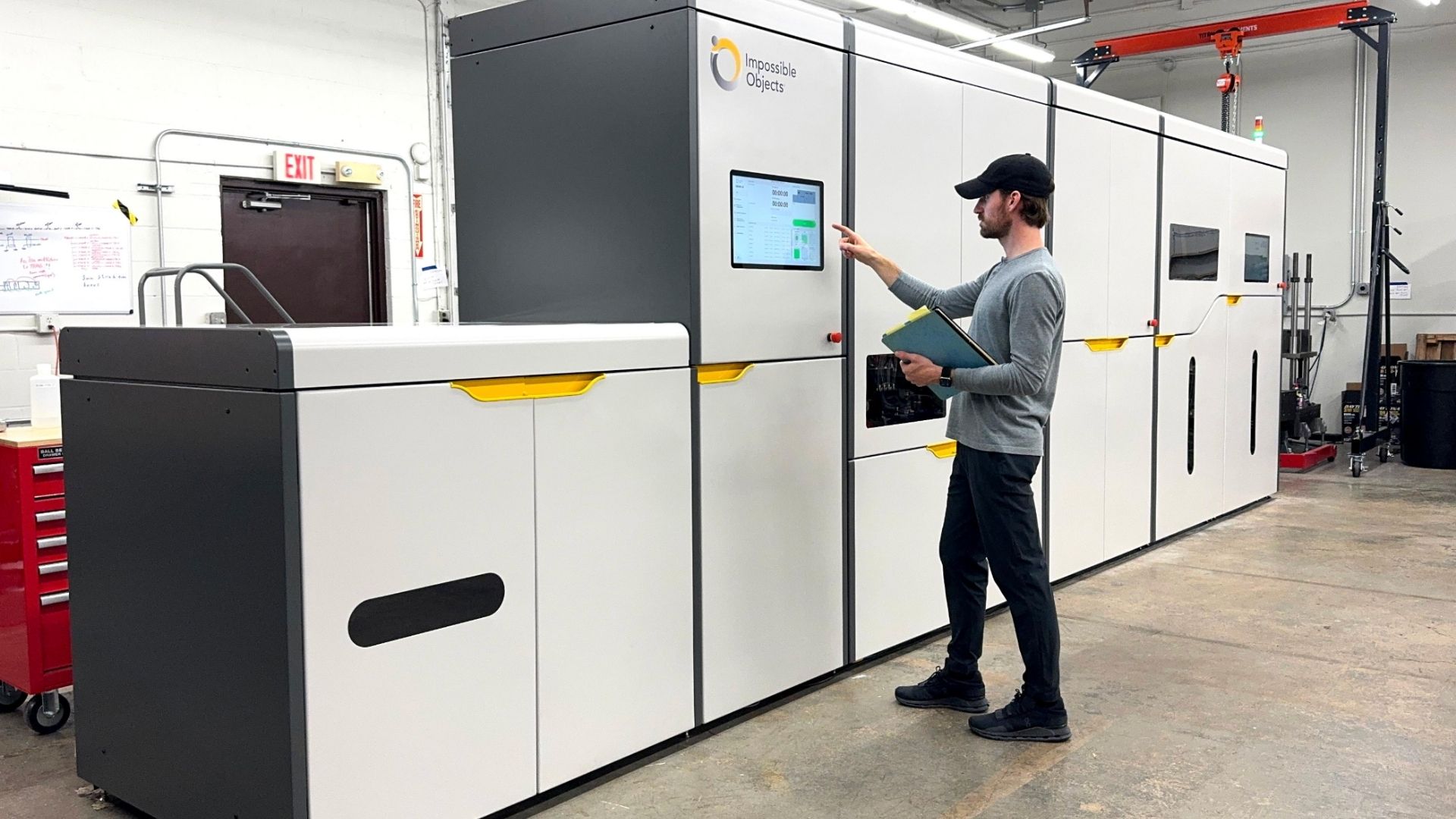
Impossible Objects, an Illinois-based manufacturing technology company, has secured $40 million to expand a high-speed 3D printing system designed for industrial-scale production. The Series B round, led by Inflection Equity, will help the company increase production of its Composite-Based Additive Manufacturing (CBAM) systems. The funds will also support further deployments across aerospace, defense and advanced manufacturing. At the center of the expansion is the CBAM 25, a carbon-fiber printing system that can produce strong, lightweight components without the expensive tooling required by conventional manufacturing processes. From prototyping to mass production Although 3D printing has been available for decades, its industrial use has often remained limited to prototyping. Slow production speeds, material constraints, and high costs have prevented many additive manufacturing systems from competing with CNC machining and injection molding. Impossible Objects claims its CBAM process addresses these limitations by combining rapid production with advanced composite materials, including carbon fiber. The system can manufacture parts for applications traditionally served by established production techniques while reducing tooling requirements, costs, and lead times. “We’ve created a fundamentally new way to manufacture,” said Robert Swartz, founder and chairman of Impossible Objects. “We live our lives through things, and we have changed how things are made. This is as important as the mill, precision measurement, and interchangeable parts. This funding gives us the resources to bring that vision to more customers and make it real at scale,” he added. Printing stronger parts at higher speeds The CBAM 25 can print as many as 25 layers per minute, making it 15 times faster than competing production additive technologies, according to the company. Its process can produce composite components with strength reaching 200 MPa, which Impossible Objects says is up to four times greater than parts made through rival additive manufacturing methods. The technology also minimizes shrinkage and warpage, two issues that can affect the dimensional accuracy of printed components. Since the system was introduced in early 2025, Impossible Objects has received five orders and begun placing machines with customers and research organizations. These include the U.S. Air Force, the National Institute for Aviation Research, the Oregon Manufacturing Innovation Center, and the Rochester Institute of Technology. “Our CBAM 25 system is designed from the ground up to meet the high productivity and high reliability needs of advanced manufacturing combined with the flexibility and tool-less manufacturing that modern flexible supply chains require,” said Steve Hoover, CEO of Impossible Objects. Supporting drone and aircraft manufacturing The technology could play a particularly important role in distributed defense production. At the U.S. Army’s Rock Island Arsenal, CBAM can support manufacturing of up to 10,000 drone bodies every month. Impossible Objects has also secured $20 million through U.S. government contracts and awards. Its work covers high-strength long-range drones, lightweight wing and fuselage structures, embedded wiring and additively manufactured components approaching the strength of traditionally produced composites. The latest funding will allow the company to manufacture more CBAM systems, deploy them at additional customer sites, and expand the service and commercial teams supporting its growing installed base. Get the latest in engineering, tech, space & science - delivered daily to your inbox.Atharva is a full-time content writer with a post-graduate degree in media & amp; entertainment and a graduate degree in electronics & telecommunications. He has written in the sports and technology domains respectively. In his leisure time, Atharva loves learning about digital marketing and watching soccer matches. His main goal behind joining Interesting Engineering is to learn more about how the recent technological advancements are helping human beings on both societal and individual levels in their daily lives.
Carbon-fiber 3D printer targets mass production of drones and aircraft parts
Full Article
Original Source
Read the full article at Interestingengineering →KhanList aggregates and links to publicly available news content. We do not host full articles from third-party sources. Always verify important information with original sources.