
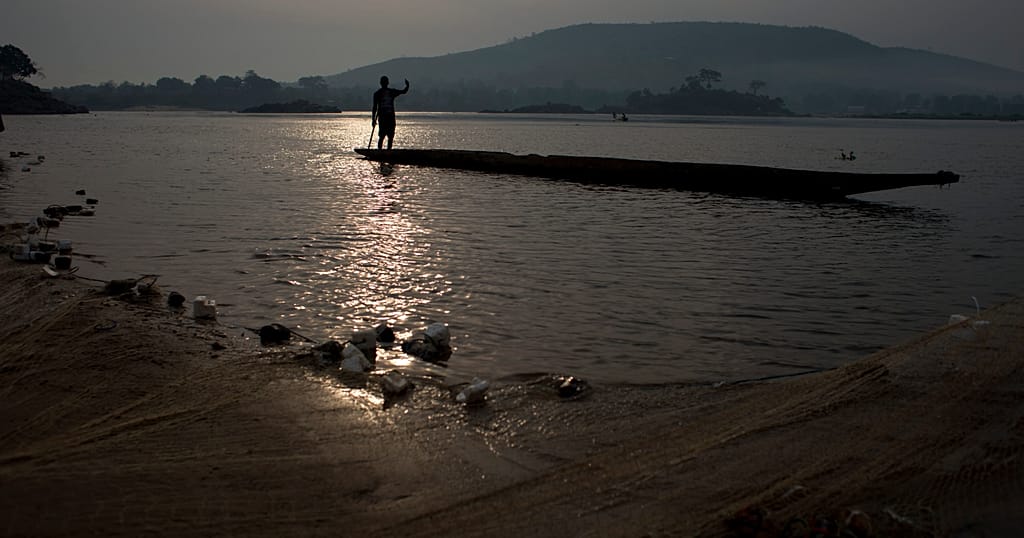
As the number of Ebola cases in neighbouring Democratic Republic of Congo hits over 10,000, the Central African Republic has stepped up screening along the river border between the two countries. At the M'Poko Bac pier frontier post, in the south-west of the capital, Bangui, which sits on the banks of the waterway, health workers are raising awareness among local communities. "Passengers arriving by canoe dock at the entry point. Then they disembark one at a time," explained Maldiana Bagalama, tasked with health screening at the site. "One of our colleagues is there to direct them to the hand-washing station. Next, we brief them on the situation, then direct them to the tent for temperature checks and registration," she said. While the DRC is the epicentre of the outbreak, the virus has spread to several other countries with several cases reported in Kenya and one detected as far west as Nigeria. On top of that, the DRC and CAR share a porous and largely unmonitored frontier stretching for more than 1,500 kilometres. “As you know, the same communities live on both sides of the border. As a result, there is a great deal of movement of people and goods," said Dr Valentin Nebanga, head of the Health Promotion Department at the Ministry of Health. Despite the risks, economic activity continues apace along the Oubangui river. Fishermen, canoe operators, sellers of fresh fish and many others all depend on the vital waterway linking between the two countries. "We are worried because we work right here, by the river, and if Ebola reaches here we shall be the first to fall victim to it. We're asking the ministry of health to take far greater precautions," said Neige, a fishmonger and mother-of-three. A few metres away, Foxy Yeti Nzapa, ferried passengers by canoe which is his only source of income. The father-of-two fears that travel between the two countries may expose him to the virus. "We transport them between the two countries without any protection. Sometimes we hear that someone over there has died of Ebola. I could also become infected," he said. His concern is shared by the Central African authorities, who insist that they have toughened their border controls. "We have entry points staffed by health workers, the Water and Forests Department, Customs, Civil Protection and Internal Security Forces," said Nebanga. "All passengers, both those arriving and departing, are systematically screened by community health workers. In addition to those checks, the authorities have launched awareness-raising campaigns. Neighbourhood chiefs, community leaders and religious figures are being drafted in to pass on prevention guidelines to residents. For Nebanga, preparedness also means keeping the public engaged and making sure that they understand the importance of protective measures, particularly while there are no reported cases in the CAR. Yet around the river, residents' growing concerns are starkly visible in their daily lives. For those who make a living from river transport, fishing or trade, avoiding travel is not always an option. "We've not had any cases yet, but our biggest challenge remains retaining staff and keeping them engaged," said Nebanga. But "we are never fully prepared", he conceded.
CAR tightens border checks tightened as DR Congo's Ebola cases rise
Full Article
Original Source
Read the full article at Africanews →KhanList aggregates and links to publicly available news content. We do not host full articles from third-party sources. Always verify important information with original sources.