
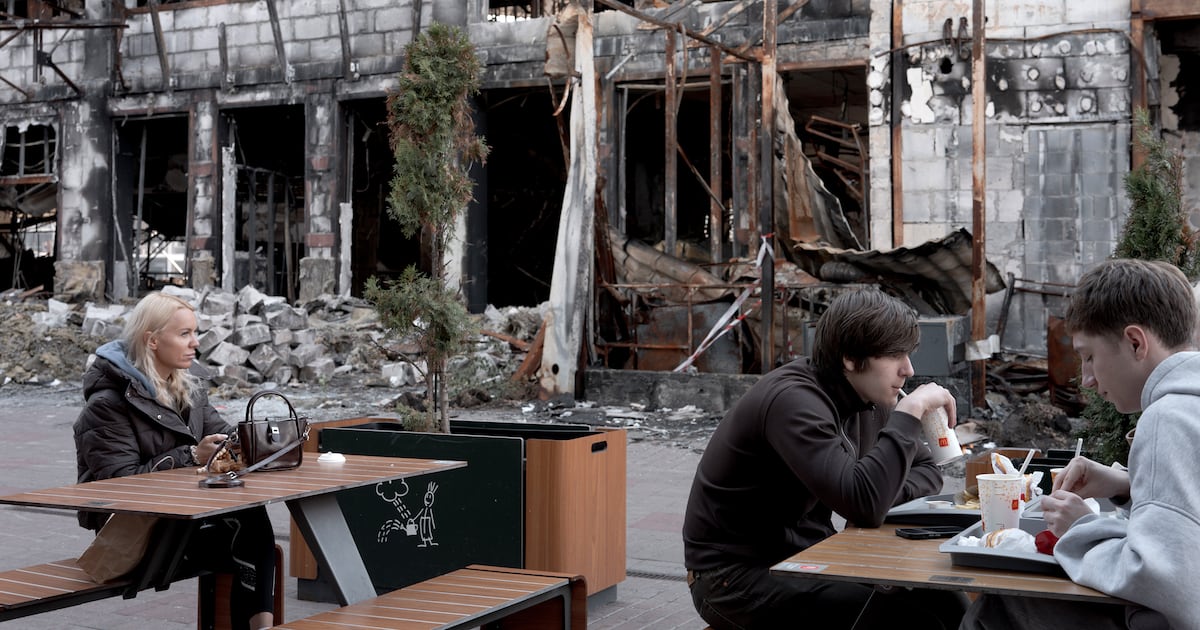
Ukraine put back the clocks on Sunday, but brilliant autumn sunshine helped people in Kyiv push away fears brought on by that harbinger of winter.The city’s historic heart was bustling, from Independence Square, better known as Maidan, up the narrow streets that climb to St Sophia’s Cathedral and St Michael’s Monastery, and through the park covering Volodymyr Hill to where it overlooks a broad sweep of the Dnipro river. Across the gleaming water, golden forest stretched away to the serried tower blocks of the left bank – residential districts that often bear the brunt of Russian drone and missile strikes.After nearly five years of all-out war, the wail of air-raid sirens elicits barely an eye roll in this city of 3.5 million, and few flinch at the rumble of air-defence guns blasting away at incoming threats.Some people scroll their phones as they stroll, checking Telegram channels that give running commentary of what is flying where, and apps showing maps of Ukraine dotted with moving multicoloured icons of jet- and propeller-powered drones, different ballistic and cruise missiles, and air-launched glide bombs.READ MOREThe digital maps created by Kontur Systems and others shade areas of the country that are under air attack in yellow and red, in line with a new alert system announced last month by president Volodymyr Zelenskiy. Yellow signifies danger from one or a few drones, and red means that missiles or many drones are on the way.At a time when Ukrainians are increasingly inured to alerts – despite Russian air strikes intensifying and civilian casualties rising – the changes are partly intended to jolt people out of any complacency or fatalism by making the warning system more precise.Now they can see more clearly if their own town or city is in danger and what exactly is approaching, and make a more informed decision about how to react rather than potentially carrying on as normal and hoping for the best.Zelenskiy said it was also about giving “people and businesses greater predictability and a clearer understanding of how to respond”, and helping the country’s ailing economy by establishing “clear criteria to allow state institutions, local authorities and businesses ... to continue operating during a ‘yellow’ threat”.Ukrainians have developed their own coping mechanisms by now, seeking a balance between danger and disruption, between possible threats to their lives and the chance of getting a decent night’s sleep at home.[ Elon Musk says SpaceX behind Starlink restriction that disrupted Ukraine’s defencesOpens in new window ]During recent frequent attacks from Russia’s ballistic missiles and new jet-powered drones, many people in hard-hit districts of Kyiv have bedded down in the nearest metro station, heading there each evening with yoga mats, sleeping bags, food and water rather than risking it at home.Others still move mattresses and duvets into the hallways or bathrooms of their flats, even though experts say the so-called two-wall rule – putting an outer and inner wall between yourself and any incoming object – provides only limited protection from a serious air strike and is no alternative to a proper shelter. Most people just hunker down in their own bed and accept the odds, determined to get whatever rest they can before another unpredictable day.Russian attacks on the energy grid have plunged Kyiv into blackouts, so generators are rumbling once more on pavements, lifts sit immobile in tall tower blocks, computers shut down mid-task and public transport is disrupted. As the nights draw in, wavering pools of torchlight again guide workers home through darkened streets.Kyiv residents fear this winter could be even worse than the last, when they faced danger from below as well as above due to a thick crust of ice that covered many of the city’s streets for months and prompted fierce criticism of mayor Vitali Klitschko.Activists hold placards and chant, "Down with Klitschko," during a rally outside the town hall in Kyiv on October 17th, 2026, calling for the resignation of Kyiv mayor Vitali Klitschko. Photograph: Sergei Supinsky/AFP via Getty Images About 200 people protested outside city hall recently to demand his resignation, citing issues ranging from alleged corruption to a failure to provide dozens of mobile bomb shelters and meet other pledges.Klitschko denies the accusations and claims Zelenskiy wants to oust him and control all of Ukraine’s main cities. On Tuesday morning, Klitschko inspected a road and metro bridge over the Dnipro that was closed after an overnight ballistic missile strike. The former world heavyweight boxing champion says he can only do so much to help Kyiv when Ukraine’s air defence stocks are dwindling.But the colder winter gets, the more political heat he is likely to face.“Kyiv is the heart of the state that the enemy is trying to destroy,” Klitschko told parliament this month as he defended his record. “But no less scary are those petty politicians who are trying to do the same.”[ Could a Melania Trump-brokered truce for Oleshky help end the Russia-Ukraine war?Opens in new window ]
Capital grateful for mild autumn amid intensifying Russian strikes and blackouts
Full Article
Original Source
Read the full article at Irishtimes →KhanList aggregates and links to publicly available news content. We do not host full articles from third-party sources. Always verify important information with original sources.