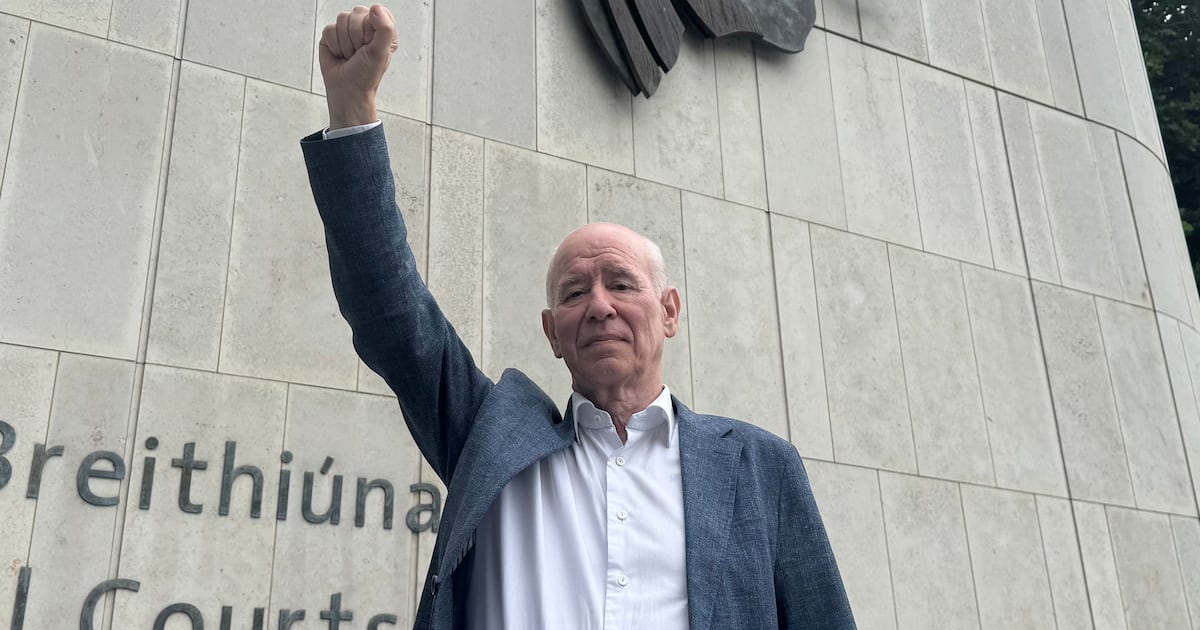
My brother Osgur Breatnach secured a miscarriage of justice certificate in the Court of Appeal in Dublin 10 days ago. In the hushed courtroom, we listened as the three judges unanimously granted the application, which states that he had no hand, act or part in the Sallins mail train robbery. This was an important finding which now, 50 years later, the Director of Public Prosecutions ostensibly agrees with. My brother was tried over the March 1976 robbery with Nicky Kelly and Brian McNally, who died last month. A sum of IR£200,000 was taken during the robbery, later claimed by the IRA. All three men were convicted by the non-jury Special Criminal Court in 1978.My brother had served 18 months of his 12-year sentence when his conviction – and McNally’s – were quashed on appeal in 1980 because the Court of Criminal Appeal was not satisfied their statements were made voluntarily. The earlier criminal trial had ruled the injuries Osgur and his co-accused had suffered were either self-inflicted or inflicted by each other after they’d signed their “confessions”. (Conveniently, Kelly and McNally been placed in a cell together after the interrogations; my brother was placed in a cell on his own).How easy it becomes, after the passage of time, to tut-tut the wrongs of the past, the festering societal wounds, the institutional abuses. READ MORE Sure didn’t we all know they were innocent anyway? Yes we did, but now at last this has been recognised by our judicial system. The next step is for the Government to finally address the question of why people sign confessions for a crime they didn’t commit. How could so many gardaí have declared in court that they did not beat anyone or see anyone being beaten? Why were agents of the State given such latitude and how were so many resources wasted in pursuing a wrong course of action? “The Heavy Gang”, as it became known, were a tough team of investigators drawn from the murder squad and other units. They specialised in getting confessions, but questions continue to be asked about their methods. I think of two appalling events in particular, the Hayes family and their “confessions” in the Kerry Babies case and the murder of Una Lynskey, for which several men were arrested and imprisoned, having signed “confessions”. One of these “suspects”, 19-year-old Marty Kerrigan, was abducted and murdered shortly after Una Lynskey’s body was discovered. They were later exonerated, with Martin Conmey securing his miscarriage of justice certificate 38 years later. I also think of my parents and others who were not here to witness this moment of exoneration. I find my mind going back to 50 years ago, the events in the tunnel under the Bridewell and what my brother experienced in the company of heavies. I too was arrested some days after the Sallins train robbery in 1976. I was 23 years of age when plain-clothes gardaí called to our house in Deansgrange, Dublin. As they searched our cottage, I remember asking them to go easy – my wife was four months pregnant. I was arrested and driven to the Bridewell. That night in prison I heard cries which I presumed came from people being beaten in other cells. I was afraid and I become upset even today, thinking about those times; about my brother put in the cell beside me the next morning, crying and saying “prepare yourself for the worst”. [ Ireland’s refusal to say sorry to men convicted of Sallins train robbery is shamefulOpens in new window ]But I was not beaten; they brought me downstairs to a room full of heavies who laughed and scoffed, telling me the lads had all confessed and named each other. They wanted me to deny that one of the accused, Mick Plunkett (who is now deceased) was in our house on the night of the robbery. But he had been – Mick was a friend and a plumber who’d come to fix our gas cooker that evening, so he could not have been at the scene of the robbery. A Dutch friend who visited us at that time corroborated this account – she had been questioned by Interpol in Amsterdam. The gardaí had actually checked this alibi, yet they claimed he was in Sallins. Fortunately, he was released on the second day of the second trial in 1978.During the first, aborted trial Judge John O’Connor, who had a heart complaint, kept falling asleep. It became another aspect that added to the farce, with slamming of doors and banging books by court officials in efforts to wake him. Defence counsel complained, but the Special Criminal Court, High Court and Supreme Court all rejected the appeals, with nine senior judges ultimately ruling that the judge was fit. He died soon after that. The Sallins case took over eight years of my own life, organising protest meetings, trying to convince a wary media of this miscarriage of justice, hoping to get across to vainglorious politicians and others. Our campaign had no social media, no internet, no mobile phones to rely on. I missed out on seeing my children grow.The Irish State has yet to account for its misconduct in cases such as my brother’s. Justice has yet to be served.Caoilte Breatnach is a translator and author of several books
Caoilte Breatnach: My brother was put in the cell beside me. ‘Prepare yourself for the worst,’ he said
Full Article
Original Source
Read the full article at Irishtimes →KhanList aggregates and links to publicly available news content. We do not host full articles from third-party sources. Always verify important information with original sources.