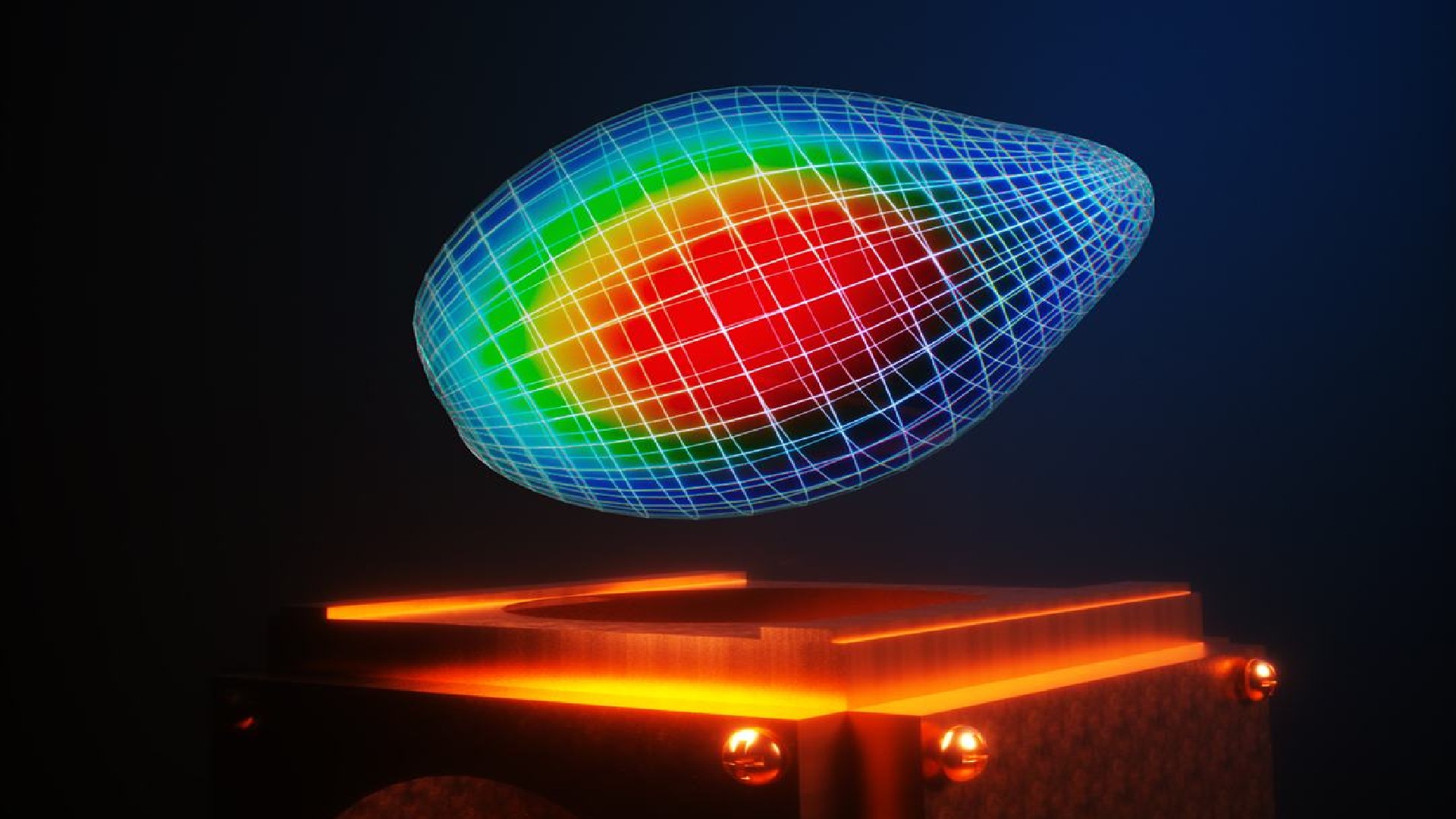
Radium's pear-shaped nucleus makes it highly sensitive to hidden particles and forces.Ella Maru Studio Caltech researchers have created cold molecules containing the radioactive element radium for the first time, opening a new way to investigate why the universe is made mostly of matter instead of equal parts matter and antimatter. The breakthrough allows scientists to prepare, cool, and precisely study radium-based molecules with lasers in a tabletop experiment. These molecules could act as highly sensitive quantum probes capable of detecting tiny signals that hint at new particles or forces beyond current physics. Scientists believe matter and antimatter were produced in equal amounts shortly after the Big Bang. Since particles and their antimatter counterparts destroy each other when they meet, physicists have long struggled to explain why ordinary matter survived while antimatter almost completely disappeared. The research team, led by physicist Nick Hutzler, chose radium because of an unusual feature of its atomic nucleus. Unlike most atomic nuclei, which are nearly spherical, radium’s nucleus has a pear-like shape that could amplify tiny symmetry-breaking effects researchers are trying to detect. Pear-shaped nuclei matter “Pear-shaped nuclei are asymmetric and dramatically amplify the potential signals we are looking for to explain the asymmetry in matter and antimatter,” Hutzler says. “Most nuclei are spherical like an orange or stretched out in one direction like an American football. Radium has the rare pear shape we want.” Working with radium, however, presented major challenges. The element is radioactive, highly reactive, and available only in tiny quantities. To safely handle it, researchers developed a method inspired by candy making. They mixed radium with water and a sugar substitute called xylitol before evaporating the liquid to produce a thick, stable material that could be transported and processed. The radium mixture was placed on gold foil inside a helium-cooled chamber, where temperatures dropped to about minus 450 degrees Fahrenheit. Lasers then excited the radium atoms into a chemically reactive state, allowing them to form molecules. A separate laser system measured the molecules’ quantum properties with high precision. According to Hutzler, developing the process required years of testing. “How do you go from a fleck of radium to cold molecules that are ready for tabletop quantum experiments in the lab?” Hutzler says. “It took us years of trial and error to finally come up with a protocol for handling the radium, making the molecules, detecting them, and measuring their properties.” The approach could extend beyond radium. Researchers say the same technique can be adapted to prepare other heavy radioactive molecules for precision quantum experiments. The team is also developing “engineered molecular clocks,” a method designed to reduce noise that typically disrupts delicate quantum measurements. The technique is already being tested with ytterbium-containing molecules and is expected to be applied to radium in future studies. “Our goal is to create the best quantum tools out of these very complicated molecules,” Hutzler says. “We are engineering molecules for precise quantum control.” The study was published in the journal Science. Recommended ArticlesGet the latest in engineering, tech, space & science - delivered daily to your inbox.With over a decade-long career in journalism, Neetika Walter has worked with The Economic Times, ANI, and Hindustan Times, covering politics, business, technology, and the clean energy sector. Passionate about contemporary culture, books, poetry, and storytelling, she brings depth and insight to her writing. When she isn’t chasing stories, she’s likely lost in a book or enjoying the company of her dogs.
Candy-inspired method yields first cold radium molecules for quantum experiments
Full Article
Original Source
Read the full article at Interestingengineering →KhanList aggregates and links to publicly available news content. We do not host full articles from third-party sources. Always verify important information with original sources.