
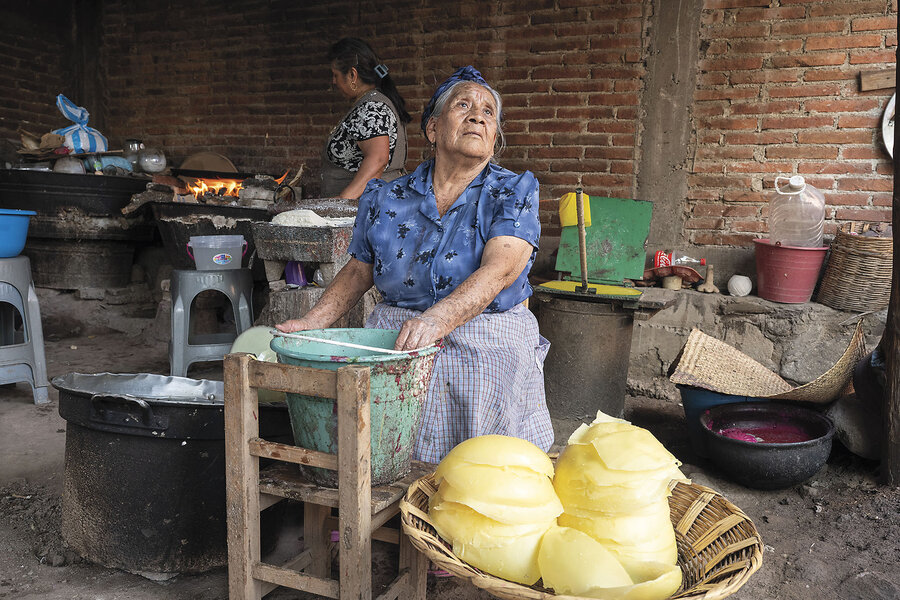
Teotitlán del Valle, Mexico | Nov. 13, 2026, 12:58 p.m. ET | 4 min read When Viviana Alávez Hipólito learned the craft of candlemaking from her grandmother some 66 years ago, it was over the open flames of a wood-burning fire, working above a dirt floor.Decades later, Ms. Alávez’s workshop, known as Casa Viviana, looks much the same. Her brick-walled, open-air space brims with silver buckets of naturally dyed wax. A stout, leafless huisache tree sits in the center of the courtyard, covered with thin beeswax sheets that locals call tortillas, bleaching white under the pounding afternoon sun.Although the workshop seems frozen in time, much has changed for Ms. Alávez and her craft. Many credit her with revamping the traditional art of candlemaking in this Indigenous Zapotec community, putting delicate candles adorned with wax flowers, shells, and fruit on the global map. Alfredo Sosa/StaffPRETTY IN PINK: Candles sit on a shelf in Manuel Hernández’s family-run showroom in Teotitlán del Valle in the Mexican state of Oaxaca. Until the 1990s, candles here were produced primarily for Catholic churches, which would give makers food instead of cash for their labor. But candles play an important cultural role in this valley, central to marriage proposals and family celebrations. Typically, when a groom asks a family for their daughter’s hand in marriage, he and his parents bring an ornate, handmade candle known as a vela de concha, or shell candle. Per tradition, the candle is meant to unite the families, and once it has completely burned, the couple are ready to wed. The larger and more intricate the candle, the more admirable the groom’s love for his bride. Ms. Alávez sits on a small wooden stool on a recent afternoon and rhythmically moves through the process of making the thin sheets of natural-yellow beeswax. She dips a clay bowl into hot beeswax, then cool water, and then peels the sheet off and tosses it into a growing pile in a basket by her feet. After learning the craft of candlemaking from her grandmother, Ms. Alávez took some creative liberties. She designed her own wooden molds that allowed her to create layers that, once joined together, resembled fresh roses, blooming carnations, and lifelike daisies. Alfredo Sosa/StaffWAXING POETIC: Roman Hernández Jr. (from left), César Hernández, Guillermina Ruiz, Viviana Alávez Hipólito, and Roman Hernández Sr. stand in the family’s candle showroom. “It was controversial,” she recalls, getting some assistance expressing herself in Spanish by confirming certain words in Zapotec with her daughter-in-law. Ms. Alávez’s grandmother at one point stole her molds and kicked her out of the house – a punishment for trying to blaze her own path.“My work is personal, and that’s not how my grandmother approached making candles,” she says. “It was hard for her to understand.”Across the courtyard, two of Ms. Alávez’s grandsons work around and under a wooden hoop that hangs from the ceiling. They call it a skeleton. Candles dangle around the perimeter of the hoop, and the young men – one in high school and one just starting college – work together to pour hot wax down the sides of the candles, spinning them as they work so that the wax is distributed evenly. “We’ve never counted how many times we’ve dipped the candles,” says Roman Hernández Jr., who just turned age 18. “Five hundred times? Eight hundred?” he guesses with a laugh. Alfredo Sosa/StaffHOT SPOT: Jose Hernández pours beeswax during the candlemaking process. Just as Ms. Alávez diverted from the path of tradition with her colorful beeswax creations, her children and grandchildren are finding their own ways to make candlemaking relevant in a globalized world. Mr. Hernández says coming to the candle workshop after school relaxes his brain after long days of problem sets and coursework. He’d like to study business in college and try to bring his family’s work to a broader international audience. Already their workshop gets orders from designers in the United States asking for the typically vibrant-colored works to be special-made in black or gray to more sleekly fit into clients’ homes, he says. Nearby, Roman Hernández Sr., one of Ms. Alávez’s sons, flips through a book of old photos and news clippings. For most of his childhood, no one appreciated candles in this community, he says. Most tourists came for the traditionally dyed textiles and rugs. Alfredo Sosa/StaffFLOWER POWER: Manuel Hernández shows wax flowers. Leaving room for exploration within the candlemaking craft is important, he says. “When her work exploded about eight years ago, a new generation of people here started making candles,” he says. “Before, we didn’t know it was an art. But when people start to value something as art, that pushes you to see your work differently.” Deepen your worldviewwith Monitor Highlights.Politics with respectGet political stories with respectful analysis.There‘s a world of new ideas in everyBooks newsletter.There‘s more to life, enrich yours withCulture & Learning weekly.Follow humanity‘s discoveries withScience & Nature stories in your inbox.Gain a spiritual perspectivefrom the stories in your inbox.Want to understand the deeper impact of critical events? Learn the Monitor‘s insight.Already a subscriber? Log in to hide ads. Another of Ms. Alávez’s sons and his family have opened their own candlemaking operation, Humea, about five minutes down a nearby dirt road. There, her grandson Manuel Hernández, in his early 20s, walks along the edge of his family’s courtyard workshop pointing out materials used to create each vibrant candle. Small cochineal insects that live on cactus paddles are squished and mixed with melted-down, sun-bleached beeswax to create vivid hues of red. That concoction is mixed with lime juice to make orange. Wild marigolds go into batches of bright yellow waxes. Alfredo Sosa/StaffNATURAL COLORING: A nopal plant full of cochineal, an insect used for creating dyes, hangs in Manuel Hernández’s family workshop. Manuel Hernández says family members have been building up their project for about a year, experimenting with new designs, including candles woven together to resemble the long, shiny black braids of regional Indigenous women.Carrying this craft forward – while leaving room for exploration – is important, he says. “It’s a big responsibility. I don’t want to lose the past, but I also want to try new things. It’s not only about tradition.” Alfredo Sosa/StaffROSE BOWL: A container with red beeswax, colored with cochineal insect dye, sits in Manuel Hernández’s family workshop. Alfredo Sosa/StaffA PLACE IN THE SUN: Thorny bushes hold wax tortillas for bleaching under the pounding sun. Until the 1990s, candles here were produced primarily for Catholic churches. Alfredo Sosa/Staff WAX MUSEUM: Finished candles are displayed in Mr. Hernández’s family workshop. Much has changed in the candlemaking craft over the past several decades. ALREADY A SUBSCRIBER? LoginReal news can be honest, hopeful, credible, constructive.The Christian Science Monitor was founded in 1908 to lift the standard of journalism and uplift humanity. We aim to “speak the truth in love.” Our goal is not to tell you what to think, but to give you the essential knowledge and understanding to come to your own intelligent conclusions. Join us in this mission by subscribing.
Candlemakers in Oaxaca keep the flame of tradition – and creativity – alive
Full Article
Original Source
Read the full article at Csmonitor →KhanList aggregates and links to publicly available news content. We do not host full articles from third-party sources. Always verify important information with original sources.