
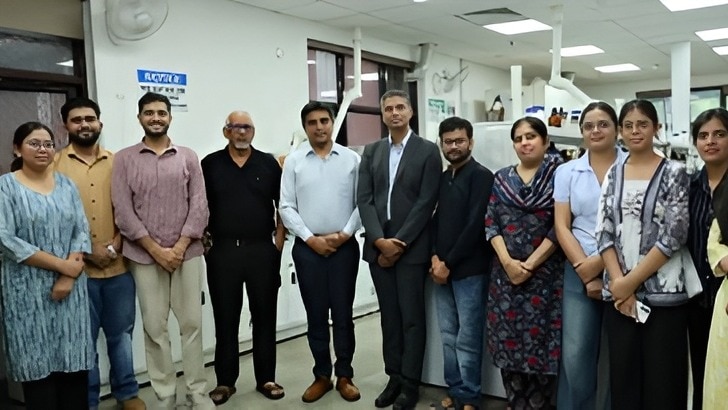
Hansraj College and the University of Chicago are exploring a research collaboration in radiopharmaceutical chemistry. The proposed work could connect chemistry research with new approaches to cancer diagnosis, imaging and treatment.Hansraj college, University of Chicago explore Radiopharmaceutical research for cancer diagnosis (Photo: X/hrcduofficial)Hansraj College, University of Delhi, and researchers associated with the University of Chicago are exploring a possible joint research collaboration in radiopharmaceutical chemistry, with cancer diagnosis and treatment emerging as a key area of interest.The proposed collaboration involves the Department of Chemistry and the HG Khorana Centre for Chemical Biology at Hansraj College, led by Professor Brijesh Rathi, and researchers working in radiopharmaceutical research at the University of Chicago. Professor Satish Chitneni, research faculty in the field, recently visited the college and interacted with students and researchers.WHERE CHEMISTRY MEETS CANCER CAREChitneni's work focuses on developing radiopharmaceuticals for the diagnosis, imaging and therapy of diseases, particularly cancers.Explaining the importance of chemistry in the field, he said radiopharmaceutical development relies on “good chemistry and innovative chemistry” to make molecules and introduce radioactive isotopes quickly. Radiopharmaceuticals use molecules to carry radioactive isotopes to specific targets in the body. This allows them to be used for imaging as well as targeted treatment.Chitneni described the area as part of nuclear medicine and stressed that it is not limited to one discipline. “It is a very multidisciplinary field,” he said, adding that chemists, pharmacists, pharmacologists, biochemists, medical physicists and nuclear medicine physicians all have a role to play.WHY THE FIELD COULD NEED MORE STUDENTSThe proposed collaboration comes at a time when radiopharmaceutical research is gaining greater attention in cancer care.Chitneni said the field is now at an “exciting stage” and is emerging as a niche area within therapeutics and pharmaceuticals. According to him, major pharmaceutical companies are increasingly working on radiopharmaceuticals, particularly for cancer treatment.But therapy and diagnosis are closely linked.Before therapeutic radiopharmaceuticals are given, imaging can help identify patients who are likely to benefit from a particular treatment. This creates a demand for research that connects drug development, imaging and medicine.“Anybody who is interested in getting into this field, this is definitely the right time,” Chitneni said.He also highlighted the need for more people to enter the field as research and development expand.FROM HANSRAJ'S CHEMISTRY LABS TO GLOBAL RESEARCHChitneni said he was impressed by the research presented by Hansraj College students during his visit, describing the work as “new and novel type of chemistry” to him.That interaction could be significant for students because radiopharmaceutical research requires expertise across several areas rather than knowledge of chemistry alone.The proposed partnership between Hansraj College's chemistry research ecosystem and University of Chicago-linked radiopharmaceutical research could give students and researchers a route into this growing area.Chitneni said he was “very pleased by the research going on here” and looked forward to continuing his affiliation and collaboration with the university.For Hansraj College, the proposed collaboration is therefore more than an international academic link. It could place its chemistry research closer to a specialised area of cancer research where chemistry, medicine and technology increasingly meet.- EndsPublished By: Princy ShuklaPublished On: Aug 27, 2026 16:45 IST
Cancer research gets a new push as Hansraj and Chicago University eye Radiopharma
Full Article
Original Source
Read the full article at Indiatoday →KhanList aggregates and links to publicly available news content. We do not host full articles from third-party sources. Always verify important information with original sources.