
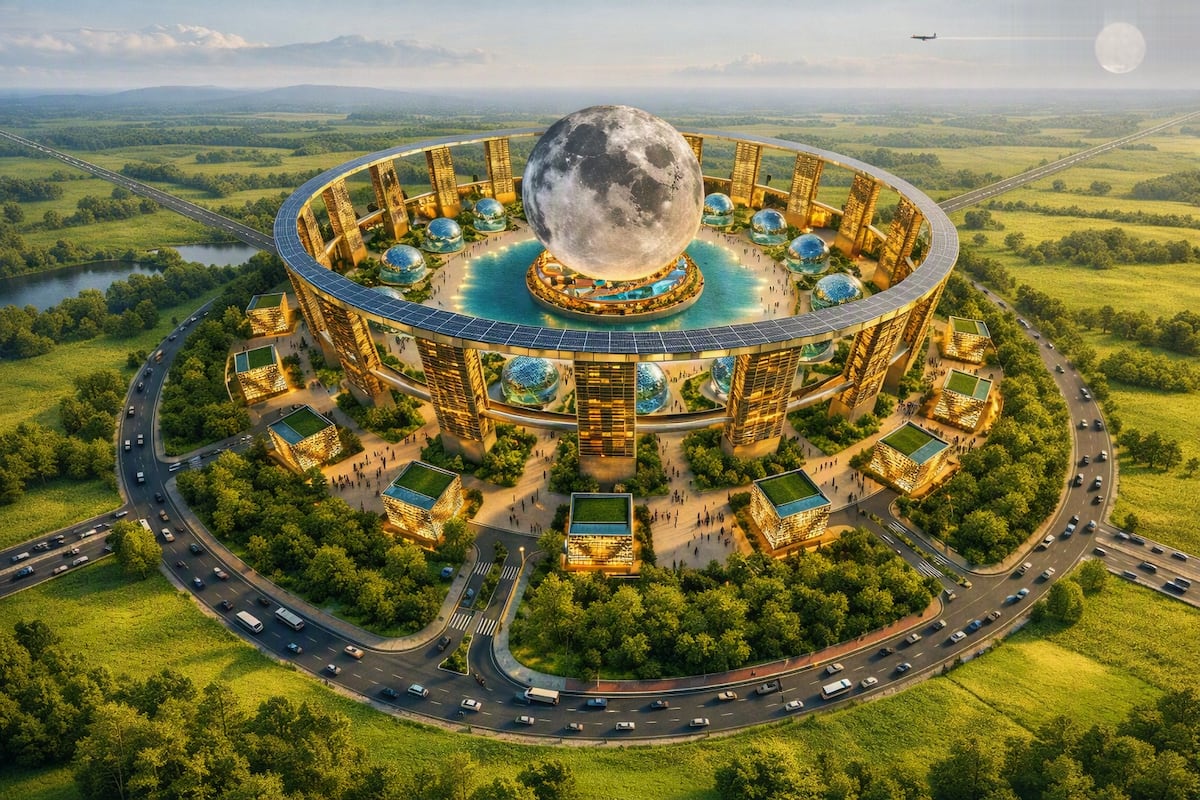
Canadian astronaut Jeremy Hansen, who in April became the first non-American to travel to the Moon, has a new job. The 50-year-old astronaut and test pilot made history as a mission specialist on Artemis 2, which orbited the Moon for the first time in more than 50 years. Six months later, Hansen has become an adviser and ambassador for Moon World Resorts, a Canadian company planning to build a gigantic replica of the Moon along with a vast tourism, residential, and educational complex centered around what would be the largest sphere in the world. Inside, its promoters say, visitors will find a recreation of the lunar surface complete with an explorable colony.“This project is as ambitious as a space program; it’s going to be extraordinary,” Hansen tells EL PAÍS via video call from Ottawa, Canada.The megaproject will give people the chance to “live, work, and play against the up-close visualization of the Moon,” Hansen says. “We’re talking about an area the size of 10 football fields, and on that surface you’ll see the sky exactly as you would if you were actually on the Moon.” The facility aims to offer “a replica as close as possible to a real Moon base,” serving both as a tourist attraction and a testing site for “future technologies,” according to the astronaut.In September, Hansen transferred to the reserve force of the Royal Canadian Air Force after 32 years of service and also left his country’s space agency, where he had spent 17 years. He has now decided to support the Moon World Resorts project, where he will serve as an adviser, member of the advisory board, and ambassador. According to a statement from the project’s promoters, his direct responsibilities will include the lunar surface and lunar base experience; astronaut training facilities; commercial partnerships across the space, aerospace, and space tourism sectors; collaboration agreements with universities; technology-sector partnerships; and the visitor experience at all space-related touchpoints throughout the project.A couple of weeks ago, Canadian Prime Minister Mark Carney appointed Hansen as his new adviser on space affairs, as well as an adviser to the country’s industry minister. His mission is to strengthen Canada’s position among the world’s space powers and promote its role in the emerging lunar economy. Hansen will hold that position alongside his role as a figurehead for the Moon project, which he supports “in a personal capacity” and whose credibility and potential he strongly defends: “I think they put together a highly capable team, done a lot of real work, and developed a design that is credible from an engineering standpoint,” he says. Hansen explains that he will be paid for these services but declines to specify the amount.The Moon World Resorts project was created by two Canada-based entrepreneurs: Sandra Matthews, its president, and Michael Henderson, its chief executive. Matthews describes the venture as “the blueprint for a smart city,” with a total construction cost of about $5 billion, encompassing some 12,000 luxury residences spread across 24 towers. The development would also include hotels, shopping centers, parks, and universities. “You’ll be able to own a condo overlooking the Moon,” Matthews says in a video interview. Visitors would pay $500 for a 90-minute walk across the Moon. Hotel rates, she adds, would be comparable to those of any five-star establishment.The two promoters’ goal is to finalize a design for Moon and then license it to a single client that would take charge of construction. Matthews says that client could be a major construction company or a sovereign wealth fund with sufficient capital to finance the entire project before development begins. The idea is eventually to build as many as 10 such cities around the world. “It’s similar to how J. K. Rowling licensed the rights to her books to Universal for a theme park,” Matthews explains, while stressing that Moon “is not a theme park.”According to Matthews, Spain is a leading candidate to host one of those 10 potential locations. Madrid will also be home to the office responsible for marketing the project to prospective investors. “Madrid is the ideal location for the pre-development showcase display center, where we will have drawings, full-scale renderings and model, and a virtual tour of the project,” she says. The Spanish capital is also under consideration as a site for the final development should an agreement be reached with an investor. Matthews adds that the company is also evaluating possible locations in Seville, Valencia, and Barcelona. For now, she acknowledges, all discussions have been exploratory, and there have been no meetings with either the central government or regional authorities to present the proposal.What Moon World Resorts does already have is a roster of more than 50 companies from 12 countries listed as partners on its website. The list includes major firms in architecture, engineering, consulting, insurance, transportation, and even gym chains.Matthews defends the strength of the Moon project and “its numbers.” On paper, those projections include 10 million visitors a year, 4,000 hotel rooms, and 2.2 million square meters (23.7 million square feet) of built space. The base of the lunar sphere is planned to house shops, a convention center, concert venues, and a wellness and longevity center, among other facilities. Matthews says Moon World Resorts has already raised “millions” of dollars, though she declines to specify the amount, and hopes to secure additional funding over the next eight months to complete the design phase. The company would then grant a license for the first lunar city to the strongest candidate, who would be responsible for building it in an estimated five‑year period.The project has taken many forms over the years. Its two founders first launched the idea in 2000, and even then the proposed design and budget were broadly similar to today’s plans. In 2002, they proposed bringing the project to Las Vegas, where their artificial Moon, measuring 271 meters (889 feet) in diameter, would have been almost twice the size of the Las Vegas Sphere. The project failed to attract an investor. Two years later, the developers sought to build it on a series of artificial islands in the Bahamas. In 2016, attention shifted to California’s Coachella Valley. By 2022, the preferred location was Dubai, in the United Arab Emirates. Just a few days ago, the project’s backers identified Abu Dhabi, also in the UAE, as one of the most promising locations, though still without a clear investor. Madrid has now joined the list, likewise without confirmed financial backing, the promoters acknowledge.Speaking from Ottawa, Hansen offers one final reflection on the project. “At this point, only visionaries are interested, because you really have to be one to imagine something on this scale. But in a world that needs more housing and more construction, this is a new way of building communities. And it’s possible there could be 10 of them around the world.”Sign up for our weekly newsletter to get more English-language news coverage from EL PAÍS USA Edition
Canadian who went to the Moon leads a Madrid development project with 12,000 luxury homes: ‘It’s going to be extraordinary’
Full Article
Original Source
Read the full article at English →KhanList aggregates and links to publicly available news content. We do not host full articles from third-party sources. Always verify important information with original sources.