
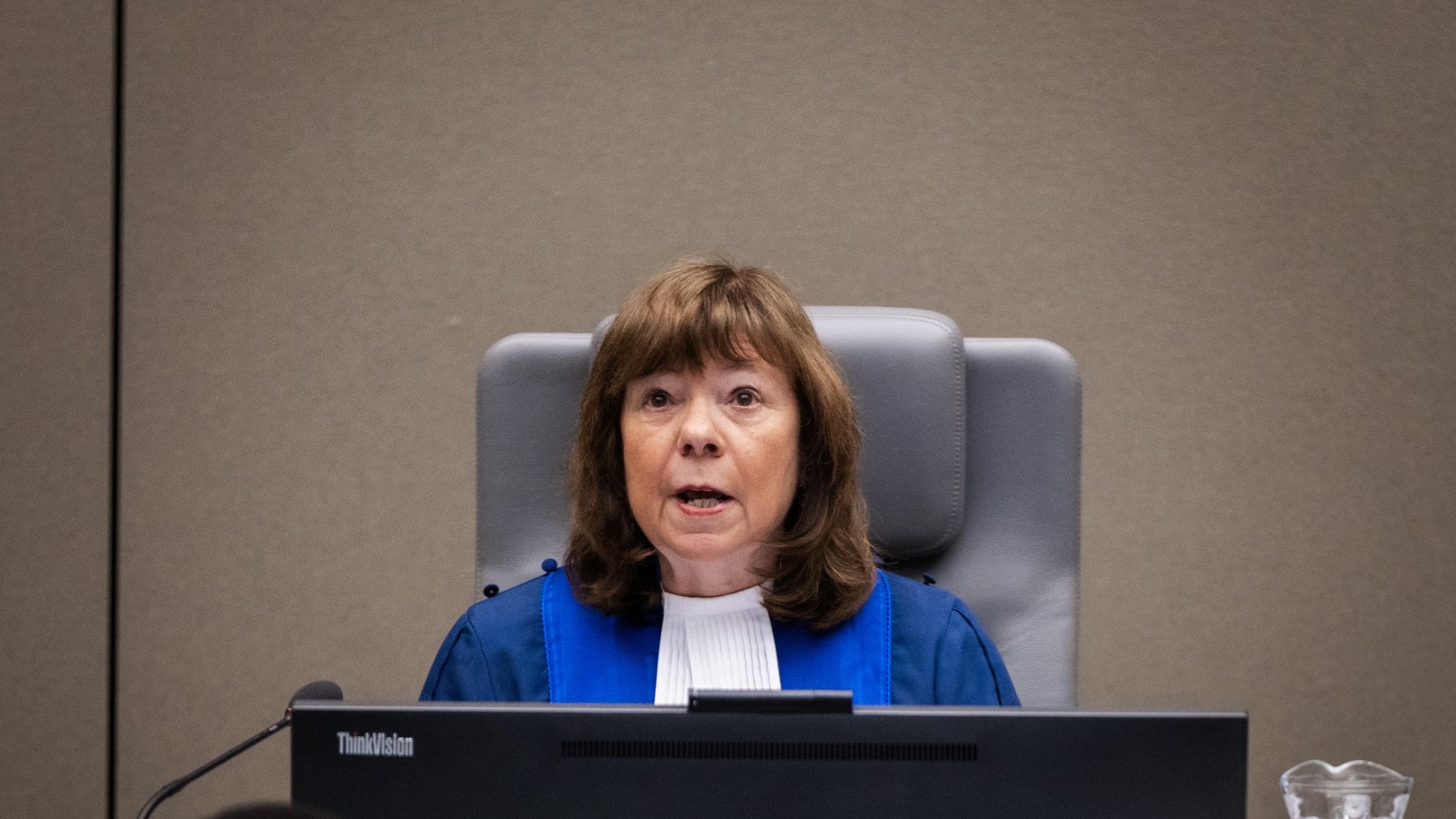
International Criminal Court (ICC) judge Kimberly Prost has called on Britain to act after two payments she sent to the UK were frozen for months under US sanctions. Prost said she had raised the transfers with British authorities and was considering asking whether the UK’s blocking statute could help her recover the money. The Canadian judge said one transfer was a wedding gift for a young couple and the other was a hotel payment. Both were sent from the Netherlands in euros to Britain in pounds. A US bank’s UK branch became involved in both transactions, she said. “In the United Kingdom, I have two instances where money was blocked and remains frozen,” Prost told journalists at the court’s headquarters in The Hague. “And this is the scenario, money sent from here in the Netherlands in euros to the United Kingdom in pounds, and I get an email which says: ‘Your money has been blocked on the basis of the order of the President of the United States, and if you want your money back, you must apply to the Office of Foreign Assets Control in the United States for a licence.’” New MEE newsletter: Jerusalem Dispatch Sign up to get the latest insights and analysis on Israel-Palestine, alongside Turkey Unpacked and other MEE newsletters In response to a request for comment, the UK foreign office did not address Prost's concerns. Instead, a source said that the UK "stands with the ICC" and is opposed to the sanctions. Her account sheds light on the personal toll of crippling US sanctions ahead of the ICC’s annual Assembly of States Parties, which opens in The Hague on 30 November. The meeting was moved from New York over concerns that sanctions and visa restrictions would limit participation. Washington sanctioned the court itself on 9 October, after targeting individual judges and prosecutors. 'The fact that [the US is] applying these measures is futile. I like to communicate that message, because we will not be intimidated' - Kimberly Prost, ICC judge The meeting comes amid criticism that member states have failed to match their public support for the court with practical protection for officials such as Prost. Washington's sanctions and threats to the ICC have been prompted by the Trump administration's opposition to the court's arrest warrant for Israel's Prime Minister Benjamin Netanyahu and the court's Afghanistan investigation which previously looked into US crimes. Washington has offered member states a six-month grace period to take measures that would address US demands to amend the court's treaty to prevent the prosecution of nationals of non-member states, like the US, Russia and Israel. Once fully in effect in April, the sanctions could stop the court from transacting in US dollars and potentially cripple its operations. Middle East Eye revealed on Monday that Guatemala had circulated a proposal urging talks with Washington on curbing the court’s ability to pursue nationals of countries outside the ICC, echoing US and Israeli demands. Amnesty International Secretary General Agnes Callamard accused Britain, Canada and other governments of seeking to appease Washington and called on them to act on their pledges to defend the court. ‘I have no regrets’ Washington sanctioned Prost in August 2025 over her role in a 2020 appeals ruling that authorised an investigation in Afghanistan, which could cover alleged crimes by US personnel. Asked about a recent decision to close that investigation and open a separate inquiry focused on the Taliban, Prost said she had questions about the decision herself and would wait to see the outcome of the appeal lodged by the Office of the Prosecutor against the decision. “I was sanctioned on the basis of my participation in the Appeals Chamber decision [to open the Afghanistan investigation], which I would make again today on the basis of the evidence that was in front of the Chamber,” she said. “I don’t know the state of the evidence today, only the prosecutor does. And I have no regrets about that decision whatsoever.” Kimberly Prost, ICC judge, speaks to journalists at the court's headquarters in The Hague on 19 November 2026 (MEE/Sondos Asem) Prost said the sanctions had left her without a credit card, made online shopping nearly impossible and stopped her from using Google Maps when she needed directions in London. She said, however, she is undeterred and that the pressure had no bearing on her work. “Independently and objectively, we look at the facts, the evidence, apply the law, and that’s the basis for our decision,” she said. “So the fact that they’re applying these measures is futile. I like to communicate that message, because we will not be intimidated.” She is one of three ICC judges who have sued the Trump administration over the sanctions. ‘Clear red lines’ Prost said British authorities had treated the frozen transfers as a decision for private industry. She disputed that the bank was obliged to block the funds and said she was considering asking about Britain’s blocking statute, a mechanism designed to counter certain foreign sanctions. Exclusive: Guatemala circulates proposal to curb ICC powers in line with US-Israeli demands Read More » Britain was among nine countries that publicly opposed the October sanctions against the court. “Now, in addition to those reactions and to the diplomacy, we need some strong measures being taken,” she said. She urged governments to use legal tools to tackle overcompliance and called for more public support from civil society and judicial associations. Prost, who helped negotiate the Rome Statute for Canada in 1998, said she supported dialogue with Washington but warned against putting the court’s jurisdiction up for negotiation. She was speaking about possible talks in general, without addressing Guatemala’s proposal specifically. “I mean, to me, that decision to include territorial jurisdiction was at the heart of the Rome Statute, and, in addition, it’s the will of those who participated in negotiations,” she said. “You can’t just change that because a group of states decide that it’s inconvenient at this point in time.” Under that principle, the court can pursue certain crimes committed on the territory of a member state regardless of the suspect’s nationality. Guatemala’s paper floated requiring the consent of the suspect’s country even when the alleged crimes took place in a member state. “One thing that cannot happen is this court cannot [be made to] stop,” Prost said.
Canadian ICC judge urges UK to release funds frozen under US sanctions
Full Article
Original Source
Read the full article at Middleeasteye →KhanList aggregates and links to publicly available news content. We do not host full articles from third-party sources. Always verify important information with original sources.