
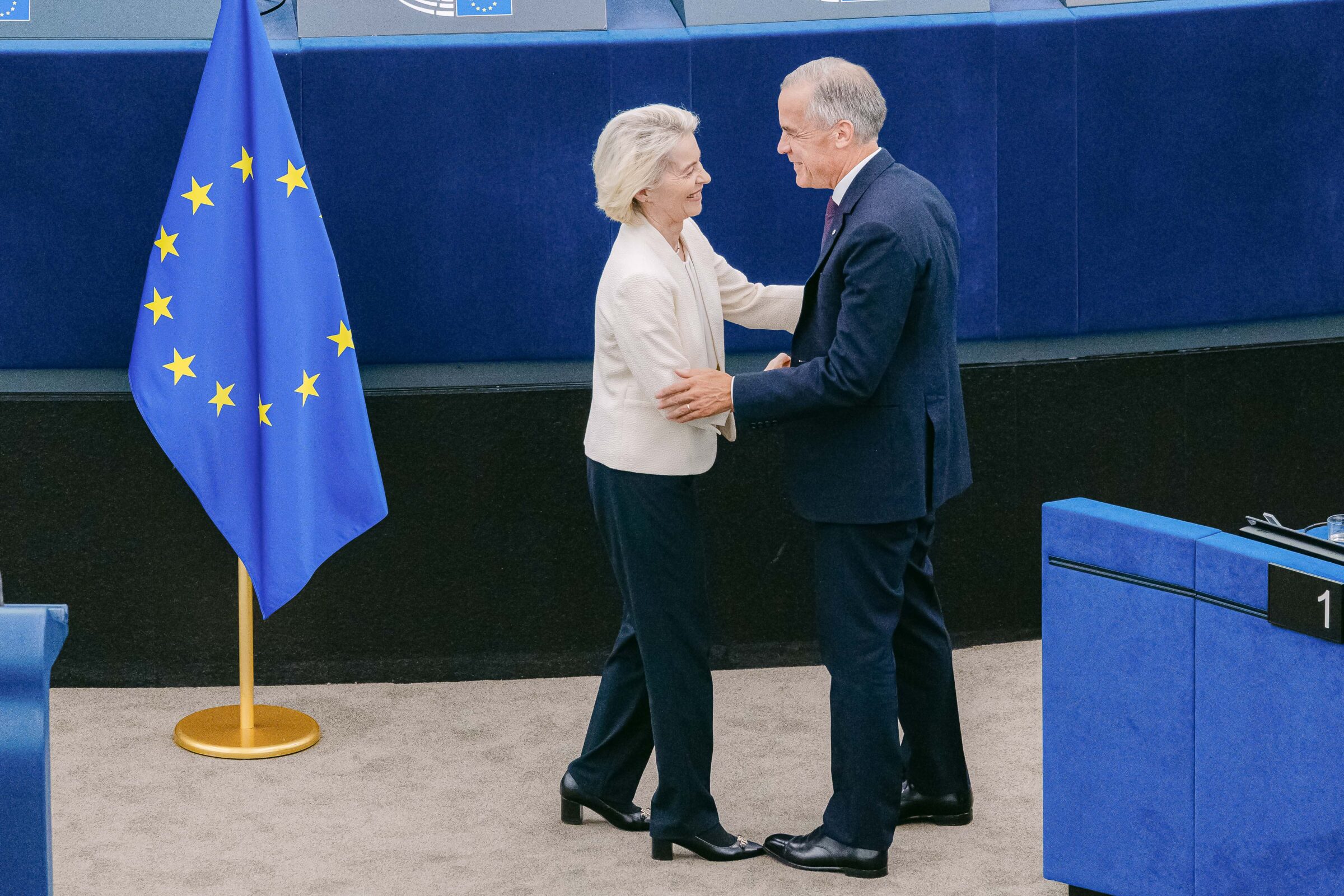
Canada is set to become the first ever ‘associate member’ of the EU, after European Commission president Ursula von der Leyen formally offered the status during her annual ‘State of the Union’ speech on Wednesday (16 September). “I would like to work with you on opening the door for Canada to be the first associate member of the EU,” von der Leyen told Canadian prime minister Mark Carney in Strasbourg. Ahead of his trip to Strasbourg, Carney told reporters in Toronto that he was seeking associate membership as part of a “unique alliance” with Brussels. He received a standing ovation from MEPs in Strasbourg on Wednesday. Although details on what precisely this could mean for EU-Canada relations – particularly on whether Canada would be expected to contribute to the EU budget – are scarce, talks would start from an advanced level. The EU-Canada trade deal, which came into force a decade ago, is already one of the bloc’s most ambitious in scope, though it is not equivalent to membership of the EU single market. And despite the trade pact, the EU currently accounts for less than six percent of Canadian goods exports. For geographical reasons, which are set out in the EU treaties, Canada cannot become a full EU member. Last year, officials from Ottawa and Brussels said that they wanted to agree a digital trade chapter that they hope to have concluded before a summit in Montreal on 29 and 30 October. They have also prioritised defence cooperation. Last year, the Carney government agreed a defence and security cooperation pact with the EU, as well as a cut price €10m deal to have access to the EU’s €800bn new defence procurement scheme. In her speech, von der Leyen said that the two sides would “integrate defence industrial bases” and “make the Arctic a flagship joint project”. “We share one ocean, one set of values, one way of seeing the world. And we will now build our shared future as well,” said the commission chief.
Canada’s Carney gets the red carpet treatment and EU ‘associate member’ offer
Full Article
Original Source
Read the full article at Euobserver →KhanList aggregates and links to publicly available news content. We do not host full articles from third-party sources. Always verify important information with original sources.