
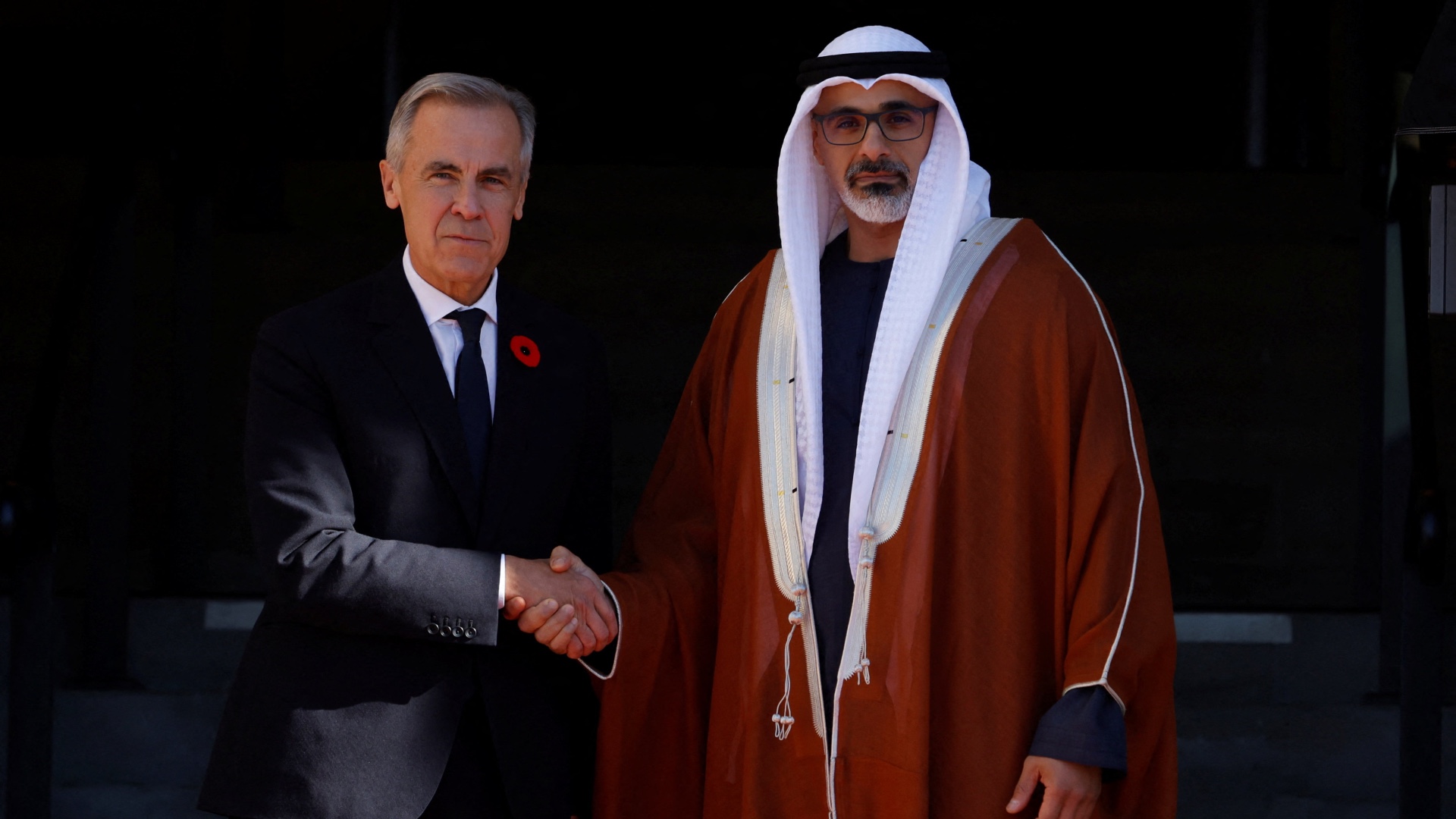
Canada and the United Arab Emirates have signed a wide-ranging free trade deal and begun talks towards an extradition treaty that would allow Abu Dhabi to request the handover of those accused of criminal conduct, Ottawa announced on Tuesday. The announcement followed the first visit by an Emirati crown prince to the Canadian capital. Khaled bin Mohamed bin Zayed Al Nahyan spent two days with Prime Minister Mark Carney this week and also signed a Memorandum of Understanding (MoU) to establish a Joint Military Committee between the two sides, which will include military education and training, joint exercises, cybersecurity and information exchanges. The free trade deal, negotiated in a record 47 days for either side, is dubbed the Canada-UAE Comprehensive Economic Partnership Agreement (Cepa), and will reduce or eliminate tariffs on over 99 percent of Canadian exports to the UAE starting next year, Carney said in a statement. "That means new markets for Canadian farmers growing pulses and canola, for manufacturers of industrial machinery and power generation equipment, for our world-class aerospace sector, and other Canadian innovators," he said. New MEE newsletter: Jerusalem Dispatch Sign up to get the latest insights and analysis on Israel-Palestine, alongside Turkey Unpacked and other MEE newsletters Cepa will double Canada-UAE two-way trade from $2.4bn to nearly $5bn over the next decade and give Canadian businesses greater access to the UAE's $500bn economy, Maninder Sidhu, Canada's minister of international trade, said on Wednesday. The UAE already pledged a $50bn investment in Canadian energy and development projects a year ago, particularly in the Arctic, after Carney visited Abu Dhabi. Carney said this week's discussions with bin Zayed "delivered significant progress" on that pledge. He did not elaborate. The Emiratis are essentially dangling those funds in front of Ottawa, said Stuart Trew, director of the Trade and Investment Research Project at the Canadian Centre for Policy Alternatives. 'It looks like Canada is willing to agree to basically anything to try and get that money' - Stuart Trew, Canadian Centre for Policy Alternatives "It looks like Canada is willing to agree to basically anything to try and get that money. That's one way to interpret, I think, what we saw this week with the UAE deals," he told Middle East Eye on Wednesday. "Because how else do you explain an extradition treaty with a paranoid surveillance state, which sees dissenters everywhere and treats them very harshly in its legal system, and signing a defence cooperation agreement with a country that is fomenting war and human rights violations across Africa?" Rights groups as well as MEE's own correspondents have reported on evidence that the UAE is financially supporting the breakaway paramilitary Rapid Support Forces (RSF) in the Sudanese civil war. The RSF is accused of carrying out a genocide. The UAE denies any involvement. The think tank Democracy for the Arab World Now, founded by the late MEE columnist Jamal Khashoggi, says that in the UAE, "citizens have no enforceable civil and political rights... [and] no tolerance for critical political opinions". 'A confusing strategy' In May 2025, not long after assuming office, Carney called the "old" Canada-US relationship "over". Tariffs launched by US President Donald Trump last year have threatened one of the world's largest bilateral trade relationships, with more than $2.5bn worth of goods and services crossing the Canada-US border each day. Canada initially announced retaliatory tariffs covering up to $109bn in US imports after Washington imposed 25 percent tariffs on most Canadian goods and 10 percent on Canadian energy in March 2025. Previously, in the bilateral trade relationship between the US and Canada, Ottawa was buying "more from American businesses than the UK, France, China and Japan combined", according to former Canadian Foreign Minister Melanie Joly. 'Shared ambitions': Canada, Saudi Arabia sign deals on defence, investment, and AI Read More » With Ottawa under pressure from post-pandemic inflation and rising fuel prices due to the US-Israeli war on Iran, Carney has moved quickly to mend and establish relationships with Europe and the Global South, in a bid to demonstrate to the Americans that Canada can rely on a plethora of global partners. "Canada is building a trading network that is the envy of the world, with preferential access to 1.5 billion consumers across 16 free trade agreements, 51 countries, and roughly two-thirds of global GDP," the prime minister's Tuesday statement said. A banker by trade and former chief of both the Bank of England and Bank of Canada, Carney has made economic relationships his primary focus, and sought to repair strained connections, even at the expense of mounting human rights concerns, largely couching it in language that suggests Canada has no choice but to move away from US reliance. "This is a confusing strategy that the Carney government has laid out," Trew told MEE. "Canada is no different than any other countries in seeking out investment, and capital has been pooling in smaller and smaller places, right? Everybody's going to the same people for money, so everybody's going to the UAE for money," he said. "But it is surprising in that it doesn't seem to make sense to us... They've identified the wrong crisis and have exaggerated the extent to which we need this much foreign funding," he added. Canada is the second largest country in the world and a member of the Group of Seven industrialised nations. It is also a member of the Nato alliance and, despite acknowledging its "middle power" status, remains one of the world's largest humanitarian aid funders. In December, Carney committed another $1.8bn to Ukraine, as it has remained embroiled in a war with Russia for the last four and a half years. That raised Canada's total contribution to Ukraine to more than $25bn. Ottawa's gross domestic product is just over $2.4 trillion, while the UAE is at $2.03 trillion, World Bank data shows. Globe-trotting for foreign investment In January, Carney became the first Canadian prime minister to ever visit Doha, after which Qatar committed to major investments in Canadian "nation-building" projects. Ottawa said the move would create a swell of new Canadian jobs and that Qatar would make "significant strategic investments" to boost Canada's economy. A joint statement from the two sides at the time committed to accelerating investment and collaboration across AI, quantum computing, aerospace, defence technologies, advanced manufacturing, agriculture, and agri-food. That stop in Doha followed a closely watched and historic visit to China. The prime minister spent four days there and spoke of a "new world order". He walked away with an agreement stipulating that Beijing lower tariffs on Canadian canola oil exports to 15 percent, while Canada takes in 49,000 Chinese electric vehicles. Canada's Carney to make historic bilateral visit to Turkey Read More » No Canadian leader had been to China in some eight years. In July, Carney became the first Canadian leader to visit Saudi Arabia in a quarter of a century. He walked away with 13 new commercial agreements and MoUs worth $700m, spanning health technology, mining, infrastructure, and defence. He called the two countries "complementary economies with shared ambitions". In September, Kuwait's Foreign Minister Sheikh Jarrah Jaber al-Ahmad al-Sabah and his Canadian counterpart, Anita Anand, signed a MoU on defence and security cooperation. In 2025, Kuwaiti Foreign Direct Investment Stock in Canada was valued at $1.35bn, spanning energy, petrochemicals, information and communications technology, and infrastructure, according to Global Affairs Canada. And just last week, Carney flew to Turkey for the first standalone bilateral visit to the Nato ally by a Canadian prime minister. Carney and Turkish President Recep Tayyip Erdogan launched a new strategic partnership, as well as the first round of negotiations for a Canada-Turkey Free Trade Agreement, a readout from the prime minister's office said. "In an increasingly complex global security environment, rising geopolitical uncertainties, and evolving humanitarian challenges, a strong and resilient Canada-Turkiye partnership is essential, providing a foundation to mitigate shared threats and capitalise on new opportunities," Carney said. Despite the prime minister's globe-trotting for foreign investment, Trew believes that there is ultimately little that can make up for a strong US-Canada trade relationship, which is vital not least because of the geographic proximity of the two allies. "If we don't sort this out with the United States, then it just undermines the entire point of making, producing automobiles in Canada, for example, which is our second biggest export in goods after energy," he said. "We barely export anything anywhere else."
Canada, UAE reach free trade deal amid plans for extradition treaty
Full Article
Original Source
Read the full article at Middleeasteye →KhanList aggregates and links to publicly available news content. We do not host full articles from third-party sources. Always verify important information with original sources.