
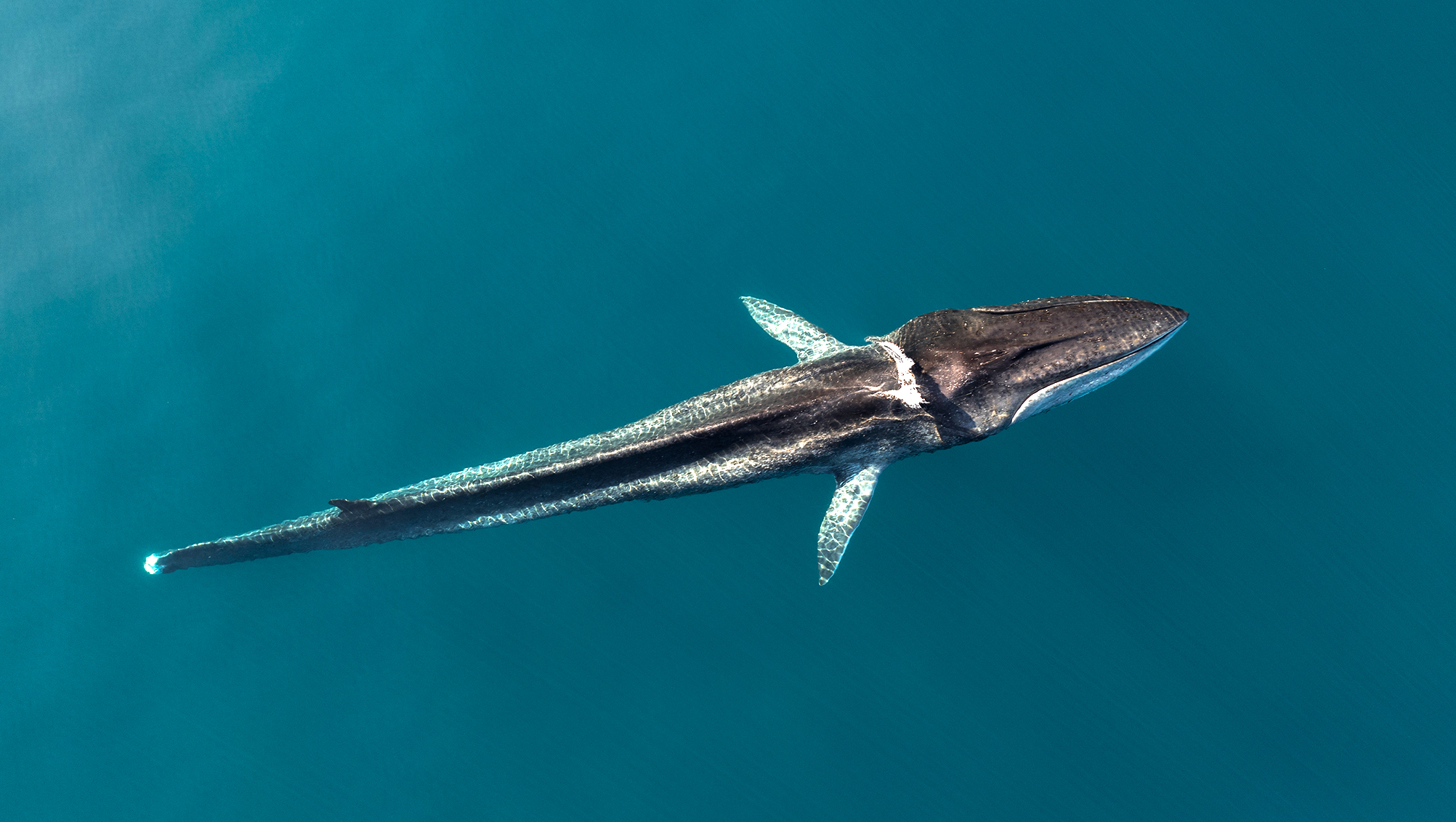
Collisions with ships are a leading anthropogenic killer of the Mediterranean’s two endangered large-bodied cetacean species, sperm and fin whales. In 2025, thousands of vessels traveled through the Mediterranean’s key whale habitats at speeds above 15 knots (28 km/h), the threshold at which vessel strikes are almost always fatal, according to an analysis by Magma Magazine and Mongabay. Using vessel and whale telemetry data, Mongabay created a visualization that illustrates how dense maritime traffic poses a continuous threat to whales in the Mediterranean. Nascent solutions include vessel speed restrictions, rerouting ship traffic to avoid whale habitats, and systems that alert ships to the presence of whales. OSTIA, Italy — Standing before the carcass of a sperm whale on a beach in Ostia, near Rome, in 2023, Lisa Stanzani had no doubts about the animal’s cause of death. The marine biologist could see clear signs that this one had been killed by a vessel’s propeller. She recognized it from the wound on its head: a colleague had sent her a video of the injured animal near the island of Ponza, some 100 kilometers (60 miles) away, a couple of weeks earlier. “This means it died slowly, in agony. As with many collision cases, death isn’t instantaneous,” Stanzani, the founder of Sotto al Mare, an Italian cetacean research and conservation association, told Mongabay during an interview in Ostia. It was a young whale with a wound about a meter (3 feet) long. “For such a deep and clean cut to penetrate the skin of a sperm whale, it must have been a propeller,” she said. Sperm whales sleep vertically, just below the surface of the water, and the wound near its eye matched the height of a vessel’s propeller. “When a cetacean sleeps, half its brain is inactive,” Stanzani said. “And sound dispersal is different underwater. It’s not easy to detect an approaching boat.” Marine biologist Lisa Stanzani, founder of Sotto al Mare, an Italian cetacean research and conservation association, in Ostia, Italy. Image by Federica Rossi for Mongabay. The vessel strike problem Though sperm whales (Physeter macrocephalus) and fin whales (Balaenoptera physalus) are typically associated with vast oceans, the Mediterranean is also home to populations of these large cetacean species. Both populations are classified as endangered by the IUCN, the global wildlife conservation authority. Globally, more than 90% of shipping routes overlap with whales’ migratory paths, and the Mediterranean is a phenomenally busy sea, hosting 15% of global shipping activity despite accounting for less than 1% of the world’s ocean surface. Against the backdrop of rising maritime congestion in the Mediterranean, conservationists fear collisions could drive the disappearance of this sea’s giants. Fin and sperm whales are slow to reach reproductive maturity, and their losses have outsized impacts on the ecosystem. Describing whales as “the biggest warriors against climate change,” Aylin Akkaya, scientific director at the Turkish NGO Marine Mammals Research Organization (DMAD), told Mongabay in a phone interview that large cetaceans are the “spoon in the soup,” feeding in the depths before excreting nutrient-rich waste at the sea’s surface. This fertilizes microscopic organisms like phytoplankton, which absorb the greenhouse gas carbon dioxide and produce about half of the world’s oxygen. In addition, during their typically long lives, whales sequester many tons of carbon in their large bodies as they feed and grow. When they die, their carcasses can sink to the seafloor, carrying that carbon with them, where it may remain locked away for centuries. The sperm whale whose carcass was seen by Lisa Stanzani in September 2023. This photo of the injured animal was taken off the Italian island of Ponza a few weeks before it died. Stanzani said the deep cut visible on the whale’s head was almost certainly made by a vessel’s propeller. Image courtesy of Oceanomare Delphis Archive. Strikes are almost always fatal to whales when the vessel is traveling above 15 knots (28 kilometers per hour), research shows. An analysis by Magma Magazine and Mongabay of data from the Global Fishing Watch (GFW) vessel-tracking platform found that in 2025 almost 2,800 unique large vessels traveled above this threshold through the Mediterranean’s key whale habitats: the Pelagos Sanctuary, spanning the waters of Italy, France and Monaco; the eastern Mediterranean’s Hellenic Trench; and the Cetacean Migration Corridor, off Spain. In these areas, about 30 ships exceeded 15 knots at any given moment. The analysis specifically tracked merchant ships above 100 gross metric tons in volume, as registered by the International Maritime Organization (IMO). Using vessel data from GFW and whale telemetry data provided by the Tethys Research Institute and the EDMAKTUB Association, Italian and Spanish marine research organizations respectively, a visualization by Mongabay illustrates how dense maritime traffic poses a continuous threat to whales in the Mediterranean. Experts stress that collisions with ships are a leading anthropogenic killer of the Mediterranean’s two endangered large-bodied cetacean species. In establishing both Mediterranean fin and sperm whales as endangered, the IUCN notes that in 2021 the populations each contained fewer than 2,500 mature individuals and long-running declines were inferred. The most comprehensive survey, by the Agreement on the Conservation of Cetaceans of the Black Sea, Mediterranean Sea and Contiguous Atlantic Area (Accobams) in 2018-2019, estimated some 2,135 fin whales and 1,416 sperm whales remain in the region. A second Accobams survey is underway this year, with further population declines considered likely. “I would say one-third of the sperm whales we have encountered carry ship strike marks,” Akkaya said. “We [recently] saw one with a propeller cut right below the dorsal [fin]. Another with the dorsal fin gone.” A 2023 study concluded that collisions kill, by a conservative estimate, an average of 16.6 Mediterranean fin whales each year, exceeding the level that would permit population recovery. The International Whaling Commission says assessing the true scale of the problem is difficult as strikes often go unnoticed on large vessels and many carcasses sink without a trace. Moreover, maritime radar and sonar systems cannot easily detect whales, so ships struggle to avoid them, while ships’ vast bows often block engine noise, meaning whales may not hear them in time to move away. “We have no idea how many die: collisions happen at high seas, animals don’t reach the shore, collisions aren’t reported,” Txema Brotons, the scientific director of Spanish marine research organization Asociación Tursiops, said in a phone interview. Tolomeo, a sperm whale in the Gulf of Naples tracked by the Italian cetacean conservation group Oceanomare Delphis. It has clear signs of a healed propeller injury across its back. Image courtesy of Oceanomare Delphis Archive. Curbing speeds in whale habitats Following a proposal by Spain, Italy, France and Monaco, the IMO designated a more than 200,000-square-kilometer (80,000-square-mile) swath of the northwestern Mediterranean a Particularly Sensitive Sea Area (PSSA) in 2023 to protect whales from ship traffic. It recommended speeds of 10-13 knots (19-24 km/h) in the multinational marine area stretching from Valencia to Genoa, which includes key cetacean habitats — the Pelagos Sanctuary, the Gulf of Lions, and the Cetacean Migration Corridor — but also intense shipping traffic. Research suggests 10 knots is the threshold for avoiding lethal strikes. But these voluntary speed recommendations appear ineffectual, Carlos Bravo Villa, an ocean policy specialist at OceanCare, an international NGO headquartered in Switzerland, told Mongabay during a phone interview. He pointed to an analysis the NGO commissioned finding more than 80% of travel in the PSSA by the six main merchant ship categories during 2023 and 2024 occurred at speeds above 10 knots. OceanCare argues reducing speeds is the best way to prevent lethal collisions in the PSSA. It has urged the Spanish government to mandate a general 10-knot limit in the Spanish Cetacean Migratory Corridor, with different rules to be determined for merchant vessels and scheduled ferries. Bravo said the shipping industry is unlikely to reduce speeds en masse unless compulsory regulation creates a “level playing field,” and described these policy recommendations as a pragmatic “first step” that will reduce fatal collisions by a degree. But curbing speeds across the PSSA would likely prove challenging. “A mandatory speed reduction in such a large area has not been implemented so far,” Renaud Corniquet, Accobams’s project officer, told Mongabay in a phone interview. “You have some examples in the U.S. but it’s very close to their territorial waters.” Andrew Birchenough, technical officer of ocean policy and pollution prevention at the IMO, said new rules could be introduced in the PSSA, for instance speed limits or routing changes that target parts of the PSSA considered high risk for vessel strikes. “It’s an ongoing process, so if member states are monitoring, evaluating, they can propose more measures,” he told Mongabay over a call. If it were up to Claudia Mondino, the captain of Eco Valencia, a ferry operated by the Italian Grimaldi Group, ships would slow down to limit harm to whales, she said. “But commercially the situation is very different,” she told Mongabay in a phone interview. “The routes still have to meet certain schedules, we have ports with very tight gates. It would mean completely overturning the whole system.” Mondino’s vessel travels at speeds of 18-20 knots (33-37 km/h) between Italy and Spain, and she encounters container and passenger vessels “that reach 25 knots,” or about 46 km/h. Mondino said she keeps watch for whales where possible: “We can recognize them when they blow. In that case we tend to reroute. But at night, or when the weather is bad, this is not possible.” Sweeping mandatory speed limits could “have a powerful economic and logistical impact,” Brotons of Asociación Tursiops said, including more container ships or potential ferry passengers opting to fly instead. A container vessel belonging to Swiss shipping company MSC in the Mediterranean’s Balearic Sea. Image by Clea Skopeliti for Mongabay. Other solutions being explored Instead, Asociación Tursiops is focused on technological solutions. These include developing dynamic risk maps that could warn vessels about cetaceans’ likely positions using satellite data to track water nutrient levels and other factors. “If you can predict where sperm whales are most likely to be at a given time, you can try to implement speed reductions in very specific locations, or warn shipping companies,” Brotons said. In some habitats, rerouting is possible. Simone Panigada, president of the Tethys Research Institute, told Mongabay that in parts of the Hellenic Trench, moving shipping slightly farther offshore could reduce collisions with the eastern Mediterranean’s sperm whales, of which only around 300 remain. As this is not an option in the busy Strait of Kythira, between mainland Greece’s Peloponnese Peninsula and western Crete, the Greek government, alongside the shipping industry and NGOs, is developing an acoustic warning system. Successfully tested during a 2019-2020 pilot, the SAvE Whales system uses hydrophones to passively listen for sperm whales’ clicks and warn ships, Ioli Christopoulou, policy director at the Green Tank, a project partner, told Mongabay over a call. Its launch is set for 2028. The technology could work well at other chokepoints like the Strait of Gibraltar, a collision hotspot, where rerouting, the most effective solution, is not possible, Christopoulou said. “One of the beauties of this project is that it’s really specific to the problem. It’s a bottleneck you can really solve,” she said. But exporting an alert system to other situations would be challenging, she said. In the rest of the Mediterranean, the future appears more uncertain. In Ostia, Stanzani considers the fate of the sea’s giants to be in policymakers’ hands. “I feel there’s little I can do,” she said. “I’ve worked with marine animals my whole life, but you never get used to seeing them suffer like this.” Banner image: Codamozza (Italian for “Cut Tail”), a fin whale often sighted by the Italian marine conservation nonprofit Tethys Research Institute in the Pelagos Sanctuary, which includes the waters of Italy, France and Monaco. She survived with just one fluke for several years, but has not been seen since 2020, after she lost her remaining fluke. Image courtesy of Filippo Armonio. This article was developed with the support of Journalismfund Europe and in collaboration with Magma Magazine. Citations: Nisi, A. C., Welch, H., Brodie, S., Leiphardt, C., Rhodes, R., Hazen, E. L., … Abrahms, B. (2024). Ship collision risk threatens whales across the world’s oceans. Science, 386(6724), 870-875. doi:10.1126/science.adp1950 Coomber, F. G., D’Incà, M., Rosso, M., Tepsich, P., Notarbartolo di Sciara, G., & Moulins, A. (2016). Description of the vessel traffic within the north Pelagos Sanctuary: Inputs for marine spatial planning and management implications within an existing international Marine Protected Area. Marine Policy, 69, 102-113. doi:10.1016/j.marpol.2016.04.013 Vanderlaan, A. S., & Taggart, C. T. (2006). Vessel collisions with whales: The probability of lethal injury based on vessel speed. Marine Mammal Science, 23(1), 144-156. doi:10.1111/j.1748-7692.2006.00098.x Sèbe, M., David, L., Dhermain, F., Gourguet, S., Madon, B., Ody, D., … Pendleton, L. (2023). Estimating the impact of ship strikes on the Mediterranean fin whale subpopulation. Ocean & Coastal Management, 237, 106485. doi:10.1016/j.ocecoaman.2023.106485 Credits Topics
Can we stop ships from killing the Mediterranean’s last great whales?
Full Article
Original Source
Read the full article at News →KhanList aggregates and links to publicly available news content. We do not host full articles from third-party sources. Always verify important information with original sources.