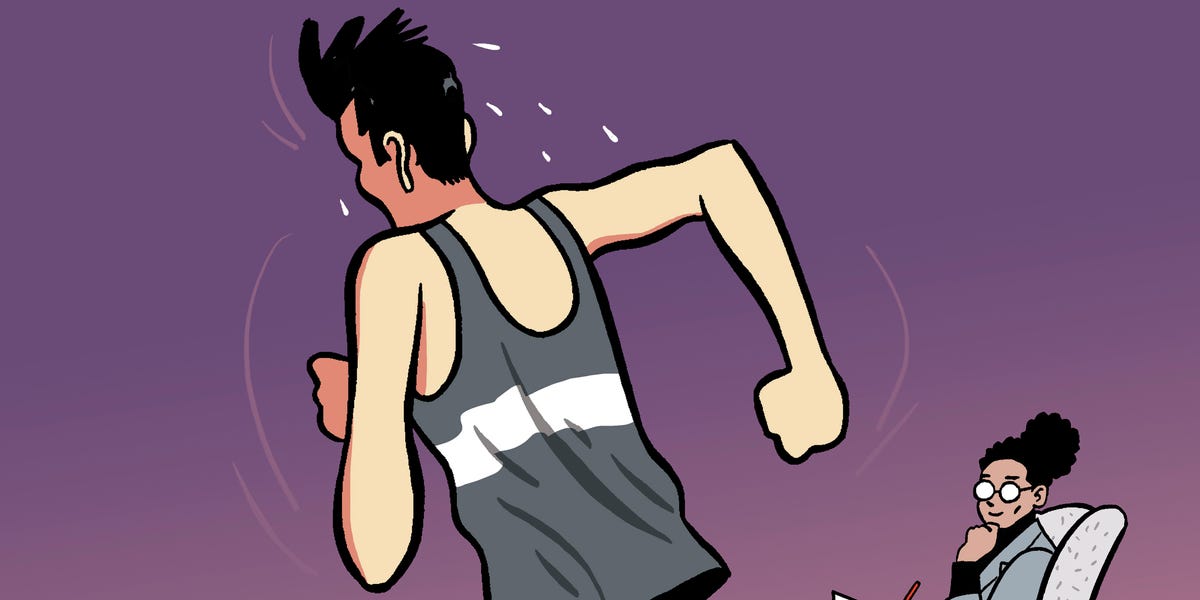
Just over a year ago, I was only a couple of minutes into Philadelphia’s 10-mile Broad Street Run when the message on a spectator’s handmade poster caught my eye: “Therapy Was Also an Option.” Several others over the next couple of miles proclaimed variations of the same message: “Therapy Would’ve Been Easier,” “Did Therapy Not Work?” and a rather inaccurate “I Told You to Go to Therapy, Not Run a Damn Marathon!”While those signs were dosed with varying levels of humor, it seems that using running to improve mental health is more popular than ever. And I’m here for it—mostly. But as someone who majored in psychology in undergrad, I also know this: Running, despite its many mental health benefits, is not a replacement for therapy.Ironically, the first thing we learned in college about running in a psychological context was its mental health benefits. Aerobic exercise can improve mood and brain function through the release of dopamine, serotonin, and other neurotransmitters that make your body feel good; it can reduce stress and help build resilience by acclimating the body to the short-term cortisol released during a run; and it can also support sleep and mindfulness, two critical contributors to mental well-being. This collection of benefits makes running a potent tool, so much so that its effects are comparable to—and according to several studies, arguably better than—some medications for mood disorders.I can personally attest to the benefits. Running has been my go-to form of catharsis for years. After my apartment flooded last summer, destroying the majority of my belongings, I headed to a local hill to work through my distress with some hard 300s. When my car broke down a couple of days later, and I learned the extent of the repairs it would need, I did a workout with some of my fastest 200s in years. But like medication and catharsis, running is a tool, not a long-term solution. Treating running as a substitute for therapy can actually be harmful.Relying on running alone as a coping mechanism can shift from a healthy habit to exercise dependence. Chasing the short-term benefits of endorphins—especially without proper rest—can lead to injury and symptoms of withdrawal. Plus, running doesn’t help with all mental health issues: In the case of compulsive exercise and eating disorders, it makes things worse.More often, we use running as an avoidance strategy to distract or escape from negative thoughts, feelings, or experiences. Distraction isn’t inherently bad and can be an effective short-term fix in certain scenarios. In college, nothing beat my 2.5-mile loop through campus to shake out my nerves the morning before an exam. It was way better than sitting around and letting my worries take over—and more productive than other avoidance strategies like doomscrolling or substance use. The obvious issue with avoidance techniques? They do nothing to address underlying problems or prevent mental woes from happening in the future. You can outrun the stress spike from that awkward interaction with a coworker, but you can’t outrun deep-rooted trauma or relationship issues. By counting on running as your only stress management, you’re preventing yourself from developing other positive coping techniques.Now, am I guilty of not practicing what I preach? Absolutely! According to Strava, I set my new PR in the 2-mile the night of a devastating breakup when I got home and ran and ran until I could hardly move. Over the next several months, I pushed my limits in training, diving into workouts more intensely than ever before.Sure, all of that running helped me cope with the tidal wave of emotions in the moment. But it wasn’t until I paired it with weekly therapy sessions that I was able to start moving forward mentally. Instead of tunneling in on myself during a run, second-guessing my choices and listing all the things I should have done differently, I talked with a professional who offered an objective, experienced perspective and helped me replace distorted thinking with strategies for a healthier path forward: letting my emotions flow, grounding myself in the present, and reconnecting with friends.Making the first step toward therapy is not easy. And though it has diminished in recent years, there’s still a stigma around mental health treatment—fear of being seen as weak, broken, even unstable. Being vulnerable and tackling issues head-on can be daunting; so is opening up to a complete stranger.But as those race signs said, therapy is still an option, one that offers boundless long-term benefits: improving communication skills, strengthening relationships, and so much more. It helps you deal with current stressors and combat future ones. It teaches resiliency and self-confidence, emotional expression, and conflict resolution. It opens opportunities to break unhealthy behavior patterns and start new ones.Running has so many fantastic benefits; replacing a qualified mental health professional is not one of them. If an ultramarathon seems like an easier solution than going to therapy, you might want to re-evaluate your coping strategies.Michael McDonough joined Popular Mechanics, Runner’s World, and Bicycling in November 2024. He loves the variety of subject matters that comes with his work—as a former contributor to Encyclopedia Britannica, he’s previously written about topics in statistics, psychology, and more. A former sprinter, he’s currently working his way up to longer distances with the encouragement of his coworkers.
Can We All Just Agree? Running Is Great for Your Mental Health, But It’s No Substitute for Actual Therapy
Full Article
Original Source
Read the full article at Runnersworld →KhanList aggregates and links to publicly available news content. We do not host full articles from third-party sources. Always verify important information with original sources.