
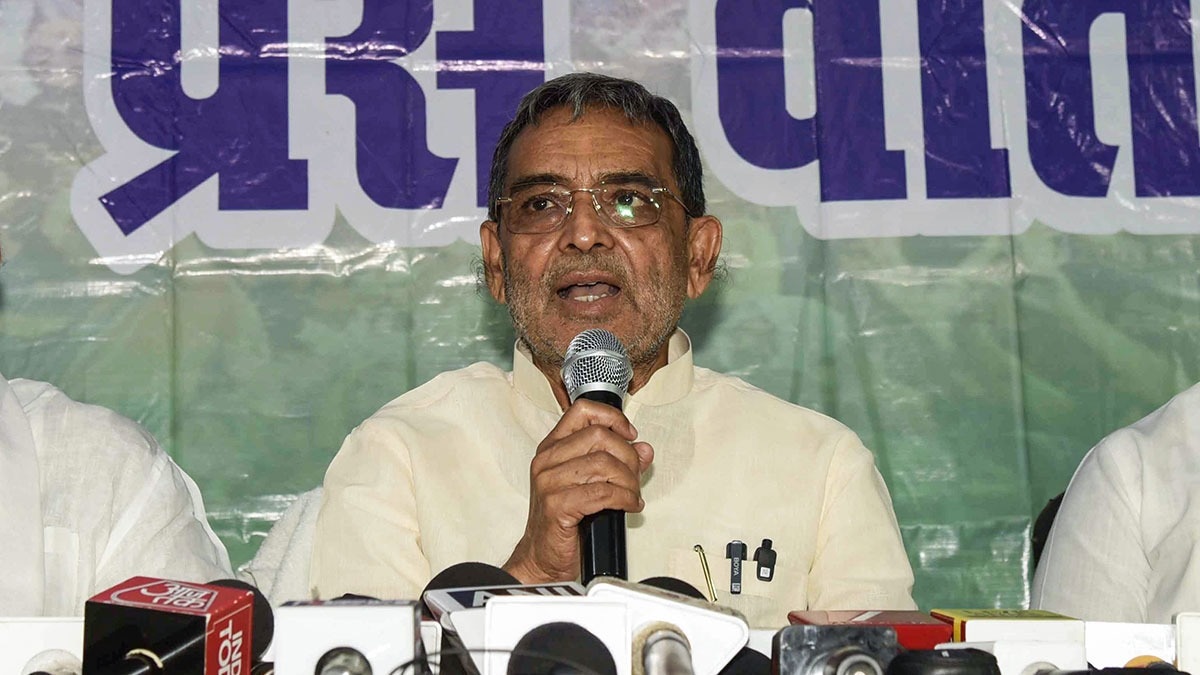
At his recent party camp, Kushwaha spoke about who would carry Nitish's legacy forward. No explicit claim of succession yet the implication was difficult to missBihar’s political landscape has been on a slow boil since August 21 when Rashtriya Lok Morcha (RLM) supremo Upendra Kushwaha spoke about former chief minister Nitish Kumar’s legacy at a three-day camp of his party in Rajgir.Nothing dramatic has happened on the surface, but something has been bubbling underneath: the question of what happens to Nitish’s political legacy now that he has moved away from the centre of active politics in the state. The contest for that inheritance has not yet begun in the open. But claims are already being staked.At the RLM camp, Kushwaha articulated a perspective that was bound to travel. He spoke about Nitish and who would carry his legacy forward. His point was not an explicit claim of succession. Yet the political implication was difficult to miss.With Nitish no longer in the chief minister’s chair, both politicians and a section of the public are beginning to ask what remains of the political space he occupied for so long. Many will stake claim. Kushwaha has not formally declared himself the heir. But it is clear that a significant constituency would like him to shoulder that responsibility. The succession question is not simply who succeeds Nitish as a politician. It is who owns the political tradition he leaves behind—particularly the socialist, backward-caste space that once allowed Nitish to stand apart from both the Rashtriya Janata Dal (RJD) and the BJP.That is where Kushwaha enters the picture. He is perhaps the closest thing Bihar has today to a potential successor to Nitish’s political grammar. Like Nitish, he comes from the socialist tradition shaped by Karpoori Thakur, Ram Manohar Lohia and Jayaprakash Narayan; like Nitish, he understands the importance of the backward-caste social coalition that made the Luv-Kush (Kurmi-Koeri) equation politically consequential; and, crucially, he has spent decades moving through the same political terrain rather than arriving as a late claimant to it.Kushwaha has been in government, built and led political organisations, negotiated alliances with both the BJP and the broader Janata family, and retained an independent political identity. His appeal, therefore, is not merely that he is a Koeri leader or a former associate of Nitish. It is that he understands the particular space Nitish occupied: socially rooted but not caste-exclusive, socialist in vocabulary but pragmatic in alliances, and capable of speaking to both the backward classes and the middle-class constituency that responded to the promise of governance. If there is a “next Nitish” to be found, Kushwaha’s claim rests on his ability to inherit not the chair but the political method that made Nitish relevant for so long.Kushwaha, however, has been careful to define legacy differently. For him, legacy is not the inheritance of a chair or the automatic transfer of political authority from one generation to another; it is the continuation of ideas, values and a political tradition. That is why his reference to Karpoori Thakur and Ram Manohar Lohia matters. He is, in effect, arguing that Nitish’s real legacy lies in the socialist politics he inherited, adapted and made electorally relevant in Bihar—and that whoever claims that legacy must demonstrate an ability to carry those ideas forward.The distinction is important because Nitish’s Janata Dal (United) has a very different answer to the succession question. Its leaders have begun projecting health minister Nishant Kumar as the future of Bihar, an entirely understandable proposition given his position as Nitish’s son and the most obvious custodian of the family’s political inheritance.But being the son of a political leader and being the inheritor of his political legacy are not necessarily the same thing. Nishant has yet to face the test that every political heir eventually must: establishing an identity, constituency and credibility of his own.In politics, lineage may provide an entry ticket; it cannot by itself guarantee acceptance. Time, political performance and the ability to connect with voters will determine whether Nishant can turn familial inheritance into an independent political mandate.The JD(U)’s response may itself reveal the anxiety beneath the surface. If Nitish’s legacy were merely a matter of succession within the JD(U), there would be little reason to worry about an outsider claiming its political vocabulary. Kushwaha’s intervention matters precisely because he is not claiming Nitish’s chair. He is claiming the political space that, after Nitish, may no longer have an obvious owner.WHAT THE LEGACY IS“Nitish’s legacy” is three things that are too often spoken of as one. The first is the governance brand: sushasan. Things like roads and schools, bicycles for schoolgirls, the argument that Bihar after 2005, when Nitish assumed chief ministerial office, was no longer condemned to the 1990s (RJD rule).The second is a social coalition—a Kurmi core, the Koeri-Kushwaha half of the Luv-Kush pairing, Extremely Backward Classes and a slice of Mahadalits—that allowed the JD(U) to occupy the political space between the BJP and RJD.The third is a political inheritance older than Nitish himself: Lohia’s assertion of the backward castes, Jayaprakash Narayan’s call for total revolution, and Karpoori Thakur’s socialism, which refused to become a single-caste enterprise.What Kushwaha is trying to pick up is not the files of the old secretariat. It is the third force: a backward-caste, socialist pole that is neither the RJD nor the BJP.Why the space looks vacantNitish is semi-retired in the only sense that matters in Patna. He is no longer chief minister. He remains JD(U) president and sits in the Rajya Sabha, but the state is now run by senior ally BJP. JD(U) has become the junior partner in an alliance it once led. That is the moment when a third force either finds a new voice or dissolves into the larger formation.Inside the party, the visible succession is familial and managerial. Nishant has a ministry and the workers’ blessing. Sanjay Jha and Vijay Kumar Choudhary keep the organisation in conversation with the BJP. That can conserve a party. It does not automatically conserve the independent socialist pole Nitish occupied when he could sit with the BJP without becoming it.THE CLAIM KUSHWAHA IS MAKINGOn paper, Kushwaha looks a more natural occupant of that space than anyone now in JD(U)’s front rank. He comes from the same Karpoori-JP-Lohia political tradition as Nitish and Lalu Prasad Yadav, not from a later generation of alliance managers. He helped build the Samata Party and JD(U); Nitish once made him leader of the Opposition in Bihar. The surname itself was political craft. He is a Koeri face in a coalition that still needs Luv-Kush if it is not to become a BJP-only social bloc.He has an independent organisation and a Rajya Sabha seat within the NDA, allowing him to use the vocabulary of socialism without taking instructions as a JD(U) office-bearer. When he talks of 65 per cent OBC reservation and an education commission, he is packaging unfinished Nitish business as programme rather than nostalgia.The contrast with the men Nitish chose to keep the party running is the heart of the argument. Sanjay Jha and Vijay Kumar Choudhary are organisational stewards, not products of that social-political constituency. They can hold the machine, talk to the BJP and manage a junior-partner JD(U). They cannot, by biography or political base, speak as the next voice of the Lohia-Karpoori stream that made the party a third force rather than a secretariat.Nishant carries the only stamp JD(U) now trusts: he is Nitish’s son. That is not a small thing in a personality-driven party. It is also not a socialist career. He does not yet have the years in the trenches, the record of building a political coalition or the plain, practised oratory that once allowed Nitish to sound like both an engineer and a movement. Bloodline can inherit a party. It does not automatically inherit a tradition.The BJP may find Kushwaha useful as Luv-Kush insurance. That makes his claim to Nitish’s legacy even more significant. If anything, Kushwaha has a stronger basis for making that claim than a politician whose only qualification is proximity to the departing leader. He comes from the same socialist political stream that shaped Nitish—the Karpoori Thakur, Ram Manohar Lohia and JP tradition—and has spent much of his political career operating within the same social and ideological constituency.He is a Koeri leader at a time when the Luv-Kush combination remains an important element of Bihar’s backward-caste politics. More importantly, he is not seeking to inherit Nitish’s office; he is seeking to inherit the political space Nitish occupied—a space that combined backward-caste assertion, socialist politics, governance and the ability to stand between the BJP and the RJD without being subsumed by either.Kushwaha has been on both sides of that political equation, has built his own organisation, contested elections independently and remained politically relevant despite repeated changes of alliance. That history gives him something more substantial than a surname or a family connection: a political biography that allows him to argue that he understands the constituency and the tradition behind Nitish’s politics.It is true that Kushwaha’s claim is not that he alone owns that inheritance. It is that, among those seeking to carry it forward, he possesses an unusually credible combination of ideological lineage, social identity, political experience and organisational independence. Whether that is enough to turn a legitimate claim into a mass political movement is another question. But the claim itself is neither artificial nor without foundation.Subscribe to India Today Magazine- EndsPublished By: Shyam BalasubramanianPublished On: Sep 3, 2026 20:25 IST
Can Upendra Kushwaha be the next Nitish Kumar of Bihar politics?
Full Article
Original Source
Read the full article at Indiatoday →KhanList aggregates and links to publicly available news content. We do not host full articles from third-party sources. Always verify important information with original sources.