
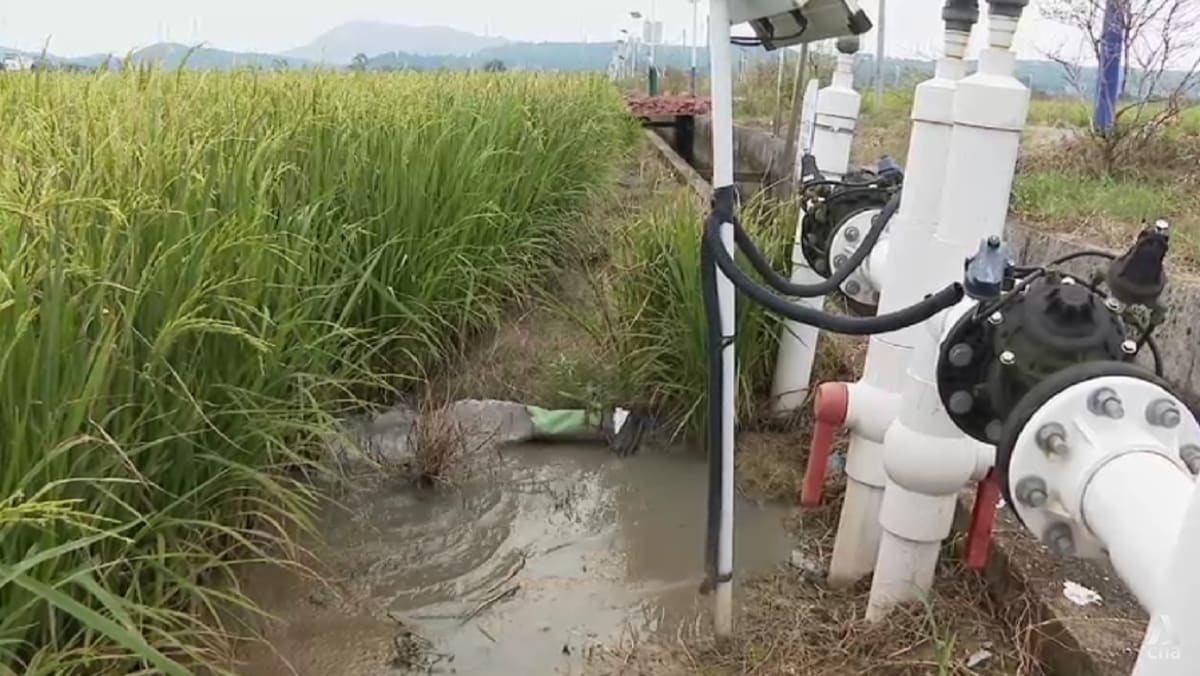
East Asia In the second of a two-part series on climate resilience, CNA looks at how farmers in China are using AI, drones and other technology to prepare for storms – and the challenges of making these tools more widely available. A smart irrigation system at a demonstration farm in Huizhou, Guangdong province. (Image: CNA) New: You can now listen to articles. This audio is generated by an AI tool. 02 Sep 2026 04:52PM HUIZHOU, China: Across 67ha of farmland in Huizhou, a city in China's Guangdong province, rice, potatoes and corn are being grown with barely a worker in sight.The project is a demonstration farm operated by Shenzhen-based agricultural technology company FN Holdings. It offers a glimpse of how technology could shape the future of agriculture.Sensors collect information from the fields, while drones inspect crops from above and artificial intelligence helps analyse the data. Even irrigation can be controlled remotely, says the farm’s project manager Liu Lizhu, demonstrating the function using an app on his phone. Liu Lizhu, project manager at a demonstration farm in Huizhou, speaking to CNA. (Image: CNA) “I can navigate to the water system and activate the right valve,” Liu told CNA.“It’s convenient as I don't have to walk 50km to reach a water pump. I can just open it right from my phone.”“With a rice paddy this large, it's actually very difficult to walk into the middle of the fields for manual inspections,” he said.“With drones, I can get aerial shots of the entire crop growth and pest and disease conditions. This greatly improves efficiency.”The system also gathers information on weather, soil conditions, pests and plant growth.Liu said using drones to spray pesticides can be dozens of times more efficient than traditional methods, with just one person needed to operate the equipment. A drone is used to monitor crops at a demonstration farm in Huizhou. (Image: CNA) PREPARING BEFORE A STORMGuangdong is frequently affected by typhoons, which can pose significant risks to farms.When Typhoon Noul made landfall in Huizhou in late July, preparations at the demonstration farm had begun two days earlier.Workers reinforced fences and equipment around the farm, while also clearing drainage routes.After the typhoon, only a small part of the 67ha farm was badly affected.Liu said the farm’s rice paddy remained standing, while large areas belonging to some surrounding farmers suffered lodging – when crops bend or fall over. He attributed the difference to a combination of planting techniques and schedules, early warnings and preventive measures.The demonstration farm also had stronger infrastructure, Liu said. Its greenhouses, for example, remained standing while some nearby structures were destroyed.While other farmers can access publicly available weather warnings, FN Holdings’ system analyses data and recommends steps they can take to prepare, he added. Liu also said technology has helped the farm increase rice yields.“Through smart management and scientific water and fertiliser management, our yields are higher than traditional agriculture for rice. We can increase yields by about 5 per cent to 10 per cent,” he said. THE COST OF SMART FARMINGFN Holdings also trains farmers in smart agriculture and farm management.The company uses tools including drones and satellite remote sensing to help assess damage after disasters.Images captured before and after an event can be compared to help farmers assess their losses.But expanding the use of such technology remains a challenge, as equipment costs can put it beyond the reach of smaller farmers.“We have found that ordinary farmers, smaller-scale farmers, have difficulty because most cannot afford the cost of such heavy hardware equipment,” said Sean Zhou, vice-president of the company's research and development centre.Zhou said operating at a larger scale could allow the costs of smart farming infrastructure to be shared.“Once centralised and scaled up, the construction of smart agriculture can address the problems of individual farmers through cost sharing.” Sean Zhou, vice-president of FN Holdings’ research and development centre, speaking to CNA. (Image: CNA) BUYING MORE TIMEAccess to technology is only part of the challenge. Farmers also need enough time to act before severe weather arrives.Researchers at the Hong Kong University of Science and Technology (HKUST) are developing technology that could provide earlier warning of severe thunderstorms.Su Hui, chair professor in HKUST's Department of Civil and Environmental Engineering, said conventional forecasting methods typically provide between 45 minutes and two hours of warning for such storms.“That's not sufficient time for people to prepare,” she said.Her team's AI model can forecast them up to four hours in advance. Su Hui, chair professor at HKUST's Department of Civil and Environmental Engineering, speaking to CNA. (Image: CNA) “This AI model is trained on satellite data, and that gives some precursor information for the storms' development. So, we can have a longer lead time.”The model uses infrared information from China's FengYun-4A geostationary weather satellite to track the development of clouds. It was trained on four years of data.Su said cloud temperatures provide clues on how storms are developing. HKUST's Su Hui demonstrates how satellite data can be used to track the development of severe thunderstorms. (Image: CNA) “The colder the clouds are, the more vertical development these clouds will have. That means they can shoot up very high in the atmosphere, (and) the storms are more intense. Using this coldness of clouds, we can predict whether there's thunderstorms in some places,” she said.The model is being tested by meteorological authorities in Hong Kong and mainland China, while the HKUST team continues to train it with new data to make it more robust.The team is also looking to incorporate other sources of information, including ground-based radar and wind observations.“We hope to make the model more and more accurate,” Su said.
Can technology give China’s farmers an edge against extreme weather?
Full Article
Original Source
Read the full article at Channelnewsasia →KhanList aggregates and links to publicly available news content. We do not host full articles from third-party sources. Always verify important information with original sources.