
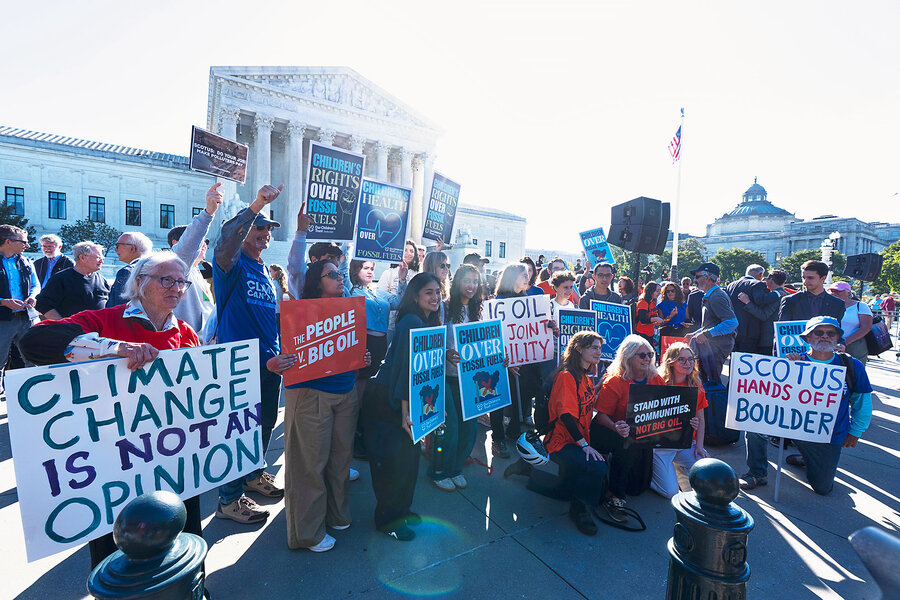
The U.S. Supreme Court heard oral arguments in a major climate change case on Monday. The case, the first of the court’s new term, concerns whether Boulder County, Colorado, can sue two fossil fuel companies in state court to reclaim damages caused by climate change.The Boulder County officials want energy companies to help pay for the county’s investments to mitigate wildfire, drought, and flood threats, especially after the 2018 Marshall fire swept through the county.The companies Suncor Energy and Exxon Mobil argue that such lawsuits must be heard in federal court and that allowing this case to proceed in state court would tie up energy companies in endless, financially ruinous lawsuits across the country. Boulder County has pushed back, arguing that nothing in federal law or the Constitution precludes the suit from proceeding, and that, because the case has not yet been fully litigated at the Colorado Supreme Court, the U.S. Supreme Court should wait to weigh in.In agreeing to hear the case, the justices had asked for briefings on whether the high court has jurisdiction to hear this case at all. But during the oral argument, the justices spent more time grilling the parties’ attorneys on the other question at issue: whether federal law blocks Boulder County from bringing its case in state court. Candace Elliott/Reuters/FileA Suncor Energy facility rises in Sherwood Park, Alberta, Aug. 21, 2019. The U.S. Supreme Court heard oral argument Oct. 4, 2026, on whether Boulder County, Colorado, can sue Suncor and Exxon Mobil in state court for climate change damages. Justice Brett Kavanaugh said that “a wall of precedent” establishes that lawsuits concerning interstate air and water pollution are matters of federal law. To rule otherwise, he added, would see the court “be rightly accused of misleading Congress for decades” as to the scope of federal laws like the Clean Air Act and the Clean Water Act.And yet, Justice Sonia Sotomayor pointed out that the high court has allowed similar suits to proceed in state courts. In a 1987 decision, the court held that “nothing in [the Clean Water Act] prevents a court sitting in an affected State from hearing a common law nuisance suit.” Other justices voiced different concerns. Justice Ketanji Brown Jackson asked whether the case had reached the high court too early. The Colorado Supreme Court has not decided any other claims the companies have made in state court relating to federal law, she noted.“Why shouldn’t we wait [to] hear all of these claims once the state courts are done?” she asked.The lawyer for Suncor and Exxon Mobil, Kannon Shanmugam, replied that some three dozen similar lawsuits have been filed around the country, and that no clear ruling on their legality has been reached. “Given the extraordinary magnitude of these cases, ... now is really the time to answer these questions,” he said.Some justices raised concerns about the potential national – and international – implications of allowing the Boulder County lawsuit to proceed.Chief Justice John Roberts said if that were to happen, “the next day ... there will be at least 50” similar lawsuits filed in state courts around the country. “How do you think that will work out on the ground?” he asked. “As a practical matter ... what should happen?”Another complication in this case is that Justice Samuel Alito has recused himself. He did not participate in the argument and will not cast a vote in the case, which could result in a 4-4 decision. A tie would affirm the Colorado Supreme Court ruling but would not hold any precedential force. In that scenario, energy companies and the localities seeking to recoup funds for climate change damages would remain in legal limbo. ALREADY A SUBSCRIBER? LoginReal news can be honest, hopeful, credible, constructive.The Christian Science Monitor was founded in 1908 to lift the standard of journalism and uplift humanity. We aim to “speak the truth in love.” Our goal is not to tell you what to think, but to give you the essential knowledge and understanding to come to your own intelligent conclusions. Join us in this mission by subscribing.
Can states make Big Oil pay for climate change? Supreme Court weighs a precedent.
Full Article
Original Source
Read the full article at Csmonitor →KhanList aggregates and links to publicly available news content. We do not host full articles from third-party sources. Always verify important information with original sources.