
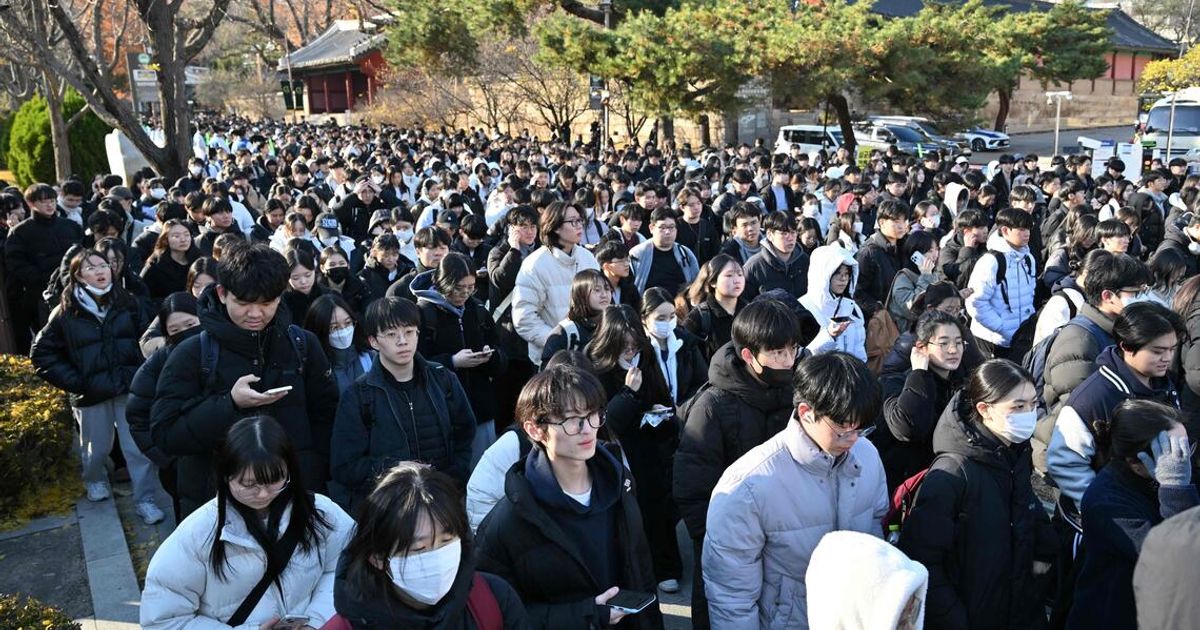
SEOUL – Smart glasses and miniature cameras discovered during South Korea’s college entrance exam have exposed a growing challenge for the country’s high-stakes testing system: How to prevent AI-assisted cheating while ensuring that the exam remains relevant in an age when artificial intelligence can generate answers in seconds.President Lee Jae Myung on Nov 20 ordered a sweeping review of the national examination system, calling on the authorities to reconsider existing testing methods “from A to Z” after five test-takers were caught in cheating cases involving smart devices during the previous day’s College Scholastic Ability Test, or Suneung.The incidents have reignited a broader debate over whether South Korea should move beyond its decades-old, multiple-choice-heavy examination system towards assessments that emphasise critical thinking and reasoning.But replacing multiple-choice questions with essays or other forms of evaluation presents its own challenges, particularly in a country where the Suneung plays a decisive role in university admissions and public confidence in grading fairness remains paramount.Beyond multiple-choice testingCalls to reform the Suneung predate the latest cheating cases, reflecting concerns that the exam places too much emphasis on finding correct answers rather than developing the skills needed in an AI-driven society.In December 2025, Seoul education chief Jeong Geun-sik proposed introducing essay-based testing by 2033 and ultimately abolishing the Suneung by 2040.“What we need for our children who will live in the age of AI is not the ability to simply seek answers, but to ask questions and think critically and creatively,” he told The Korea Herald in an interview.The National Education Commission has also considered expanding essay-based assessments as part of its 2028 to 2037 national education strategy. However, disagreements over grading fairness and the burden on schools delayed the release of its reform plans in October.Lee Hye-jung, director of the Institute for Education and Innovation, argued that the latest cheating cases have exposed deeper weaknesses in South Korea’s reliance on standardised testing.“The multiple-choice system has survived because of the belief that it ensures reliable and fair grading, regardless of who evaluates the answers,” she told The Korea Herald.“But the latest AI cheating scandal has shattered that myth. I believe the era of multiple-choice Suneung exams has come to an end.”She said the national curriculum already emphasises competencies needed in an AI-driven society, but the examination system has failed to keep pace.“We don’t need to change the curriculum itself. We need to change how students are taught and evaluated,” she said.However, she cautioned that simply replacing multiple-choice questions with written responses would achieve little if students were still expected to reproduce pre-determined answers.Instead, she advocated a broader assessment system combining different methods, pointing to the International Baccalaureate, which uses written examinations, oral presentations and longer-term projects.Such an approach, she argued, could reduce the dependence on a single high-stakes test while better assessing students’ reasoning and creativity.Can reform preserve fairness?Other experts highlighted the limits of relying on question formats alone to prevent cheating, particularly in assessments conducted outside tightly supervised examination rooms.“Simply switching from multiple-choice to essay-based or oral examinations will not solve AI-assisted cheating,” said Moon Hyung-nam, a professor at Sookmyung Women’s University and president of the Korea AI Education Association.He noted that generative AI can produce sophisticated essays and explanations, making it difficult for evaluators to determine whether students have completed assignments independently.He cited a 2024 University of Reading study in which 94% of AI-generated answers submitted to non-invigilated undergraduate assessments went undetected by graders.Moon also argued that examination security must remain a priority, and called for clearer restrictions on electronic devices, consistent pre-exam checks and stronger exam supervision.Ahead of the Nov 19 Suneung, the authorities tightened security measures, including restrictions on electronic devices, checks for concealed smartphones and enhanced Wi-Fi monitoring around testing centres.The exam concluded without major disruptions, but the discovery of sophisticated cheating devices underscored the difficulty of keeping pace with rapidly evolving technology.Beyond security, the transition to essay-based testing raises another fundamental question: Can subjective assessments deliver the consistency expected of a nationwide examination taken by hundreds of thousands of students?In a deliberative exercise involving 180 citizens, 55.5% supported introducing essay-based questions, while 41.7% opposed the proposal. Grading fairness was the most frequently cited concern, identified by 48.3% of participants.Lee Hye-jung argued that carefully designed grading criteria and multiple levels of assessment could address such concerns, citing international examination systems that rely on standardised evaluation procedures.“What matters is establishing a system that produces consistent, reproducible results within an acceptable margin of variation,” she said.Despite the growing calls for change, the education authorities remain cautious about the pace of reform.“We are considering ways to gradually expand written-response and essay-based assessments in schools over a considerable period, allowing the public education system sufficient time to prepare,” National Education Commission chairman Cha Jeong-in said.He stressed that such a transition could not be accomplished within one or two years. THE KOREA HERALD/ASIA NEWS NETWORK
Can South Korea’s high-stakes Suneung college entrance exam survive the AI era?
Full Article
Original Source
Read the full article at Straitstimes →KhanList aggregates and links to publicly available news content. We do not host full articles from third-party sources. Always verify important information with original sources.