
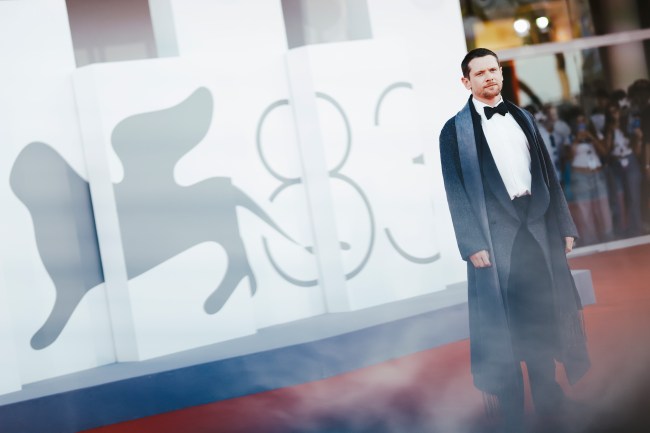
With the opening night of the 2026 Venice Film Festival comes a new wave of Oscar prognostication, starting with festival opener “Ink” from Academy Award-winning director Danny Boyle. Though the idea of a film about Rupert Murdoch’s media empire invokes the idea of Emmys juggernaut “Succession,” the Studiocanal production (set to be distributed by Netflix in the United States) is a late ’60s, early ’70s period piece about when the Australian mogul bought the laughably failing tabloid The Sun, and placed The Daily Mirror alum Larry Lamb as its editor. While recent Oscar nominee Pearce plays Murdoch, the main focus of the film is “28 Years Later” star Jack O’Connell as Lamb, recruiting characters played by Claire Foy, Brian Gleeson, and more to become his loyal staffers. One enters the film with the idea that Pearce will be the looming figure, akin to the Shakespearean caricature of Murdoch that Brian Cox played on the aforementioned HBO series, but his Murdoch is more buttoned up and stuffy — a juxtaposition of news entertainment he’s associated with. During the film’s festival press conference, the Australian actor even said that Murdoch’s daughter Elizabeth told him, “Dad’s very happy that you’re playing him.” Meanwhile, Boyle compares O’Connell as Lamb to one of the great villains in cinema history. “He’s got that ability to take you into dark places with him like Pacino in ‘Godfather II.’ He’ll hate me saying that. But for me, that was the inspiration,” said the director, creating a throughline between his lead’s performance and the one that earned Pacino two Oscar nominations. “And I said to the production designers. I said ‘Try and make his office feel a bit like “The Godfather.”’ And if you go back and see the film, I hope you will think ‘The Godfather.’” O’Connell’s take on “Ink” and the arc of his character Lamb is that “it was about the cost of what happens then, when you do forfeit those morals and those standards, somebody’s privacy in order to sell a product,” he said. “The excavation of that on a person. I think it catches up with him.” In terms of Oscar chances, the actors in particular are caught in the in between where it is more a showcase for O’Connell, a fellow “Skins” alum alongside Oscar nominee Dev Patel and Oscar winner Daniel Kaluuya, however the Best Actor race this year is already shaping up to be a clash of the titans between “Project Hail Mary” star Ryan Gosling, “The Odyssey” star Matt Damon, and “Digger” star Tom Cruise — all of whom have not yet won an Academy Award for their acting. Meanwhile, Pearce delivers another great performance, a Best Supporting Actor nomination for him would more be driven by the afterglow of his award-winning turn in “The Brutalist.” Claire Foy similarly is a value add once again, but if she was not able to garner Oscar attention for her showstopper performances in “First Man,” “Women Talking,” and “All of Us Strangers,” then she will most likely be overlooked here for a part that could’ve benefitted from being slightly more fleshed out. Director Danny Boyle and Jack O’Connell as Lamb on the set of ‘Ink’Nick Wall The directing is a return to form for Boyle in a way the horror-averse Academy can appreciate more so than his acclaimed “28 Years Later.” He and cinematographer Alwin H. Küchler are trying every shot in the book to bring up the energy and, at times, the thrills. “We have this kind of poor man’s bullet time,” joked the filmmaker during the press conference. “We don’t have as much money as ‘The Matrix,’ so we do have a poor man’s version of that a couple of times.” He added, “We had a lot of fun with the 360 camera and it’s used very violently.” Boyle says it was Studiocanal that really allowed the film, an adaptation of the 2017 play “Ink,” written by James Graham, who also serves as the film’s screenwriter. “Because it’s a low budget film, you pick the risky option and you go for the risk,” he said of his filmmaking approach. “And I love the violent effect it has on the audience as a change from the rest of the world that’s portrayed in the story.” Despite the budget, the film never feels too much like a stage production, which is partially a credit to the skill with which Graham adapts himself. The “Ink” take on Fleet Street is expansive and immersive, using all types of filmmaking techniques to keep the audience engaged, including sounds from Oscar-winning sound mixer Simon Hayes and Oscar-winning sound editor Johnnie Burn. “They’re not just serving up clean dialogue for you. They’re adding layers to the film,” said Boyle. “We have Daniel Pemberton who did the music. And it’s sort of invisible music a lot of the time. You’re not really aware of it,” he added. “[But] as we began to develop the epilogue, [he] came up with this extraordinary piece for the epilogue, which is a really huge contribution to the film.” Boyle also gave a shoutout to editor Fin Oates, who pieced all these disparate elements together. “I haven’t worked with a female editor for a long time. That was really interesting and a really important perspective on the story,” he said. Ultimately, “Ink” is likely not an automatic Best Picture nominee out the gate, but is very much entertaining enough to stay in the conversation, especially with how it’s served as the kickoff to the fall festival season. Better to allow Boyle to have the last words on why audiences, especially members of the Academy, should give “Ink” a chance: “The film, I hope, is hugely entertaining about quite a controversial subject who lots of people some, lots of people don’t. And it’s a celebration of that division in a way, which is one of the truths of the piece, I think, is that not everybody loves it, but some people do.”
Can Rupert Murdoch Origin Story ‘Ink’ Push Danny Boyle, Jack O’Connell, Guy Pearce, and Netflix Into the Oscar Race?
Full Article
Original Source
Read the full article at Indiewire →KhanList aggregates and links to publicly available news content. We do not host full articles from third-party sources. Always verify important information with original sources.