
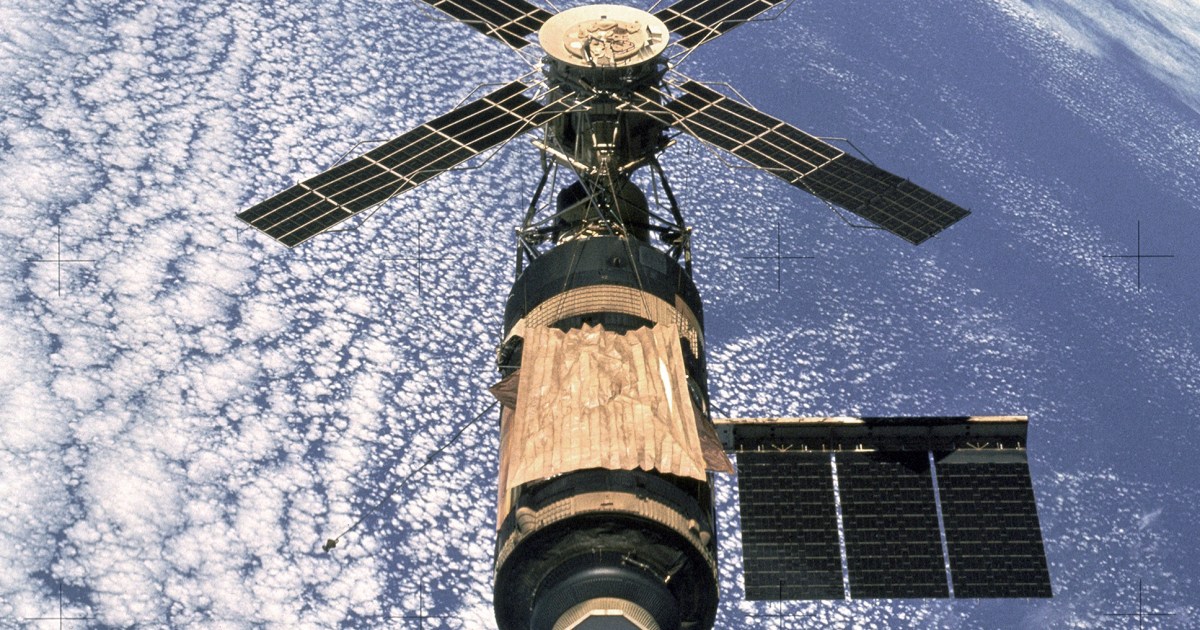
A sunshade drapes across Skylab’s hull, replacing the station’s original micrometeoroid shield that tore away during launch. The repair stands as one of the first examples of in-space servicing. Credit: NASA There are likely fewer satellites in Earth orbit right now than there will be at any point for the rest of your life. It’s a sobering thought. The threats from our ever-more-crowded skies are well documented: light pollution from megaconstellations, aluminum oxide accumulating in the upper atmosphere as satellites burn up on reentry, and the possibility of a chain reaction of collisions and debris that could render entire orbital regions unusable for generations — to name a few. So what can we do? One possible solution lies in the emerging satellite-servicing industry — also known as in-space servicing, assembly, and manufacturing (ISAM). Satellites can be refueled, repaired, and repositioned — extending their operational lives and reducing the need to launch replacements. The technology has been demonstrated and the industry is expanding. But unlocking the potential of this technology will also require a sea change in how space is regulated, experts say. “Servicing needs to go hand in hand with regulation to be effective,” says Jonas Bahlmann, a doctoral researcher at the University of Luxembourg who studies space sustainability. Some regulations may need to be eased or eliminated, and others created in order to incentivize the industry to tackle the problem. If done right, new regulations could create a win-win — slowing the crowding in Earth orbit while boosting the bottom line of the launch providers, but it’s a problem without easy answers. ISAM’s third wave The first spacecraft to undergo repair in space was NASA’s Skylab space station, launched on May 14, 1973. During launch, the station lost its micrometeoroid shield. Designed to protect the spacecraft from impacts, the shield also shaded Skylab from the Sun. Without the shield, the craft wasn’t habitable for human occupants as internal temperatures could become unbearably high. On May 25, 1973, NASA sent up the station’s first crew with newly designed hardware to replace the shield. Across a series of spacewalks, the crew installed the nylon and Mylar parasol, successfully completing the first on-orbit repair. Brian Weeden, who directs commercial space research at the Aerospace Corporation’s Center for Space Policy and Strategy, says over the decades since, ISAM has gone through three distinct waves. Milestones in on-orbit servicing stretch from the Solar Maximum Mission repair in 1984 to the European Space Agency’s planned 2029 ClearSpace-1 mission in this timeline. The graphic traces four-plus decades of servicing missions — including NASA’s long-running Hubble repairs, Orbital Express, and the current wave of commercial vehicles — building toward the sustained industry researchers now forecast. Credit: Astronomy: Roen Kelly after Levchenko et al. 2026, npj Space Exploration (timeline); images left to right: NASA, Shoemaker et al. 2003/DARPA, NASA, ESA Standard License The first wave rode the space shuttle. Astronauts on a shuttle mission serviced the Solar Maximum Mission in 1984 and, across five shuttle missions between 1993 and 2009, repaired and upgraded the Hubble Space Telescope. Initially, Weeden tells Astronomy, the shuttle was seen “as a vehicle you could reuse; you could do servicing of satellites and [these] kinds of things.” Ultimately “that never really panned out,” he concludes. Each shuttle launch cost $1 billion, two orbiters were lost in the Challenger and Columbia disasters, and the entire program was eventually retired in 2011. The second wave, which began in the mid-2000s, swapped astronauts for robots. DARPA’s Orbital Express mission showed spacecraft could service each other autonomously. In 2007, the mission’s servicing satellite ASTRO transferred hydrazine fuel and installed a battery for its counterpart satellite NEXTSat while the two were in low-Earth orbit (LEO). Several other experiments followed, like NASA’s Robotic Refueling Missions on the International Space Station (ISS), which demonstrated refueling of satellites not designed for servicing and advanced cryogenic fuel storage across its three phases beginning in 2011. Still, these second-wave missions were more technology demonstrations than a business model. “But then about 10 years ago, you started to see this … third wave of real interest,” Weeden says. These new missions draw on three basic servicing tasks — refueling a satellite, repositioning its orbit, and repairing or upgrading its hardware. Virginia-based aerospace and defense contractor Northrop Grumman became the first commercial firm to service a satellite when its Mission Extension Vehicle-1 (MEV-1) launched in 2019 to extend the life of an aging communications satellite in geosynchronous Earth orbit (GEO). Rather than transferring propellant, MEV-1 docked directly to the satellite and became its new thruster. MEV-2 followed, docking in 2021 with a similar communications satellite. In March 2021, Astroscale — a satellite-servicing company headquartered in Tokyo — launched ELSA-d, a mission aimed in the other direction: moving a spacecraft lower to speed its reentry for debris removal. ELSA-d demonstrated that a robotic spacecraft could capture an object in orbit, the core capability any debris-removal service depends on. The mission was aborted early due to thruster issues before it could attempt to capture an uncontrolled, tumbling object. That same year, Orbit Fab, a satellite-refueling company based in Lafayette, Colorado, launched Tanker-001 Tenzing: a technology demonstration that they call the first commercial fuel depot in orbit. Tenzing is a small, 77-pound (35 kilograms), microwave-sized satellite that houses a full tank of storable high-test peroxide fuel and Orbit Fab’s proprietary refueling interface, which is known as the Rapidly Attachable Fluid Transfer Interface (RAFTI). Tenzing has not been used to refuel any satellites, but is one step on Orbit Fab’s journey to make in-orbit refueling routine. The company is targeting 2026 for its first refueling missions and envisions an architecture where shuttles deliver fuel from depots like Tenzing to customers in orbit. In September 2025, NASA contracted Katalyst Space Technologies, a small robotic-servicing company based in Flagstaff, Arizona, to send its LINK spacecraft to rendezvous with the aging Neil Gehrels Swift Observatory and reposition the X-ray telescope into a higher, safer orbit. The mission launched in July 2026. Unfortunately, the craft experienced control issues after launch, and on Aug. 19, NASA announced the mission would not attempt to capture Swift. Perhaps the most capable example of a third wave ISAM spacecraft is Northrop Grumman’s Mission Robotic Vehicle (MRV). Launched on July 21 of this year, the spacecraft is billed as a next-generation on-orbit servicing vehicle. It features robotic arms, developed with DARPA funding, that can inspect a malfunctioning satellite, swap components, and install upgrades. It also carries three Mission Extension Pods (MEP) that it can attach to satellites as cheaper alternatives to a full MEV. Once the first three MEPs are deployed, replacements will launch and rendezvous with MRV. A built-in standardized refueling port will ensure MRV can sustain its mission for at least a decade. The spacecraft will arrive in geosynchronous orbit in 2027 to perform its first demonstrations. Unlike the two waves of on-orbit servicing before it, Weeden says this one hasn’t lost steam. Where earlier eras produced isolated demonstrations, this wave has laid the foundation for an industry that may soon see companies competing and selling ISAM services. A 2026 study led by Igor Levchenko of the University of Milano-Bicocca in Italy and published in the journal npj Space Exploration agrees. They project ISAM turning into a sustained economic sector by 2030. The study, however, highlights a gap in the industry. So far, projects have been aimed at servicing large, expensive satellites in geosynchronous orbit whose value justifies the cost. But the region with the most pressing concerns about debris, overcrowding, and atmospheric pollution is low Earth orbit — the domain of small, cheap satellites like SpaceX’s Starlink. SpaceX has handled its debris problem without much need for ISAM. Only two of the roughly 12,000 launched Starlink satellites have broken apart in orbit, each producing mere tens of tracked debris objects. That debris, says Weeden, will “come down within 20 years.” SpaceX designs Starlink satellites for a five-year lifespan and places them in orbits that decay naturally within five years. This is done in part to comply with a Federal Communications Commission (FCC) rule that mandates operators to deorbit satellites within five years of the end of their mission — a rule intended to keep Earth orbit free of debris. But this same replacement cycle also means burning up satellites every few years, putting more aluminum oxide into the atmosphere. Some forms of satellite servicing in LEO are well within current technological capabilities. But right now, there’s little incentive. Launching a new Starlink satellite is cheaper than servicing an old one, and no regulations are pushing launch providers to do otherwise. A technician tests the Northrop Grumman Mission Robotic Vehicle’s robotic arms ahead of the spacecraft’s launch. Developed under DARPA’s Robotic Servicing of Geosynchronous Satellites program, the arms are designed to inspect, repair, and refuel satellites in orbit, with the first servicing demonstrations expected in 2027. Credit: U.S. Navy photo by Sarah Peterson, Public Domain The regulatory environment What’s needed is a change in the rules — but that’s easier said than done. The U.S. accounts for over half of all annual rocket launches, giving U.S. regulators substantial influence over LEO. Yet U.S. regulations have lagged behind a rapidly growing industry, say analysts. U.S. commercial space activity runs through three federal agencies: the Federal Aviation Administration (FAA) licenses launches, the FCC licenses the radio spectrum satellites use, and the National Oceanic and Atmospheric Administration (NOAA) licenses satellites that gather data about Earth from space. That framework dates to the 1980s, built around the industry as it existed then. Newly emerging sectors have shaken things up. “Satellite servicing [doesn’t] easily fit into those existing three buckets,” Weeden says. There is no agency explicitly charged with authorizing servicing missions. Lawmakers have been working to update the framework for decades, but progress has been slow. Weeden calls it a wicked problem, a term from public-policy theory for issues with no fixed win condition. “It’s complex. It’s never-ending,” he says. If left as-is, Weeden warns, the regulatory ambiguity could scare off investors. Made too restrictive, it could delay missions or push companies to relocate. While U.S. regulations are stalled in the 20th century, other spacefaring nations have taken steps forward. The U.K., Japan, New Zealand, and France have built or are currently building licensing frameworks for servicing missions. If the U.S. were to follow suit and create regulatory clarity for commercial space activity, those new rules could be leveraged toward sustainability efforts — something that’s already happening in Europe. The European Space Agency (ESA) is pushing for an explicit sustainability policy goal — the Zero Debris Approach, which aims to limit new debris in Earth and lunar orbit by 2030. As a step toward that, ESA has approved Europe’s first debris-removal mission, ClearSpace-1, which is scheduled for a 2029 launch to capture and deorbit a defunct Earth-observation satellite. But missions like ClearSpace-1 on their own aren’t enough. While deorbiting space junk eases the crowding in LEO, it does so at the atmosphere’s expense. To address the full suite of problems, sustainability experts argue new regulations will have to incentivize an entirely new way of doing business in space. A servicer spacecraft closes in on a defunct rocket component in low Earth orbit in this illustration of the ClearSpace-1 mission. Backed by ESA, the mission is planned to demonstrate the first active removal of orbital debris using a robotic capture mechanism. Credit: ClearSpace SA, ESA Standard License Circle of life In space policy and industry circles, people speak of a circular space economy — a concept that reframes spacecraft’s linear life-cycle. “In circular-economy terms,” Bahlmann says, “we … speak of narrowing, slowing, and closing resource loops.” Design satellites to require fewer resources, keep them in service longer, and recover the materials from retired hardware. The circular space economy is not possible without regulatory reform, Bahlmann says. In his view, outdated regulations, like the FCC’s five-year deorbit rule, reinforce the linear model. Bahlmann thinks new regulations should incentivize companies for building satellites with standardized interfaces and modular components that make future servicing possible in the first place rather than restricting them or perpetuating the build, use, dispose status-quo. According to Bahlmann, this also requires clearer international rules covering who can authorize a mission, who’s liable if something goes wrong, who owns a piece of hardware once it’s dead, and who’s allowed to touch it. Without answers to those questions, Bahlmann says, “it will be difficult to develop a circular space economy if technically serviceable hardware cannot legally be touched.” A 2025 study published in Journal of Spacecraft and Rockets found, using game theory, that removing dangerous debris already saves operators more in avoided collision risk and tracking costs than the cleanup itself costs. The problem is that remediators bear the entire cost while operators keep the savings. The study proposes a regulatory fix — a third-party body collects fees from the operators who benefit and pays out to the companies doing the cleanup — win-win. Another possibility is implementing a so-called international “orbital-use fee.” In a 2020 study published in the Proceedings of the National Academy of Sciences, economists modeled what happens if operators paid an annual fee for every satellite they keep in orbit. Each satellite poses a threat to other satellites through the potential cost of a collision — the more satellites launched, the higher that collective cost climbs. The orbital-use fee calculates the dollar value of that risk and charges it back to the operator each year, similar to a carbon tax. This lowers collision risk for everyone. And, the researchers found it could more than quadruple the industry’s long-run value, from around $600 billion to $3 trillion. Another win-win. These kinds of incentives could also open the door to entirely new ISAM markets. One such example comes from Levchenko’s team. They propose something they call small mission extension vehicles, or SMEVs: cheap, universal, mass-produced servicers built to service many satellites through simple, standardized tasks like swapping interchangeable parts. The technology to build SMEVs exists. The problem is cost. SMEVs only make sense if they’re cheaper than replacing satellites. Bringing down costs and making SMEVs a reality could be incentivized through orbital-use fees or other regulatory changes championed by proponents of the circular space economy. A small mission extension vehicle (SMEV) — a concept proposed by Igor Levchenko and colleagues in a 2026 npj Space Exploration paper — carries a standardized refuel port, diagnostic connector, and swappable payload bay in this illustration. Unlike Northrop Grumman’s Mission Robotic Vehicle, SMEVs are envisioned as cheap, mass-produced servicers built to handle simple, standardized repairs that could make servicing in low Earth orbit routine. Credit: Astronomy: Roen Kelly after Levchenko et al. 2026, npj Space Exploration Sustainable growth “My impression is that the industry will continue to grow and that we will launch more, not less, year by year,” Bahlmann says. In fact, new regulations put in place to incentivize servicing over disposal may encourage operators to launch more satellites. Bahlmann offers increases in fuel efficiency as an analogy: “Driving becomes cheaper per kilometer, which can encourage people to drive more and partially offset the expected savings.” But he believes growth and sustainability can coexist. “The circular space economy is not about degrowth, but about enabling growth in a way that creates economic and social value without compromising the environment,” says Bahlmann. The question, he adds, is what that growth looks like. “Without the right design choices and incentives, more efficient services could simply enable more activity and ultimately add to congestion rather than help us avoid a potentially catastrophic outcome.” Wicked as the problem may be, something’s got to give. Bahlmann puts it plainly: “For a long time, the linear approach worked well. We did not have to think much about debris. But it is becoming increasingly clear that we cannot continue like this forever.” Brooks Mendenhall is a staff writer at Astronomy, based in Chattanooga, Tennessee, fueled by an unending curiosity about the universe. A former classroom teacher, he has a knack for breaking down complex concepts for a wide audience.
Can robots save Earth orbit?
Full Article
Original Source
Read the full article at Astronomy →KhanList aggregates and links to publicly available news content. We do not host full articles from third-party sources. Always verify important information with original sources.