
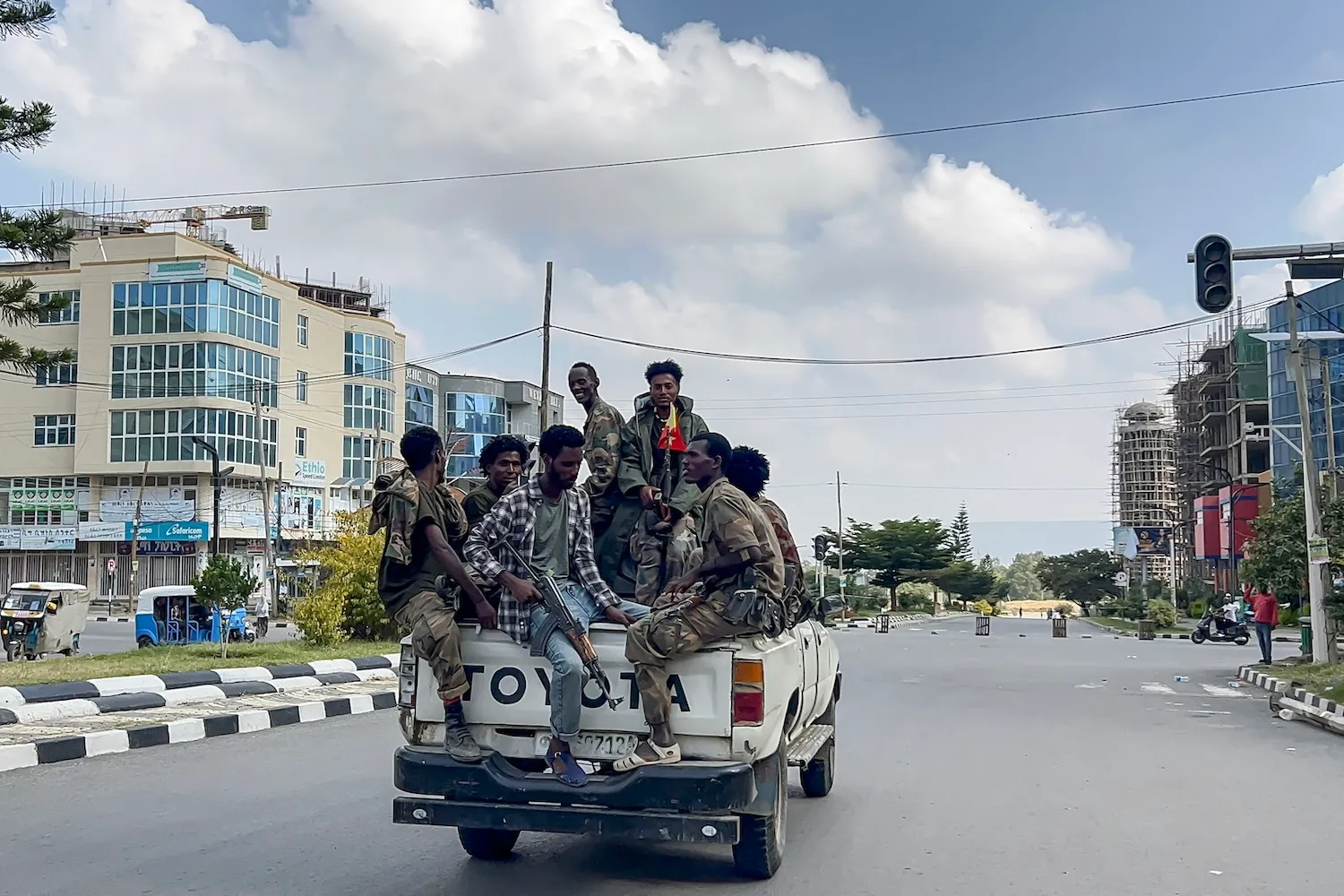
Welcome to Foreign Policy’s Africa Brief. The highlights this week: Ethiopia’s military forces rebel fighters out of Tigray’s capital of Mekelle, Kenya confirms its first-ever recorded Ebola case, and the United States waives human rights restrictions to send military aid to Egypt. A week and a half into renewed fighting in Ethiopia’s northern Tigray region, pro-government forces seized the Tigrayan capital of Mekelle, the country’s third-most populous city, from rebel fighters over the weekend. The Tigray Peace Force, a militia allied with the federal government, entered Mekelle on Saturday, followed by the Ethiopian military. The Tigray People’s Liberation Front (TPLF) has since retreated from the city, though it said its fighters would continue to “operate from somewhere else” as they seek to overthrow Prime Minister Abiy Ahmed. Nearly four years after the end of a 2020-22 civil war, major conflict resumed in Tigray on Sept. 23, when the TPLF seized three airports in the region and launched attacks into the Afar and Amhara regions. It had formed an alliance with six other rebel groups a few days prior to the offensive. By the end of September, the renewed fighting had displaced an estimated 150,000 people. While Ethiopia’s government appears to have the upper hand in the latest round of fighting, at least for now, the conflict has worsened a growing rift between Addis Ababa and regional powers. Before the fighting, Ethiopia’s diplomatic relations with Eritrea, Egypt, and Sudan were already frosty. But the situation deteriorated last month when Ethiopia accused the three nations of backing the anti-Abiy alliance. All of them deny involvement. “We are not party to the domestic crisis facing Ethiopia now. It has nothing to do with us,” Egyptian Foreign Minister Badr Abdelatty told Reuters on Sunday. Tensions are especially fraught between Ethiopia and Eritrea. On Thursday, Ethiopia announced that it would close its embassy in Eritrea’s capital of Asmara and ordered 10 Eritrean diplomats to leave Addis Ababa within 48 hours. This prompted Eritrea to cut all diplomatic ties, accusing Ethiopia of a three-year “agenda of incessant hostility” in order to gain “sovereign Eritrean ports and coastal areas.” Abiy has increasingly sought access to the Red Sea via Eritrea in recent years. Ethiopia became landlocked in 1993, after Eritrea gained independence from Addis Ababa, and Abiy has repeatedly framed direct sea access as an existential pursuit for his country. “Ethiopian civilization cannot be realized without a sea outlet,” Abiy told parliament on Monday as he was sworn in for a new five-year mandate following elections in June. Addis Ababa also ordered a senior Egyptian diplomat to leave Ethiopia on Thursday; Egypt responded by expelling a counsellor at the Ethiopian Embassy in Cairo. Meanwhile, the leaders of all three nations, along with Somalia, held a summit in Egypt on Sunday in which they called for “peaceful solutions to conflicts” in the region, according to an official statement. They also demanded compliance with international law on waterways. (Both Egypt and Sudan harbor grievances over Ethiopia’s Grand Ethiopian Renaissance Dam, which they say restricts their water access.) On Monday, the Ethiopian Foreign Ministry reaffirmed Addis Ababa’s “legitimate” interests in the Red Sea and the Nile basin in response to the regional summit. Political “rhetoric, coercive measures, and acts of destabilization will not alter Ethiopia’s geographic and historical realities,” it said in a statement. For now, regional hostility is unlikely to escalate beyond rhetorical attacks, especially if the Ethiopian military can contain the fighting and Djibouti’s port remains accessible to Addis Ababa and free from Houthi attacks. (Djibouti handles around 97 percent of Ethiopia’s import and export cargo.) With conflict ongoing in Somalia, Sudan, South Sudan, and Yemen, no party wants another war—and the subsequent economic impact—in the region. So far, regional instability in recent years has significantly impacted Egypt in lost Suez Canal revenue. An attack against Eritrea would similarly erode Ethiopia’s double-digit growth and thwart Abiy’s foreign investment plans. Still, there has been a lack of third-party mediation in Tigray while the Iran war has captured international attention. Without active, international diplomacy, long-simmering tensions could once again lead to widespread fears of an all-out proxy war in the Red Sea region. Wednesday, Oct. 7: The African Union launches the Africa Credit Rating Agency in Mauritius. Thursday, Oct. 8: The Court of Arbitration for Sport hears Senegal’s appeal against being stripped of the 2025 Africa Cup of Nations title. Friday, Oct. 9: Egyptian President Abdel Fattah al-Sisi visits Malaysia for talks to strengthen ties with Malaysian Prime Minister Anwar Ibrahim. Monday, Oct. 12: Ethiopia starts hosting the 65th session of the Intergovernmental Panel on Climate Change. Ebola spreads. Kenya confirmed its first case of Ebola on Tuesday. A Kenyan national who had been living in the Democratic Republic of the Congo for seven years tested positive for the virus after landing in Nairobi on Saturday. He was taken from the airport to the hospital, where he later died. Kenya’s Ministry of Health is tracing 57 other people who came into contact with him, including those on his flight. Africa’s current Ebola epidemic, which is centered in Congo, is the fastest-growing outbreak of the disease on record. The Kenyan case follows new figures from the Congolese Health Ministry, which show that the outbreak had killed more than 4,000 people out of 8,500 recorded cases as of Oct. 3. Over the weekend, France pledged to increase its funding and support for the Ebola response in eastern Congo. It also held a national humanitarian conference in Paris on Oct. 6 that aimed to draw wider international resources to containment efforts. Fraught relations. U.S.-South Africa tensions have deepened in the wake of heated public exchanges between South African Foreign Minister Ronald Lamola and the U.S. ambassador to South Africa, L. Brent Bozell III. In a recent interview with South African newspaper the Sunday Times, Lamola said that Bozell should “get out of the kitchen” if he no longer believes in dialogue after the ambassador said that Washington had “run out of patience” with South Africa. “You can’t have a diplomat who says the time for talking is over,” Lamola added. Bozell responded on X, “Another Minister Lamola personal insult aimed at an American leader (this time me).” The animosity follows Washington’s announcement last month of targeted visa restrictions against unspecified South African individuals who enact or enable discrimination against white Afrikaners. Bilateral relations have deteriorated over the past year and a half as the Trump administration has peddled false claims of a white genocide in South Africa. In the 2026 fiscal year, the United States admitted just 13,000 refugees, compared with around 100,000 in 2024. Nearly all of those admitted in 2026 have been white South Africans. U.S. military funds. On Thursday, the U.S. State Department waived restrictions concerning Egypt’s human rights record to release more than $300 million of military aid to Cairo. An internal memo sent to lawmakers highlighted Egypt’s “helpful role” amid the U.S. war in Iran. The Biden administration issued a similar waiver in 2024, citing Egypt’s assistance during Israel’s war in Gaza. Egypt has received around $1.3 billion annually in U.S. military aid since the late 1980s. Seth Binder and Kristina Biyad argued in Foreign Policy in May that no U.S. administration has applied sustained pressure on Egypt, “sending a clear signal to Cairo that U.S. red lines are negotiable.” Minerals deal backlash. The African arm of the International Trade Union Confederation has criticized a framework agreement that Abuja and Washington signed last month that aims to bring U.S. private investment to Nigeria’s critical-minerals industry. The organization said that details about the agreement were “scanty” and that questions remained over how it would benefit Nigerians. “Nigeria cannot replace dependence on crude oil exports with dependence on exports of lithium, rare earths or other unprocessed minerals,” it said in a statement, adding, “Agreements of this strategic importance warrant legislative scrutiny.” Following U.S. strikes against Islamist militants in Nigeria in December, some Nigerian observers questioned whether the intervention was genuinely motivated by counterterrorism, believing that it might instead be part of the Trump administration’s bid to access Nigeria’s mineral wealth. The minerals agreement has heightened those concerns. The Alliance of Sahel States (AES), comprising Burkina Faso, Mali, and Niger, has launched a television channel with support from Russia. Tafouk TV, which began broadcasting on Sept. 16, seeks to counter Western media narratives about AES nations and share information about the junta-led governments’ war efforts against Islamist insurgencies. Tafouk signed a cooperation agreement in July with RT (previously Russia Today), Moscow’s state-funded broadcaster. All three nations have largely kicked out French media outlets in recent years as they have severed diplomatic and military ties with France, their former colonizer. Everyone Got Pete Hegseth Wrong by Emma Ashford Trump Unleashed by Cole Bucy and Nate Swanson Where Does Russia’s Violent Imperialism Come From? by Ian Garner Russia’s risky gambit. In Foreign Policy, Taiwo Hassan examines the shifting security dynamics in Niger following a coup attempt in August, which failed in part because of the support that Russia’s Africa Corps gave to the country’s ruling junta. He argues that “while Russia’s strategy of regime protection has proved successful in expanding its footprint across the Sahel, it also contains the seed of its own exhaustion.” Algeria-Tunisia ties. In the New Arab, Abdelkader Cheref argues that Algerian President Abdelmadjid Tebboune’s recent pledge to protect Tunisia from external threats is an attempt to limit Emirati influence in the country that will also help shield Tunisian President Kais Saied from democratic accountability. Both Algiers and Tunis “have stifled democracy by altering constitutions, demonising opposition, and ramping up the criminalisation of critics,” Cheref writes.
Can Regional Powers Prevent Ethiopia’s Conflict From Spreading?
Full Article
Original Source
Read the full article at Foreignpolicy →KhanList aggregates and links to publicly available news content. We do not host full articles from third-party sources. Always verify important information with original sources.