
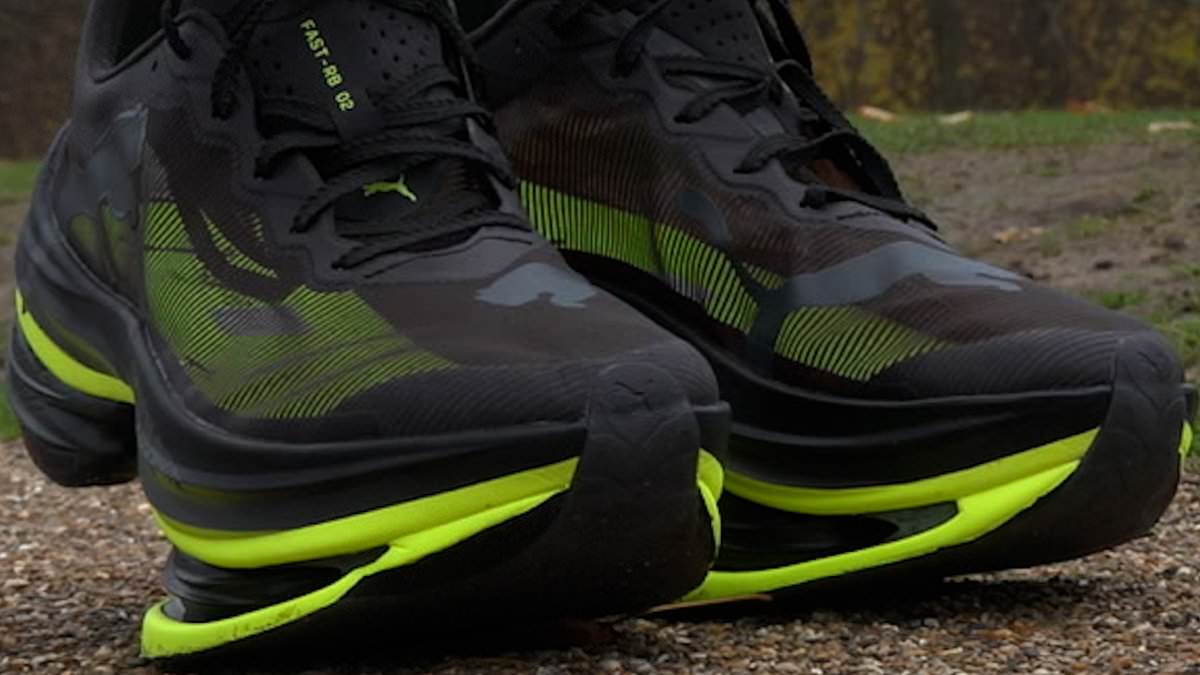
Becoming a top athlete normally takes years of hard work, determination and gruelling training – but maybe it doesn't have to.That's the promise of Puma's new £310 Fast RB NITRO Elite 2 supershoes.With a towering 55mm of foam padding and a double carbon plate 'springboard', these shoes offer such a boost that they are illegal under World Athletics rules.But can they really turn a thoroughly average runner like myself into the next Usain Bolt?To find out, the Daily Mail's Senior Science & Technology Reporter, Wiliam Hunter, set out to the local park to see how the latest in cutting–edge running technology matches up to a more standard pair of shoes.Our tests suggest that these pricey shoes really do live up to the hype, shaving a chunk of time off my runs and considerably reducing the impact on my joints.But experts still aren't convinced that these are the kind of shoe the average runner will really get the most out of.And with Puma estimating that a pair is only good for about 200 miles (320km), I'm not certain they are worth the price tag. The Daily Mail's Wiliam Hunter set out to see whether the new £310 Fast RB NITRO Elite 2 supershoes could make him the next Usain Bolt These supershoes feature 55mm of foam padding and a double carbon plate 'springboard', making them illegal to race in under World Athletics rules Taking the Puma supershoes out of the box, the first thing you will notice is just how bizarre they look.These shoes look genuinely unlike any other piece of footwear I have ever encountered, walking a thin line between incredibly futuristic and extremely goofy.The extreme springboard profile is so aggressive that they can't sit flat on the ground, standing up on their toes instead like they're about to sprint off on their own.They are also outstandingly light, weighing only 250g and using a strange mesh material that is so thin you can see your toes through the top – not exactly ideal for cold autumn days in the UK.However, no matter how unusual they might look, nothing compares to just how strange they feel on your feet.Slipping them on feels like you've just stepped onto the surface of a taut trampoline, with every little shift of your weight loading and flexing the carbon plates.The trainers are so springy that they create an almost irresistible urge to jump up and down with glee the moment you put them on, bouncing around like a kid in moon shoes.But when you finally start running, the feeling is simply sublime. Puma says these shoes create 'the best running economy we've recorded in our internal testing' by returning more power from each impact into the stride These supershoes have such an aggressive angle that they don't naturally sit flat on the floor, tipping up on their toes instead Puma Fast RB NITRO Elite 2: Key specs Price: £310 Designed for: Road runningAverage usable mileage: 200 milesHeel–to–toe drop: 8mmStack height: 47mm/55mmWeight: 250g (UK size 8)Carbon plates: Two fused carbon–fibre plates Every single step feels like it has a propulsive kick that sends you flying forwards in a bounding spring.By combining a thick layer of elastic foam with two flexy carbon plates, the shoes create a system that stores energy when your foot hits the ground and releases it with every stride.That means more of your energy gets converted into forward momentum, making your strides more efficient and improving how fast you can run.Romain Girard, VP of Innovation at PUMA, told the Daily Mail that the FAST–RB 2 has 'the best running economy we've recorded in our internal testing, surpassing every shoe we've benchmarked to date'.Mr Girard warned me that these shoes have a strong influence on your gait, and that runners 'may need a few runs to adjust to its unique ride'.That's definitely something I noticed right away, and probably something serious runners will need to bear in mind.Because the shoes are so springy, you naturally want to open up your gait and take long, loping strides, and I think it would take a while longer to find the most efficient approach.However, all that really matters is whether they actually made me a faster runner. Despite the see–through mesh and ultra–lightweight design, the Puma supershoes are actually exceptionally comfortable Did the supershoes make me faster? Regular shoesDistance: 1.28kmTime: 6:23Average pace: 4:58/kmSupershoesDistance: 1.31kmTime: 5m 37sAverage pace: 4:17/km I ran the same short circuit twice, once in my regular shoes and once in the new Puma supershoes to see how they would compare.To keep things fair, I tried to keep my effort levels roughly consistent, aiming for a pacy but comfortable 5K speed.Although it wasn't the most rigorous or scientific of tests, I was shocked to see just how dramatic the difference really was.In my regular trainers – an old and slightly beaten–up pair of Brooks Ghost 13 running shoes – I completed the loop with a pace of 4:58 per km.However, slipping into the Puma super shoes saw my pace accelerate to 4:17 per km without any considerable difference in effort.According to Mr Girard, all runners can benefit from the supershoes' spring, but he notes that a pace of about 5:00 per km is where 'runners really start to feel the magic'.The fact that my unassisted speed sits right around that critical value could explain why I saw such big benefits.Dr Brian Hanley, a sports scientist at Leeds Beckett University, explained that the speed difference likely came down to the towering foam stacks.With the supershoes on, I ran a short course at an average pace of 4:17/km, shaving 40 seconds per km off my previous pace 'There is good evidence that it is the stack height that makes most of the difference to performance in super shoes, so going beyond the legal limit of 40 mm should make a big difference,' says Dr Hanley'This is because the foam used in the sole is a major component of the increased energy return.'While the pace improvement on paper is already impressive, I actually think one of the most important factors is just how great they felt to use.After running in the FAST–RB 2, putting my regular shoes back on felt like encasing my feet in concrete.The supershoes reduced the impact on my joints, helped me maintain an easy, open gait, and generally made running feel fun again.And, on a drizzly morning when all you want to do is stay in bed, that little difference could be all you need to get out and train.However, there are still some pretty important caveats to bear in mind.The most obvious is that they can't be used in most competitive races due to their extreme stack height and two carbon plates. However, after less than two miles of running, the shoes were already starting to show a bit of wear and tear. Puma says these have an average lifespan of 200 miles (320km), which might not be great value for £310Mr Girard says: 'Most fast runners are looking to enjoy the thrill of running faster and improving their times, whether that's within their local community or simply against themselves.'However, the evidence doesn't necessarily support the idea that the supershoes are actually any better for you in training than regular running shoes.Dr Hanley notes that the shoes might be useful for 'assisted running', similar to how sprinters will practice running downhill to get their legs used to a faster turnover, but the benefits in regular training are limited.He says: 'It appears that training in normal trainers works just as well for developing beneficial physical attributes for distance running, and it's a good idea to save super shoes for targeted events.'The FAST–RB 2 supershoes also aren't as durable as some normal running shoes, lasting about 200 miles (320km) on average.To drive that point home, I found that some of the foam had started to show the first signs of wear and tear after just a few laps in the park.There's no denying that these shoes will make you faster, and they feel so good to use that I'm already looking forward to my next run.But the question is whether that is worth it for a £310 shoe you can't race in. How Nike's £240 Vaporfly sparked the super shoe debate at the 2016 Olympic marathon in RioThe debate of super shoes isn't new and first reared its head in 2016, with Nike's £240 Vaporfly product raising concern among commentators and experts alike.During the 2016 Olympic marathon in Rio, all three male medallists wore a prototype of the trainer, with the same technology extended to track races from 2018. The debate of super shoes isn't new and first reared its head in 2016, with Nike's £240 Vaporfly productNow the high–tech trainers, which are lighter and more responsive, are 'almost ubiquitous on the feet of elite road runners'.That is according to Jonathan Taylor, a sports researcher at Teesside University, who has branded the revolution in footwear development a 'technological arms race'.Experts predicted the shoe improved the running economy of highly trained runners by four per cent compared to a normal shoe, boosting performance by three per cent.Since 2016 when the Vaporfly was released, the top 50 male marathon runners have improved by about two per cent on average, much of which attributed to the carbon fibre plate.Similar technology was then transferred into track spikes in 2019 which led to middle– and long–distant records falling.Regulations were introduced in January 2020 over the sole thickness of track spikes used in sports other than high jump and long jump.This was due to other companies replicating their carbon–fibre plate and springy foam technology into more spikes for running shoes.The new regulations require a maximum sole thickness of 20mm for up to 400m races and 25mm for any longer distances.However, experts say this is far too lenient, suggesting rules should be stricter and to a point where air pods can't be inserted into the spikes.
Can Puma's illegal super-shoes turn me into the next Usain Bolt? Daily Mail tests the £310 trainers to find out if their double carbon 'springboard' is all it's cracked up to be
Full Article
Original Source
Read the full article at Dailymail →KhanList aggregates and links to publicly available news content. We do not host full articles from third-party sources. Always verify important information with original sources.