
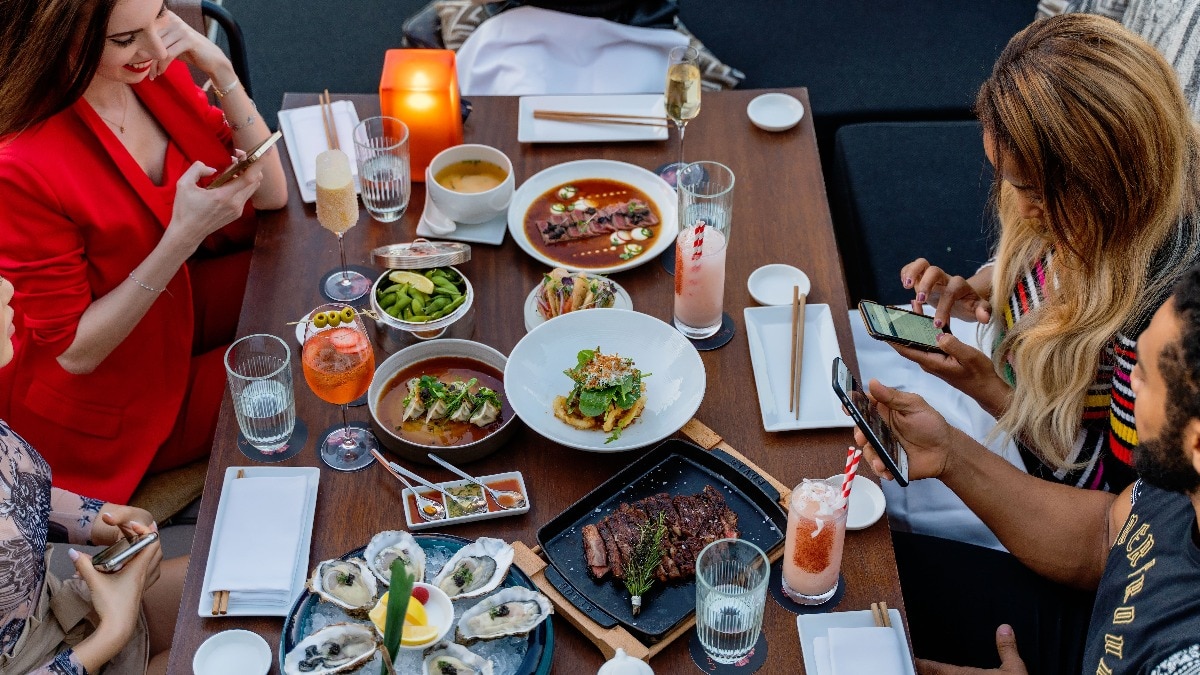
A plate, a bowl, cutlery on the sides—the usual dining-table setup. Oh wait, we’re missing something. A phone. One beside every plate, within easy reach. Obviously.Most of us (this author included) bring our phones to the table. One buzz, and the hand reaches out to check that notification. Sooner or later, everyone is looking down, engrossed in their phones, doing one thing or another.And in Indian homes, there’s a good chance you’ll hear something like:“Phone side mein rakho, pehle khaana kha lo.” You’ve probably heard some version of this at home. Now imagine being told the same thing at a restaurant where you’re paying for dinner. Some restaurants and bars abroad are increasingly asking guests to put their phones away. India is not immune to this concept either. While we’ll come to that in a hot minute, the larger question is: is it even a sustainable business model, and will customers welcome this bid to unplug and indulge?But first, let’s have a look at what’s really happening in the West.“Phones are the new cigarettes” Writing in The Wall Street Journal, Adam Chandler drew a striking comparison as how “At Restaurants, Phones Are Becoming the New Cigarettes.”One buzz, and we reach for a quick digital drag. Even a minute’s lull in conversation can trigger the urge to scroll just one post, we tell ourselves. It can feel addictive. Been there, done that.Now, some restaurants are asking us to stub out the habit, at least until dinner is over. Several places abroad are introducing policies that restrict phone usage in one way or another.In Sardinia, Italy, “A tavola senza schermi” (“At the table without screens”) is a month-long pilot across 15 restaurants, encouraging parents and children to put their phones away in exchange for a “reunion kit” with drawing activities and games. According to The Guardian, the idea is to help families reconnect over a meal.Then there are places that have offered free bottles of wine or discounts to customers who voluntarily lock away their phones. Others have a no-phone policy or simply no Wi-Fi.At Antagonist in Charlotte, US, guests’ phones go into locked in pouches. Phoenix’s Trophy Room, a cocktail bar, prohibits phones and cameras and provides locked storage. Sydney steakhouse Bistecca keeps phones out of its dining room as well. In this paradoxical world, while people are chronically online, there's a rise in the desire to be able to unplug. (Photo: Pexels) This isn’t a sudden movement. It has been happening for a few years, but what feels more contemporary is the tension: after years of making nights out shareable, hospitality is also selling the chance to be unavailable, unplug and be a little less online. And anyway, 2026 seems to be all about being analogue.Coming to India, the concept might not be a rage yet, but certain eateries have a version of it as well.At Bengaluru’s 403 Forbidden Bar, founder Rachit Saboo describes a gentler approach to all this, called “Digital Detox” where the network is intentionally poor. Since opening in January 2026, he says, the focus has been on making the experience engaging enough for guests to disconnect naturally.“When conceptualising the bar, we observed how technology was increasingly influencing social experiences, with conversations often interrupted by notifications and people experiencing moments through their screens rather than being fully immersed in them,” he tells India Today.Even Raga by Gaggan Anand—the Indian chef whose restaurant in Thailand has featured on the World’s 50 Best Restaurants list—has a restrictive policy on the use of phones and cameras during its mystery 22-course menu.There have been a few other places in India that offered similar propositions to diners but have since closed, for reasons unknown. Immersive cocktail experiences give diners a less chance to look at their phones. (Photo: 403 Forbidden Bar/Instagram) The reasons everyone needs to be less chronically online are well established, but why do restaurants care so much?Well, they do have a bit of a bone to pick with the digital era. It’s rather nuanced.For chefs and restaurateurs, customers indulging in their food is of paramount importance. And when people concentrate more on the perfect photo, or eat while using their phones, they miss out on the nuances that go into serving a scrumptious meal.Why restaurants think it is a problem“Photographing a dish, sharing an experience or checking with someone is perfectly natural. The issue is when the phone becomes the centre of attention and sort of distracts you away from the dining. So, it’s a very fine line,” Jatin Mallick, chef and co-founder of Dos and Tres, tells India Today.For the kitchen, that fine line also comes with a temperature problem.Omkar Rai, junior sous chef at Omo Gurgaon, has a distinct explanation. Speaking with India Today, he says, “A lot of effort goes into the food that people don’t see. When people use their phones and laptops, they don’t enjoy the food as much. When you leave the food for some time, the aroma goes away, it gets cold and the texture changes. You won’t feel the food you’re eating. You’re just eating for the sake of it because you ordered it and want to fill yourself up.” Indian experts acknowledge the power of social media for business, yet they also want customers to appreciate the hardwork their chefs put in. (Photo) Unplugging also creates space for mindful eating: noticing flavour, smell, texture and your body’s hunger and fullness cues. Harvard’s Nutrition recommends eating without distractions and engaging the senses.But here’s the interesting bit. Indian experts are not completely on board with a complete blanket ban on phones either.The business POV of things“You cannot simply tell them not to use their phones. It’s not a good thing to say no to a customer in the hospitality industry,” Rai says firmly. He has to consider business, guest comfort and the kitchen together, which means understanding what type of clientele the restaurant serves and what kind of food it offers.Mallick sees it working at premium restaurants or destination dining establishments because they offer an experience.“I think we should allow people to photograph the food and share it. And once the moment is done, let them engage and let them indulge in the food and the service and the hospitality and energy of the place for what they’ve come for. So I think it’s more about mindful use of the phone rather than eliminating it,” Mallick adds.The consensus among the experts we spoke to is that repeat visits depend on hospitality, storytelling and exceptional food and drinks. For phone-free policies to work as sustainable business models, experts believe restaurants must give diners an experience worth putting their screens away for. This generation is ready to pay when there's an experience worth it.(Photo: Pexels) Rai, who is planning to discourage gadget use at his restaurant, would rather hold guests’ attention through conversations, stories about dishes and interactions with the team. “They should want to come, have food, talk to the server, know about the restaurant and the food, and talk to the chef,” he says.Sahoo echoes this approach. At his bar, that means a cocktail programme that encourages curiosity and an intimate setting where guests can engage with bartenders and the stories behind their drinks. In fact, he says, it's very well welcomed by his customers too.They even emphasised that this is also the era where everyone is ready to pay for good, unique experiences. Sky dining, sensory dining, several course meals with limited seating are usually expensive, yet they work because this generation, with disposable incomes, is ready to splurge.Will Indian diners bite into this trend?Being able to switch off—or being required to—is becoming a luxury. Experts believe Indian audiences could be ready for it, provided they get an experience worth disconnecting for.Rai also has a rather distinct explanation for the current generation’s difficulty sitting without their phones. “They only sit without them when they have a purpose. Nowadays, we all need a purpose to do anything.” And experiential dining could be that purpose, a middle ground rather than extreme policies.And perhaps we can meet restaurants halfway. Take the photograph, if you want one. Then let the meal, and the person across from you, have a turn.- Ends
Can phone-free dining find a place at the Indian restaurants?
Full Article
Original Source
Read the full article at Indiatoday →KhanList aggregates and links to publicly available news content. We do not host full articles from third-party sources. Always verify important information with original sources.