
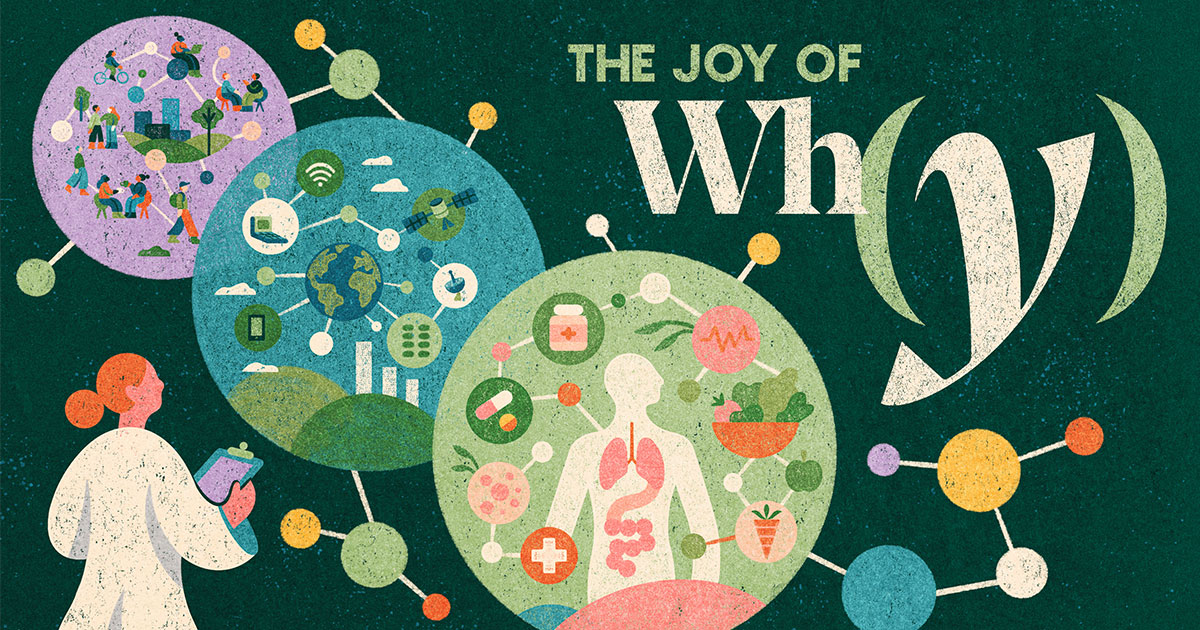
Nothing really exists in isolation. Almost every part of our lives exists in a network. Consciousness arises from what neurons do together, life from what genes and proteins do together, society from what we do together. When researchers began mapping real-world networks in the 1990s – from the World Wide Web to Hollywood actors linked by films – they found that wildly different systems shared architectural features that their components alone could not explain. This suggested common organizing principles for how networks form and develop. In this episode, two of the pioneers of network science – Albert-László Barabási and co-host Steven Strogatz – discuss how the field took shape, the ideas that underpin it, and why this is more than graph theory under a different name. The conversation then turns to health and nutrition. Disease-related genes cluster in “network neighborhoods”, Barabási explains, which may help identify better drug targets and predict which patients will respond to which drugs. That work led him to his Foodome project, which catalogs the molecules found in the food we eat and asks what they do inside our cells. By his count, around 135,000 compounds lie outside conventional nutrition, which concerns itself mainly with energy, building blocks, and vitamins. These compounds, which he calls the “dark matter of nutrition,” and their effects on the body are only beginning to be understood. Listen on Apple Podcasts, Spotify, TuneIn or your favorite podcasting app, or you can stream it from Quanta. Transcript STEVE STROGATZ: Hello, I’m Steve Strogatz. JANNA LEVIN: And I’m Janna Levin. STROGATZ: And this is The Joy of Why. LEVIN: A podcast… where… you can’t make me laugh, okay. A podcast from Quanta Magazine where we explore some of the biggest unanswered questions in math and science today. STROGATZ: Well, hey, Janna, I’m gonna take you back in a time warp to the 1990s. Do you wanna go there with me? LEVIN: Yeah, for sure. STROGATZ: There was a trend back then, where people would play a game that they called Six Degrees of Separation. LEVIN: Yeah, it was like the Kevin Bacon game. STROGATZ: Right. So if people don’t remember, Kevin Bacon, he was in a lot of movies and a game developed around him where you would name an actor, whoever, Marlon Brando or James Dean, and then you have to figure out a path of co-stars. You know, Marlon Brando was in such and such movie with somebody who was in a movie with Kevin Bacon. In that case, we would say Marlon Brando was two steps away. He had a Bacon number of two. LEVIN: [Laughs] Right. Now, this though has some actual mathematical underpinnings. And as I remember, you did substantial work on some of this, how we’re all connected and how the world is smaller than we think, how that happens. You know, how do you… Do you know the guy Joe from Chicago? And you’re like, “Of course I know Joe.” Right? STROGATZ: Well, it is true. My student Duncan Watts and I got very interested in the math of Six Degrees of Separation, like what would a network have to be like to have that property? And around that time, when we published our paper, soon after we heard from Malcolm Gladwell before he was really famous as Malcolm Gladwell, and he wanted to talk about this idea, and he ended up writing an article that was called Six Degrees of Lois Weisberg. LEVIN: Sure, I know Lois. STROGATZ: Yeah, that’s the point. Everybody knows Lois. Lois knew everyone in Chicago and all over the place. And so, we all know that there are these connectors in our networks, and that’s actually what we’re gonna be hearing about to some extent in this upcoming interview with László Barabási. So, he is a network scientist at Northeastern University. He’s also got an appointment with Harvard Medical School and with the Central European University in Budapest, Hungary. And he has been looking at the role of what he calls hubs. You know, these outsized Lois Weisberg-like nodes in a network that seem to have a tremendous number of connections and the effect that they have on the behavior of the network as a result. LEVIN: This probably has application for other complex systems than just human social systems? STROGATZ: Oh, it certainly does. Understanding networks, not just from the perspective of human social life, has had all kinds of consequences for our understanding of how diseases spread through populations, but also how brains are wired together. The way genes are connected in gene regulation networks, or even the power plants that provide energy to all our homes and businesses. So, yeah, very big implications way beyond human society. So, for that, let’s turn to one of the experts. Here we go with László Barabási. [Music plays] STROGATZ: Welcome to The Joy of Why, László. ALBERT-LÁSZLÓ BARABÁSI: Oh, Steve, this is so much fun. I am a big listener of podcast, and Joy of Why is actually on my active list, so it’s so much fun to kind of see the sauce being made. STROGATZ: [Laughs] Well, it’s great to have you here. So just for full disclosure to our listeners, we have known each other a long time. It must be close to 30 years by now. I’d like to begin by going down memory lane with you to the early days of network theory. You spent a lot of your career looking at the world through the lens of networks. Why don’t you start by telling us what we mean by networks, and also what looking at the world this way offers us? BARABÁSI: Well, you forgot to disclose the fact that we were responsible, you and I, for the field of network science, right? So we were once competitors, too. But let’s talk about why I think both of us cared about the networks at that time. Because fundamentally, nothing exists in isolation, right? A gene, a neuron, a human doesn’t make sense at all to kind of think about them in isolation. They all start making sense when they connect to other things. So consciousness is really about what the neurons do together. Life is what our genes and molecules do together. Society is what we do together. And if we tend to focus, as much of science did historically, on the pieces, we are actually missing the why. Why do we have intelligence? Why do we have life? Why do we have societies? STROGATZ: A-ha. So it’s this relational perspective. You’re pushing back against the usual straw man of reductionism, it sounds like. BARABÁSI: Don’t we all, right? Because, I mean, listen. Reductionism is a key tool in science, right? Without that, we cannot do networks. We need to know the pieces. But we as scientists got so busy looking at the parts that we have forgotten the whole thing. And then network science is really one of the disciplines whose starting point you gotta map out how things are connected and why that matters. STROGATZ: It’s interesting you talk about mapping things out, because back in the 1990s, especially towards the second half of the 1990s, each of us with our students wrote papers that made a big splash. That’s what you’re referring to when you speak of us starting the subject. But what do you think was known at the time we were starting and what was not known? What was it we collectively were trying to figure out? BARABÁSI: Yeah. So I think none of us discovered networks, right? Networks were there for a long, long time, and many disciplines were aware of that, right? And I think in my mind, two things have changed. One of them is the availability of data, right? Our ability to take advantage of the revolution that was really brought to us by the internet to really start putting the pieces together and create the maps of how metabolites in the cell are connected to each other, how actors in Hollywood — your work, right — are connected to each other through common movies and so on. And so one really opportunity that we all took advantage is the availability of the data. But then that by itself, in my mind, would have not been sufficient, right? Because if data becomes available, we could still have a theory of biological networks and a theory of social networks and difference. The key discovery that we and others had made at that time is once we look from the network perspective of these systems, there are many more similarities in the architecture of real systems than differences. And I think that was surprising to all of us because I don’t have to convince anybody that a metabolic network within the cell should be different from a social network or should be different from the wiring of the brain. They have totally different purpose, totally different scale, totally different units who are being connected in different ways of interactions. So what really shocked many of us physicists, mathematicians, biologists, is that many of these networks have common architectural features that could not be simply explained by the nature of the nodes and the links or the nature of the components, but it was hinting to some deeper organizing principles that governs connectedness. STROGATZ: That’s very well expressed. That’s nice. This is a field, as you remember, and I certainly do, there’s a question of turf. You know, there are people, for instance, in pure math, who will say, “Don’t tell me networks are new. We’ve been doing graph theory since the Königsberg bridge problem with Leonhard Euler sometime in the 1700s.” But so, what are some of the differences in philosophy and content between, say, this subject and the older subjects, let’s just to pick two, graph theory and social networks? BARABÁSI: Of course. We are very grateful to many of our colleagues, the Erdős and Rényi and the László Lovász of mathematics and the Milgrams and the Manfred Kochens of social networks and so on, because they really been using graph theory to look at various issues related to connectedness. I think the fundamental difference was that on one end, graph theorists never really bothered or were interested to look at real networks. Social network theorists, however, were limited to very, very small networks. And once the data became available on other networks, from biological to very large social networks, we started features that simply could not be observed at those smaller samples. And most important — and I think this was the key — we and everybody realized that the models that the field has built up, for instance, the 1950s to pretty much the end of 1990s, were not sufficient to describe the reality of these systems. So there was a need for a very, very different way of thinking about that. What was missing is that graph theory and social networks were using graphs as kind of cartographers to map out what’s out there, but they were not thinking so much about how things came into being. Why are networks the way they are? That is, networks are not static objects. They are dynamical entities that evolve in time. The large networks we see are the result of massive growth processes and how this temporal evolution, how these dynamics defines the way they look, their architecture, and their ability to do things, which is being alive, to think, to function as a system. STROGATZ: That’s a really nice point that there is this temporal aspect which was not particularly the concern of traditional graph theory. You know, now we all just talk about the internet, but to us in the ’90s, the World Wide Web was a shocking thing. This is before social media. There was no Facebook. This was just web pages on the internet. There was a browser called Mozilla that came on around 1994, if I remember right, and you could start to do the thing that we called web surfing. So you started to have this visceral sensation of hopping from page to page through this vast, mysterious, hard-to-picture structure and you did some of the first work pioneering what it was like to navigate and explore this amazing, weird virtual world that didn’t exist until the ’90s. As you say, it’s like cartography, exploring a whole new world. BARABÁSI: I’m glad you mentioned that because this unlocked network science for us. As a historical note, I wrote my first network paper in 1995 that never got published. It’s still there on the archive. And ’95 and ’96, I spent trying to convince computer scientists to help me map out the World Wide Web, and no one bothered to respond. I have sent countless emails to people who were building, like, robots at that time. We didn’t call them search engine. We called them robots and crawlers, and just asking for their data, and no one bothered to respond. It wasn’t ’til 1998 when How Hong Jon, my postdoc, who had a very strong programming skill came along, that we could actually finally embark on that project and map it out. And let me give you a little historical anecdote even for the listeners to indicate what kind of world was that. So right after we mapped the World Wide Web and our paper came out in ’99, I was immediately invited to the Internet Archives in San Francisco to give a talk, and there were about 10 of us speakers there, right? And there was a guy who came along, and he put a big box on the table and said, “You know, I just funded a company, and why don’t you just take my T-shirt?” And the T-shirt said Google on it. It was Larry Page handing out, as a graduate student, his first T-shirts actually. STROGATZ: Wow. BARABÁSI: So, the fundamental difference between what we did and Larry Page did is that we just mapped out the network and not the content, and he, of course, cared about the content. And of course, that difference turned out to be a couple of trillion dollars in the long run. But nevertheless, these were the roots of how do we think about internet, World Wide Web, and so on as interconnected systems that, as you said, they are so natural to us that we don’t any longer even think about that. STROGATZ: Right, it was a mind-blowing thing at the time. And you made this point earlier that I wanna return to about growth, that the network of the World Wide Web, but also whether it’s biological networks or even a city starting from a small village, networks are not static. They grow, they accrete, they add nodes, they add connections, links. And you had the nice idea that very simple observation, that networks grow, might leave a signature of some kind on their structure. And so tell us about what you found structurally about the World Wide Web, but also about other networks that had some connection to this growth process. BARABÁSI: Oh, we have to geek out a little bit to do that, right? So I’m Hungarian and why I started thinking about networks back in late 1994 and ’95 is that I read pretty much the Hungarian graph theory literature, which is these two mathematicians, Paul Erdős and Alfred Rényi, as well as there was a book by Béla Bollobás. And they had a very simple and very powerful concept. They said, “Well, there are very complicated networks out there, and they look random, so why don’t we assume that they’re purely random? Let’s assume that the nodes are just randomly connected.” The dice decide who is your friend and nothing else but the dice.” And based on that, they made a set of predictions, and one of the key predictions was that in a random universe we are very similar in how many friends we have. Remarkably similar. So for us, the biggest shock when it came to the World Wide Web, that the number of links per node did not follow a Gaussian, the proverbial bell curve, but rather there were many, many web pages with a very few links and a few major hubs. And that was a purely empirical observation. Technically, we said the degree distribution follows a power law. What it meant is that there were major hubs holding together many small nodes, and that required an explanation, and that’s where growth comes in. Because what we realized back then is that the fundamental limitation of the random networks is that they assume that the way networks form is that we have a bunch of nodes that need to be somehow connected. But in reality, networks form by one node at a time growing. Nodes join the system. Whether it’s a social network and people come in and join the club, whether it’s a biological networks where new molecules are being synthesized and joining the network, and so on. Every network that is out there, without exception, is the result of some kind of long-lasting growth process. Sometimes four billion years, sometimes a few years, but it’s always growth. And there was another feature what was also important is that when a new node comes in the system, it doesn’t just randomly pick any node, but it’s always biased towards the more connected nodes. Popular people are easier to be introduced to. Highly connected proteins are easier to actually connect to for biological reasons. But fundamentally, new nodes tend to connect to the more connected nodes. This is what we call preferential attachment. And this growth and preferential attachment, we were able to show is responsible for the emergence of the hubs. That is, if a network is growing and the choices are not random, hubs will naturally emerge. And this was such a simple explanation, such a simple deviation from what has happened in modeling that existed before, and suddenly was able to explain lots of systems, not only the World Wide Web, but even the Hollywood actor network but also like computer chips and citations and so on. STROGATZ: Let’s talk a little more about the hubs, because I think this is a tricky point. If a person hasn’t thought about it before, the initial statement that some nodes are gonna be much more connected than others sort of seems like common sense in that we know some of our friends are very popular. So there are differences. There is heterogeneity. Everybody knows that. But the crazy thing you observed is that you could find sites on the internet that didn’t just have 10 times more or 100 times more, but you saw things with what? Like a million, a billion times more connections? BARABÁSI: Many orders of magnitude. And that the millions and billions is there for the World Wide Web, right? A few years ago, I remember that most web pages, what I mean 98% of the web pages have one to five links. But then Google had eight hundred million at that time, right? So the difference is really many orders of magnitude. And how much is the difference depends on the system size. The bigger the size, the bigger is the difference between the small and the biggest hub. And this was also key observation. The bigger the network, the bigger the hubs will become. And there’s a very precise mathematical law that connects the size of the network to the size and the number of the hubs. And I think this was really what made a difference. We’re not just saying, “Hey, there’s a popular guy out there.” We were saying the number and the size or the popularity of the popular guys is fixed by the structure of the network. And once you understand the network, you can predict that. STROGATZ: That idea, it came to be called scale-free networks, because there was no characteristic scale. We should say friendship networks don’t really work like this in real life. Nobody has 100 million friends. No human can support that. So we’re not saying here that every network has this property of scale spanning many orders of magnitude, but lots of networks did have that property. BARABÁSI: Absolutely. And, let’s talk about friendship networks. Your intimate friends is fixed, the number of intimate fixed friends. But when it comes to social networks and how many acquaintances you have, that is already scale-free, and that has been shown in many systems from the Facebook to the Twitter and so on. So there’s a fundamental difference of how you define friendship. If you define them as acquaintances, people you connect to, then that actually properties holds. But you’re absolutely right. There are well-known canonical networks that are not scale-free. None of the material networks that are out there are scale-free because like a carbon atom has four electrons to share. You will never turn it into a hub, right? So, there are lots of real systems that physics and other systems we care about that are not of that character. But many systems that we deeply care about, from biological networks like protein interactions and metabolic networks in your cell to social networks in the sense of acquaintance networks, to some infrastructure networks like the Internet, they follow that property and these systems matter. And once hubs are there, they fundamentally change their behavior, and that’s why we care about that. [Music plays] LEVIN: This is interesting, just starting with the random network model, which seems to have been brilliant in its successes, despite the fact that intuitively it feels like a very poor way of emulating reality. I mean, I don’t make friends at random, you know, toss of the die, and so I was surprised in some sense that the random network model was ever sort of revered. STROGATZ: It is revered. And I think to do justice to it, we have to remember that in science and math, different researchers have different goals. Depends what your question is. So to give a fair shake to the random model, what Erdős and Rényi were trying to understand was something really, really gorgeous and deep, but pure mathematical. They weren’t thinking about reality as far I can tell. They were making up a math problem. Can I ha- just have you picture in your mind, suppose I had a lot of buttons on the table. I just throw down a bag of buttons, and now I start throwing down some threads, one at a time and connect pairs of buttons at random. After I’ve done that for a while, if I close my eyes and pick up a button and pull it off the table, what will come with it? LEVIN: A bunch of other buttons. STROGATZ: It might be a bunch, right? I mean, it depends how far into the process we are, right? If I’ve done this for a long time and there’s a lot of threads, when I pick up one, I might pick up a big clump along with it. And so what Erdős and Rényi were interested in was the phase transition that occurs when there’s a critical ratio of buttons to threads. And what they showed was that it’s not that you pick up more and more buttons as a function of more and more threads, it’s that this happens discontinuously. At a certain critical ratio, you suddenly pick up a gigantic clump, and below that ratio, you pick up almost nothing. So, they were interested in that. How do you get a simple model of a phase transition in a network? And this network model with random connections allowed them to do the math and prove beautiful theorems. So that has stood the test of time in math, and it opened up a whole subject of random graph theory. But for decades, that was the only model we had of giant networks other than what you guys in physics do where you have crystal lattices. You have cubic, you know, nearest neighbor or checkerboard patterns. You have very regular lattices. People in epidemiology have these random graphs. The big mystery was what are real networks like? They’re probably not perfectly random or perfectly regular. LEVIN: So is this where the idea of hubs comes in? In these real networks, of course, our friends really aren’t laid down by a random toss of the die, but instead there are hubs of connectivity. And, and it really is interesting hearing some of this ’cause it reminds me of how algorithms really work on the internet in terms of boosting someone’s Twitter account, for instance. And once that starts to grow, it really takes off, whereas when the algorithm suppresses the connectivity, the whole thing is really suppressed. STROGATZ: That’s a really nice insight and an analogy because we’re now living in a world where these kinds of reinforcement effects are everywhere. As you say, like, if you’re popular on the internet, then you get recommended more to new people joining the network, and so the rich do get richer. I mean, that’s part of what’s cool about this. This kind of foreshadowed a lot of developments that are now commonplace. LEVIN: Right. Fascinating. STROGATZ: Alright, well, a lot has changed in the 30-plus years since all of this work of Laszlo and his students. So we’re gonna be hearing how he has been applying network thinking to a really different space — medicine, and food, and nutrition. More on that after the break. [Music plays] STROGATZ: Welcome back to The Joy of Why. We’re speaking with network scientist, László Barabási. You’ve, in more recent years, after this big boom in the late ‘90s, continued to do all kinds of pioneering work in applying networks to many different domains, let’s say medicine. Network medicine has become a thing. BARABÁSI: It is a thing. STROGATZ: So, for people who haven’t heard of network medicine, what is that thing? BARABÁSI: Well, network medicine really built on the back of genomics. Genomics provide us the list of the components in the cell. If you sequence your genome, you get precisely what genes you have, hence what proteins you have, what RNA you have in your body, and so on. So that gave us a complete inventory of the components. But they didn’t tell us how the pieces interact, who is interacting, who is binding to whom, and so on. However, many diseases are rooted not in the fact that a component is broken. What does a mutation do that may cause a disease? Typically, it deforms a protein. What’s the consequence of deforming the protein? That the protein cannot link to other proteins or other metabolites. Either cannot bind to other proteins and cannot form bigger machineries, or cannot bind to another molecule and cannot catalyze a chemical reaction. So really, the essence of life or how the cell works is through the connections that the components have to each other. The machineries in the cell, from mitochondria to hemoglobin, are the result of many proteins assembling tiny networks and creating little machineries that do things in the cell, like carry oxygen. And the rest of the proteins are busy catalyzing the many chemical reactions that we talked about it, because one of the features of life is that virtually none of the chemical reactions that we have in our body take place by themselves. They always need a protein catalyzer for that. So, what is network medicine? Network medicine, on one end, tries to map out these interactions and then use that knowledge — the map — to really kind of understand what happens when a component is broken and downstream, where the effects are within the network, and eventually what disease you get as a result. And equally important is like how do you intervene into this network to cure that disease, to fix the consequences of that broken component? STROGATZ: Since I mentioned turf wars earlier, like in the case of network science, it would seem to me that any biomedically savvy person listening to this would think, “Is network medicine really something new?” Say, a biochemical pathway or a signal transduction pathway that the people working in cell biology like to talk about, are those just network medicine by another name, or, or were they missing some part of the picture? BARABÁSI: They were always focused on the local effects. So, a pathway is really a set of reactions that always occur together. And yes, of course, as I mentioned earlier, there was a 150-year history in biology to systematically map each of these reactions out. But the tendency was that you became an expert on this reaction and the neighborhood, and there was no way to interrogate the full system, right? And why does that matter? The simplest way to think about why it matters to have all of this bigger picture is because we don’t know how to treat molecular defects. Medicine does not yet know how to fix a mutation, right? There are dreams that we will get there, but by and large, none of the drugs that we have out there is really fixing the cause of the problem. What do we do? We go downstream from the problem, and we intervene down there to fix the consequences. So, if a protein is not working and is not catalyzing a particular chemical reaction, then you start giving them the molecule that is missing to the patient, right? So, for you to know where to intervene, you need to have the Google Map. You need to know how things are connected and what’s the right point where you enter. So one study we did actually once I returned to Boston, to Harvard in particular, was that we looked at all the drugs out there. And the hypothesis always is that what a drug does is that it binds to a disease protein, right, a protein that is broken in the case of the disease. And shorter of a better term, it fixes the problem, right? But in reality, 85% of the drugs do not bind to anything related to the disease, that they don’t bind to what we call disease proteins or disease genes. They always act downstream. Because you don’t wanna mess with the disease genes. The disease genes are often very important genes that are involved in multiple processes. You wanna kind of correct the problem by going where the effect is that the gene is not doing or the protein is not doing what it’s doing. So if you wanna discover new drugs — discover what we call drug targets — we know all the disease genes from genomic screening, but that’s not enough. You have to go downstream from them, and network medicine gives you the pathways to say where should you look. And this is exactly one of our big discovery, back around 2015, in the network medicine space, that every disease has what we call a disease module, which means that the genes involved in the disease are not randomly distributed in the network, but they tend to agglomerate in a certain network neighborhood, right? Let’s take New York City, right? If the map of New York City would be the map of a cell, then you would find that you know the disease genes would not be randomly distributed around it. But all mental diseases are all around Times Square. And metabolic diseases may be around Wall Street, and maybe asthma would be all around Washington Square, right? So in the cell, there are these well-defined network neighborhoods where the disease resides. You need to map that out because that’s where you need to perturb in that neighborhood to fix the problem. STROGATZ: Hmm. It’s very helpful, this visual you’re giving us of maps. But what is the actual network that we’re talking about at the biological level? Is it, say, a gene regulation network? Is it a protein binding network? Is it a protein-to-disease network? What are the nodes and what are the edges in some of these things just to make them explicit. BARABÁSI: Sure. Absolutely. There are many different ways to approach it, but in my lab, we focus on what we call physical interactions. Physical interactions are really binding interactions. So, the two examples you showed are those that we focus on. Protein-protein binding interactions, which are the proteins that can bind either pairwise or form complexes, or regulatory interactions, which is the situation when the protein binds to the DNA to initiate some process or block some other processes. And so, these are kind of the two fundamental physical interactions from which we build our maps. People in network medicine can build other networks that are more virtual, like so-called expression networks. When genes are very much expressed, they’re active together, then they connect them based by co-activity. Those are also valid ways of doing that. We, in my lab, don’t use them so much because we would like to find always what we call the mechanism of action. We wanna know what really happens at the molecular level, and for that, you must have the physical interactions. And really, the last kind of twenty, thirty years was marked by a massive experimental effort to map these interactions out. And I would say that in the last ten years, these datasets have converged, which is to say we have a rather accurate description of what are these interactions. They are not a hundred percent complete, but they’re accurate enough to really start understanding disease from the perspective of a network. STROGATZ: Do you have an example you could give us of a disease or a drug or a treatment where this point of view, thinking in terms of disease modules or the larger diseaseome, had a tangible impact on medicine? BARABÁSI: I’m glad you asked that because in medicine, things only matter if they impact the patient. But in case of network medicine, we do have products that are out there. One of them, as a matter of disclosure, is a product of a company that I founded, Cypher, where we used the network medicine to tell patients with rheumatoid arthritis, or RA, what drugs works for them. The dirty secret of medicine is that virtually most drugs are only effective to twenty, thirty, forty percent of the patients. But in the case of RA, we managed to develop such a tool that from a blood sample, can tell you whether the leading drug, Humira, will work for you or not. So that’s one example where this is already has hit the market and patients are benefiting from it. STROGATZ: Let’s talk about that. So rheumatoid arthritis is a disease where you have too much inflammation, and it’s bothering your joints, is that the idea? BARABÁSI: Yeah, so, medical doctors call it an autoimmune disease, which means that your immune system is into overdrive and is attacking your own cells. And, that immune system and the whole process is governed by a set of genes who are known and understood. I would call a disease module. These are a hundred to two hundred proteins who form a sub-network, and the kind of changes in that sub-network are typically associated with the emergence of RA. And precisely because this module is so large, when you take a drug like Humira, that is perturbing one part of the network. However, if your defect or your changes are in a different part of the network, it will not impact you. And what network medicine adds to this picture is that it maps out the relationships between them. In this case, we find about sixteen genes whose activity systematically changes, and so these are what we call biomarkers. They don’t even need to be themselves associated with the disease, except they carry the signature of the disease. STROGATZ: I see. So those are the warning signals or the flashing red lights or something. BARABÁSI: That’s right. Those are our monitors about the state of the health of that particular disease module, and those are sufficient for us to tell you whether you will respond or not to that particular drug. So, it’s really was an interesting story of a combination of network medicine mapping out the neighborhood where the disease resides, and then using AI to build what we call a classifier to tell you whether for you or will the drug will work or not. And this matters because in the case of Humira, this is a $90,000 treatment per year, and it takes about six months or longer to know whether the drug has an effect for you, whether it works for you or not. So, if I can give you a test right away, you are on one end, not only saving $90,000, but you are saving six months of wrong treatment that you can go right away to the right one or the better one. STROGATZ: Let me see if I got all that. It sounds super interesting. I’m led to assume from the way you’re describing it that rheumatoid arthritis could be triggered by a different disease module, and then naturally this drug would not necessarily help those patients. BARABÁSI: A disease module is always the same, but you would have to perturb a different part of the module to treat you. Because the idea is that if this is your disease module, like a circle, and you’re on the left-hand side of the circle where your changes are, and Humira is hitting on the right-hand side, the impact of Humira will not actually travel all the way to you. So you need another drug that hits closer to you. And this is not only for RA, right? For many diseases, we have multiple drugs, and doctors do a kind of a guess, guessing game or most likely scenario when they assign one drug or the other to the patient. And so this particular network medicine toolset points to a future where that guesswork is taken out. STROGATZ: It’s nice. It’s becoming clear to me, and your map analogy really does help because, you know, just the map itself in the case of these biological unknown territories is- saves a lot of guesswork. So, can we move over to food next? Because man, food is in the news all the time. We often think about food that’s good for us or bad for us in terms of a few pretty coarse categories: fat, sugar, carbohydrates, protein, vitamins, all that. Can network thinking help us go beyond that kind of coarse view of what’s important in nutrition? BARABÁSI: Of course, you wouldn’t ask the question if the answer would not be yes. But let me tell you how we got to that. It all came from the network medicine perspective because all the data that we use in network medicine comes from genomics. However, genomics alone cannot explain the degree that people get a disease. So for example, when you look at the top ten reasons why people die in the United States, and you take them one by one from heart disease to cancers and other things, you find that only ten to twenty percent of the disease causation is explained by your genome. And then you always ask, “Where’s the rest?” Right? And they say, “Well, it’s in the environment.” So about fifty years ago, we said, “Okay, well, what does this mean from a cellular perspective and a network perspective, that environment? And what are the environmental factors?” And of course, we know what the environmental factors are. There are exercise, there are sleep, there are stress. But there’s one gorilla in the room that is the biggest, which is food. Diet, right? And so we said, “Okay, food is molecules, so why don’t we just map out somehow what does food do to our cells?” And the canonical picture is what food does is gives us energy, and nutrition is dealing with that, right? Because at the end, nutrition deals with the energy sources in the food from sugars to fats to carbohydrates and so on. And everything that you must have to survive, which is typically energy sources and some of the building blocks of the cells, as well as vitamins, are really well treated by nutrition. So we started to map out what are the molecules that are known in the food industry to be in the food, and we were shocked to realize that there are many more than what nutrition tells us. Nutrition typically gives us about 150 components that are in the cell, and they are very well categorized. We know in every single food how much of that, what is the concentration and so on, whether it’s there or not. But then as we dig deeper, we realized first that there were more than 20,000 other molecules that are not nutritional components that were also in the food. That was about five, six years ago. Now our databases have about 135,000 molecules that are not nutritional components that are carried by our food. So the question is: What are they? What do they do, right? And that kind of started the whole Foodome Project in the lab. On one end, the Foodome is focusing on mapping out what are the molecules that are known to be in the food, and the second one is that what do they do to our cells? STROGATZ: Wow. This is like when people say I’m eating chemicals. Of course, everything’s a chemical, including the nutritious ones, but I think what they have in mind is all these — what did you say? A hundred thousand of them? BARABÁSI: 135,000, our current database, right? And let’s understand what they are. So let me give you one example that I think illuminates a little bit the story: polyphenols. We know that we’re supposed to eat lots of fruits and vegetables because they’re good for us, right? Why are they good for us? Because they have polyphenols and flavonoids, which are molecules that you don’t get in meat, or you don’t get in other sources, nor can we ourselves produce it. So, the first question is: why doesn’t meat have it? And why are they good for us? Always we get the answer, they’re antioxidant, they’re good for the cell. But so, let’s first clean up why only plants have it? Well, the reason plants have it and animals don’t is because the plants don’t know how to run. Much of the animal difference is about muscles. So, we are optimized to create really, to use energy to create movement. However, plants don’t know how to run, so their defense is totally chemicals. And to build those chemicals, they built a massive secondary metabolism. We have 20,000 genes. There are some flowers that have 150,000 genes, right? Because they need that massive amount of genes to really catalyze reactions that we don’t even dream about to produce these things, right? Even onion has 40,000 genes, twice as we do, right? So, either the onion is super intelligent doing things that we don’t know, or right, it’s just really producing that taste of the onion, which we cannot produce, but requires a massive secondary metabolism to do. So now, these polyphenols are good for us, but they are not nutritional components. They don’t provide energy to us. They’re invisible to our metabolism. Our metabolism does not see them. So, what do they do? Well, when you eat a plant, it first is being encountered by the bacteria, which just break up things. But mostly bacteria are really eager to get sugar, so they don’t bother too much with the polyphenols. Ultimately, polyphenols, many of them get into your blood. Some of them are toxic. They’re being broken up a little bit in your liver, and then they will start going around in your cells. And there, what they do is they start binding to your proteins and DNA. Their role is purely regulatory. They act like thousands of drugs that are micro-modulating the full activity of our cells. So they have a totally different role than all the nutritional components that we have. Without them, we will start having lots of diseases in the long run. And one of the big challenge for all of us is to understand what polyphenols and the other 135,000 molecules do to us, how they modulate our health, and how could we use that knowledge to further improve health? STROGATZ: Hmm. This is marvelous. I feel like I read somewhere while preparing for our conversation a phrase connected to something like dark matter or dark energy. What is your phrase, dark what? BARABÁSI: Yeah, so when we published the first paper about the first 20,000 molecules, we called it the dark matter of nutrition because it’s not existing between the canon of nutrition. And I think many people simply thought that these are just inert molecules that you go in and goes out and doesn’t really affect us. But when you look deeper, there’s lots of spread around literature about showing this polyphenol does this, that does that, this has anti-cancer, that has other properties, they clean up the cell from mess and so on. And so all these molecules that are non-nutritional components, which I said right now we’re about 135,000, we call it the dark matter of nutrition. STROGATZ: So interesting. Are there some big open questions in this field of network science that, that you could reveal to us? What do you think are the great frontiers now? BARABÁSI: It’s a good question, right? When I was a graduate student, I met one of the luminaries of the field, and I was like a bright-eyed graduate student, and I ask him, “You’re the big guy. What’s next?” and he said, “I don’t know, but I’m probably working on it.” And he was not. So, grain of salt, you know. Often what’s next is really given by the next generation, right? They’re already working on it, and we don’t know that. But I do have some ideas. I know where the big holes are in our story, right? One of them that we’re currently working on is a big opportunity opening up is the brain. Brain is a very special network. I call it a physical network because the links are no longer these handshakes that we talked about earlier or these kind of virtual interactions between the people, but the neurons are permanently connected by synapses in our brain. And that physicality matters because it’s a very dense environment, and you need to really understand the properties of these physical networks to really understand why the brain looks the way it does and ultimately how it functions. Physicality is a key part of that story, and that’s one area that I’m really excited about. Also coming from that, before I came to networks, I was doing material science. And, I see a great opportunity to rethink what kind of networks could be materials that we don’t see now that could give rise to materials that are fundamentally different from anything that we have today. All the materials we have out there are either regular lattices, or randomly wired things. How could we use this wealth of knowledge that we as a community have accumulated in the last 20-wise, 30 years, right? About how many complex networks look like and bring it back to the material space. And there’s a particular opportunity here because now we have 3D printing almost down to the molecular scale. So the question there is, if you could 3D print any networks you want, what network would you print? STROGATZ: Well, Thank you, Laszlo. This was really fun. I knew it would be. Appreciate having you here. Thank you. BARABÁSI: So much fun to do this with you. Thank you so much. [Music plays] LEVIN: That’s an unusual use of dark matter. Let me see if I like it. What is it about dark matter that’s interesting? So dark matter technically is invisible actually because it’s non-interacting, but gravitationally it’s profound and strong and sculpts the universe. So, maybe that’s the sense in which he means there’s a dark matter of nutrition. It might not literally be nutrition, but it’s playing some other role in sculpting health or our reaction. STROGATZ: I think that’s the idea, that the molecules that we take in, some of them are for building strong bones and teeth, and help us make enzymes and do all sorts of things. But some of the molecules, it’s not so obvious what they’re doing. They’re not nutritious in the same way. And as he says, they used to be thought to be inert, just come in and go out, get excreted. But now it’s looking like they may have functions that we didn’t appreciate before. What really hit me was that number, over 100,000 such molecules that are dark in the sense that we didn’t know what they were for, and now we’re thinking maybe they have antioxidant properties or anti-cancer properties or whatever. It’s like there’s a new universe to explore. LEVIN: And they’re exploring it using the same kind of network thinking? STROGATZ: That’s the idea, that we’re gonna look at like which type of reaction pathways are connected if this same polyphenol occurs in both of them, or something like that. You know, I don’t know if you’ve ever looked at a wiring diagram of what goes on in a single cell. All the different molecules that are doing all these different things. It’s an incredible snarl of information. LEVIN: Right. STROGATZ: And so given human ability at pattern recognition, it helps us to make sense of things to have a map. LEVIN: Yeah. Sometimes it’s much easier just to track connectivity than it would to follow a literal path. I mean, we do that with the air molecules in a room all the time. We don’t wanna do the exhausting task of following the motion of every molecule in the room. We actually wanna look at the behavior of the larger collective, and then we have a really useful quantity like temperature, right? It sounds to me like there’s a sense in which by looking at the large collective behavior, they can kind of figure out what’s going on without knowing the literal path. STROGATZ: Yeah, I think that’s the spirit, that this is a more macroscopic view of this enormous bewildering complexity in nutrition. Rather than an average concept, like a temperature or a pressure, it still retains network structure connectivity, but on the other hand, you’re right that it’s giving a global perspective to something that in the past we might have only had a more myopic understanding of. And it gives us a place to start in the broader area of complex systems. When you have a gigantic number of parts interacting in super complicated ways, the starting point is often to just make a diagram of who’s interacting with who. Are they inhibiting? Are they exciting? Like, ultimately, as a person in dynamical systems, which is really where my heart is, I wanna know more than just I interact with you. I wanna know the strength of my connection. I wanna know the kinetics, the dynamics of how that works. So, network science is not the end. It’s the beginning. LEVIN: Yeah. We’ll see where this goes. STROGATZ: Well, Janna, thanks. This has been a really interesting discussion, and I guess we’re coming to the end of our season, aren’t we? This is our last episode. LEVIN: Yeah, this is our last episode. I’ll miss you. There’s so much to think about. STROGATZ: Well, Don’t be a stranger, man. LEVIN: Exactly. STROGATZ: You know where to find me. LEVIN: Yeah, great to see you, Steve. STROGATZ: Yeah, wonderful to see you, Janna. [Music plays] LEVIN: If you’re enjoying The Joy of Why and you’re not already subscribed, hit the subscribe or follow button wherever you’re listening. You can also leave a review for the show. It helps people find this podcast. Find articles, newsletters, videos and more at quantamagazine.org. STROGATZ: The Joy of Why is a podcast from Quanta Magazine, an editorially independent publication supported by the Simons Foundation. Funding decisions by the Simons Foundation have no influence on the selection of topics, guests or other editorial decisions in this podcast or in Quanta Magazine. The Joy of Why is produced by PRX Productions; the production team is Caitlin Faulds, Jade Abdul-Malik, Genevieve Sponsler, and Merritt Jacob. The Executive Producer of PRX Productions is Jocelyn Gonzales. Edwin Ochoa is our project manager. From Quanta Magazine, Simon Frantz and Samir Patel provided editorial guidance, with support from Samuel Velasco, Kit Sudol, Simone Barr, and Michael Kanyongolo. Samir Patel is Quanta’s Editor-in-Chief. The episode art is by Chanelle Nibbelink and our logo is by Jaki King and Kristina Armitage. Special thanks to Garth Avery at the Cornell Broadcast Studio. I’m your host, Steve Strogatz. If you have any questions or comments, please email us at [email protected]. Thanks for listening! [Music ends]
Can Network Science Transform Health and Nutrition?
Full Article
Original Source
Read the full article at Quantamagazine →KhanList aggregates and links to publicly available news content. We do not host full articles from third-party sources. Always verify important information with original sources.