
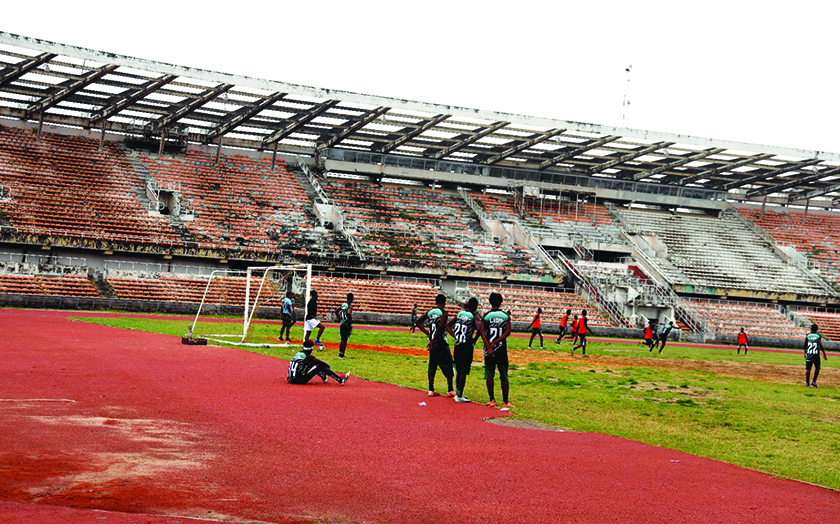
Built in 1972, the National Stadium in Surulere, Lagos, has witnessed countless memorable sporting events, hosting glorious moments achieved by individual athletes and teams alike. Its history spans from the Second All-Africa Games and Tunisia denying the Green Eagles Nigeria’s first World Cup ticket in 1977, to the senior national team winning its first African Cup of Nations title in 1980, and the Super Eagles’ controversial loss to Cameroon in the 2000 AFCON final. Indeed, one of Africa’s most decorated players, Samuel Eto’O Fils, once told this writer that his finest moment in football took place inside this iconic stadium. Today, these memories belong strictly to the past. The edifice has become a carcass of its former self, and numerous attempts to restore it to its former glory have failed to see the light of day. In this report, Kunle Adewale examines what can truly be done to reclaim the soul of what was once the pride of sports-loving Nigerians The main bowl of the National Stadium in Surulere, Lagos, stands as a quiet colossus. Outside its gates, the rhythmic drumming of traffic on the Funsho Williams Avenue creates a persistent hum, but inside, the air carries the weight of heavy, forgotten history. Once affectionately dubbed “Sports City,” this architectural masterpiece was the beating heart of West African sports. Today, it is a stark monument to Nigeria’s complex struggle with infrastructural maintenance. Yet, as the stadium undergoes a series of tactical interventions, the question remains: Can this legendary cathedral of sports ever truly roar again? Failed Promises: The Rituals of Sports Ministers It has become an unfortunate ritual for newly appointed Nigerian Sports Ministers to commence their tenures with a symbolic tour of the historic National Stadium in Surulere. On these high-profile visits, each official typically delivers impassioned speeches, promising comprehensive rehabilitation plans to fully restore the iconic sports complex to its former glory. Yet, time and again, these grand administrative declarations fade into oblivion. By the time these individuals leave office, the stadium is often left in a significantly more dilapidated state than when they first assumed power, continuing a painful, decades-long cycle of structural neglect. A recent manifestation of this frustrating trend occurred during the tenure of Senator John Owan-Enoh, the former Minister of Sports Development. Following a heavily publicised inspection of the sprawling complex, he lamented its sorrowful state and even suggested that the federal government might go as far as pulling down the entire structure to rebuild it from scratch. This radical approach was framed as the ultimate solution to bring the decaying arena back to a modern, fully functional state. However, like the long string of official promises that came before it, the proposal eventually proved to be nothing more than empty political rhetoric. As successive leadership transitions continue, the Surulere National Stadium remains a stark, deteriorating monument to unfulfilled promises and bureaucratic inertia. The Golden Era: What it Was Before When it was officially opened by the General Yakubu Gowon administration in 1972, the stadium was a symbol of post-civil war unity and oil-boom optimism. Built to world-class multi-purpose specifications, it initially boasted a 60,000-capacity layout before being adjusted to 50,000 in 1999. For decades, it anchored Nigeria’s greatest sporting memories: The 1973 All-Africa Games: Cementing Nigeria’s place as a continental sporting hub. The 1980 African Cup of Nations (AFCON): Where the Green Eagles won their first-ever continental title before a record-shattering crowd of 85,000 spectators. The African Football Cathedral has hosted legendary figures like Christian Chukwu, Emmanuel Okala, Haruna Ilerika, Segun Odegbami, Muda Lawal, Alosious Atuegbu, Stephen Keshi, Austin Okocha, Kanu Nwankwo, Rashidi Yekini amongst many other star players. “When this stadium first opened, we would walk long distances if we couldn’t afford transport just to watch a match here,” reminisced, Alhaji Lateef Mogaji, a Lagos taxi driver. It was more than a concrete structure; it was a sacred ground of collective joy. The Great Decay: The Present State The stadium’s fortunes waned dramatically in the early 2000s. Following the last major national team game hosted here in 2004, the federal government effectively locked its primary gates. What followed was a devastating two-decade decline driven by a lack of an institutional maintenance culture. The main bowl’s roof membrane tore away, the spectator stands crumbled under harsh weather, and the lush pitch gave way to wild weeds. While the stadium’s main bowl fell into decay, its vast compound transformed into an alternative commercial ecosystem. Mechanics, squatters, and traders moved in. By night, the outer perimeter birthed a booming nightlife, with popular drinking spots like O’Jez and the Old Skool Bar operating under the shadows of rotting concrete. Speaking to THISDAY Newspapers, former Nigeria international, Friday Ekpo said,” the situation of the stadium is heartbreaking. Government should take immediate action to restore the venue. They promised to renovate the stadium and ensure it is in good condition, but it shouldn’t take this long.” Tearing Down and Rebuilding: Previous Efforts The journey to fix the National Stadium has been a long series of stops and starts. Under former Sports Minister Sunday Dare, the ministry launched the Adopt-A-Stadium initiative. This public-private model yielded a major breakthrough when philanthropic billionaire Chief Kessington Adebutu (Baba Ijebu) donated N400 million to rehabilitate the main bowl pitch, the digital scoreboard, and the tartan tracks. However, the scale of the decay severely outpaced initial funding. Estimates revealed that a staggering N21 billion was required for a total overhaul. As Dare noted during his tenure, “We only got an injection of N400 million, which is about four percent of the 100 percent of what we need. We were realistic. If I need 100 percent and I have four percent, I have to keep going.” While the pitch saw partial restoration, structural challenges like the leaking roof and concrete fatigue left the main bowl unusable. Is There Hope? The 2026 Turning Point Despite years of disappointment, there is renewed momentum. The National Sports Commission (NSC), under Chairman Shehu Dikko, has prioritised a shift away from temporary fixes toward a comprehensive Public-Private Partnership (PPP) concession model. The current turnaround targets critical upgrades: The “Morocco Standard” Pitch: International contractors have been engaged to overhaul the playing surface with hybrid grass and high-tech drainage, modeled after elite modern AFCON venues. Focus has officially shifted to repairing the leaking roof structure and rebuilding spectator seating areas. Crucially, while the main bowl remains sealed for heavy structural remediation, the surrounding facilities—the Olympic Swimming Pool, Indoor Sports Hall, and Tennis Courts—remain functional and alive with local athletes, skaters, and youth training daily. As NSC Chairman observed: “It’s quite sad that an iconic national edifice of this nature was left unattended for decades to rot, but the NSC is working in earnest to fast-track and conclude the concessioning to achieve the desired objectives of creating a sports city within the complex.” The Way Forward For the National Stadium to transition from a nostalgic relic to a sustainable asset, football analysts and infrastructure experts argue that the old model of full government management must be retired. Complete Commercial Concession: The stadium complex must be treated as a commercial enterprise. Sourcing private hospitality, retail, and corporate investors to utilise the massive land available will ensure the venue generates its own maintenance budget. Legislative Safeguards for Maintenance: Nigeria must establish strict legal frameworks that mandate yearly structural health audits for public properties, decoupling infrastructure care from changing political administrations. Integration into the Modern Sports Economy: The facility must be built to host more than just sporadic football matches. Reconfiguring it to handle massive musical concerts, corporate conventions, and multi-sport academies will guarantee year-round revenue. The National Stadium Surulere is not merely a collection of decaying stands; it holds the modern history of Nigerian sportsmanship. If the current concession plans hold firm, the “Big Eagle” of Surulere may finally get its wings back. The Athletes’ Perspective Former Nigerian international and AFCON silver medalist, Paul Okoku in a chat with THISDAY said: “The National Stadium, Surulere, holds powerful memories for me. It was once the heartbeat of Nigerian football, producing and showcasing generations of great players while hosting unforgettable matches that united the country. “Saving its soul requires more than renovation. It needs consistent maintenance, professional management, regular sporting activities and protection from neglect and political abandonment. “The stadium should again become a living home for Nigerian sport, where future generations can create their own history—not merely a monument to the greatness we once witnessed there.” For Chief Segun Odegbami, a member of the glorious 1980 AFCON triumph, “Surulere was our colosseum. When you stepped onto that pitch, with 80,000 Nigerians roaring from the stands, you felt invincible. It didn’t matter who the opponent was; you knew the stadium itself would lift you up. “To see it abandoned to mechanics and weeds for all these years is a national tragedy. It represents a betrayal of our sporting heritage. Rebuilding it isn’t just about mixing cement; it’s about restoring the pride of Nigerian sports.” International Appraisal In spite of having played at several iconic stadiums around the world and with several laurels to show for his illustrious football career, Cameroon soccer legend, Samuel Eto’O Fils once revealed to this writer that his best moment as a footballer was at the National Stadium, Surulere, Lagos. For a global superstar who conquered Europe with Barcelona and Inter Milan—lifting multiple UEFA Champions League trophies—and who graced legendary pitches like the Camp Nou, San Siro, and Santiago Bernabéu, this admission remains deeply profound. Yet, the magic of Lagos held a unique allure that European nights could never quite replicate. It was a core memory forged right in the heart of West Africa. Recalling that historic afternoon in February 2000, when a star-studded Indomitable Lions squad clashed with Nigeria’s Super Eagles in a thrilling Africa Cup of Nations final, Eto’o’s eyes lit up with nostalgic reverence. “I cannot forget the National Stadium, Nigeria. That is where I won my first Africa Cup of Nations and it was a special moment in my football career. Nigeria is a special country to me,” Eto’O said. The deafening roar of the Lagos crowd, the high-stakes tension of the penalty shootout, and the sheer ecstasy of lifting his maiden continental trophy solidified that stadium as hallowed ground for him. It was the exact launching pad that propelled a young, ambitious striker into a global footballing icon, forever tying his legacy to the vibrant spirit of Nigeria. The Fans’ Lament Fans remain the bedrock of the Lagos sports community. Complete with a sign of resignation, local football fan and Surulere resident, Femi Alawode in his submission , reflected deeply on his vivid memories as a firsthand eyewitness to the historic first goal scored inside the main bowl of the National Stadium in Lagos. “Though I was just a Form One secondary school student when Nigeria proudly hosted and celebrated the Second All Africa Games in 1973, the stadium felt like the greatest thing that had ever happened to our country at the time,” Alawode recalled. “Because our house was so close to the complex, my day never felt complete unless I stepped inside the facility. It truly felt like a vibrant, self-contained city carved right out of the heart of Surulere.” He noted that the surrounding community deeply shared this connection, eagerly anticipating every matchday. “Residents looked forward to every event because it brought brisk business and vital economic life to local small-scale business owners, from food vendors to souvenir sellers. Sadly, all those bustling events and that lively atmosphere are completely gone from existence now.” Alawode expressed disappointment at the current state of the iconic landmark. “It is a profound shame that younger generations will never get to see or experience this magnificent edifice as we once knew it,” he lamented, pointing to years of neglect that have left a monument of national pride in near ruins. As the faint echoes of past sporting glories continue to fade from its rusted, weathered stands, a profound silence hangs over a venue that once defined Nigerian athletic excellence. Submission It remains to be seen if the legendary National Stadium in Surulere, Lagos, can successfully overcome decades of heartbreaking abandonment and systemic neglect. Reclaiming its former glory requires more than structural repairs; it demands a revival of the passion that once united a nation within its walls. Only time will tell if this iconic arena can fully resurrect its spirit and finally regain its rhythmic, pulsing heartbeat for future generations.
Can National Stadium Surulere Reclaim Its Soul?
Full Article
Original Source
Read the full article at Thisdaylive →KhanList aggregates and links to publicly available news content. We do not host full articles from third-party sources. Always verify important information with original sources.