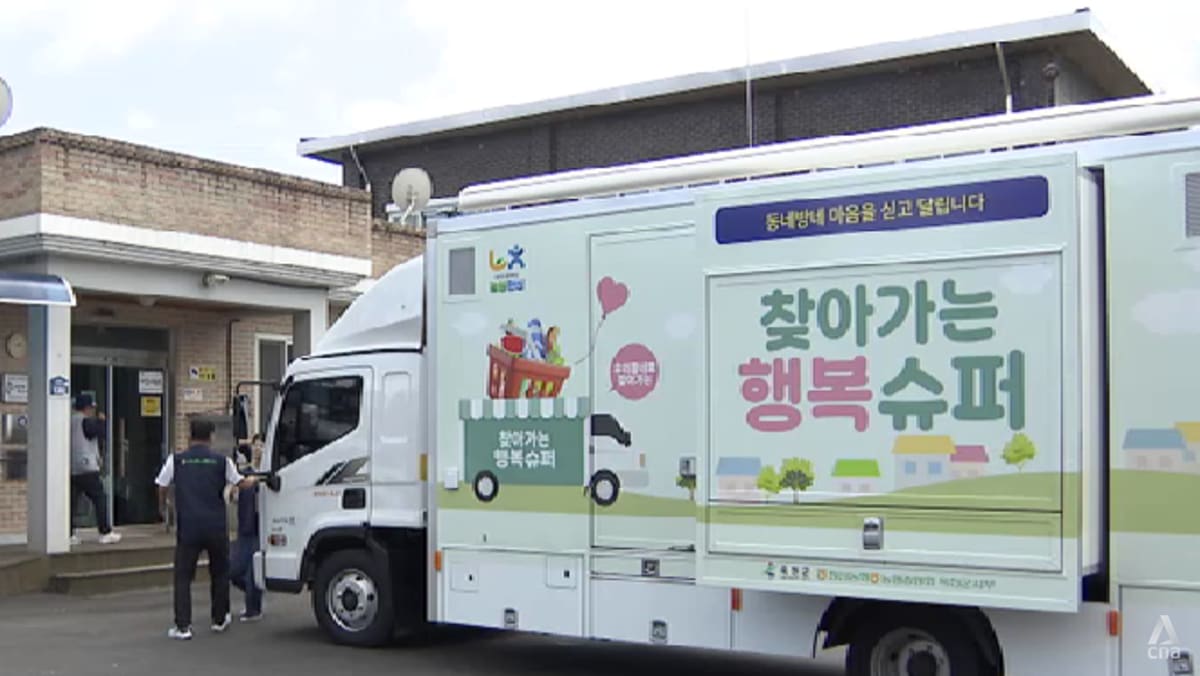
Asia A pilot scheme to offer monthly vouchers in rural South Korea is boosting local spending and attracting new residents. But officials say reversing decades of depopulation will require much more than cash incentives. Okcheon County’s first supermarket on wheels brings fresh groceries directly to residents – a much-needed lifeline for the village's residents. New: You can now listen to articles. This audio is generated by an AI tool. OKCHEON, South Korea: Every two weeks, elderly residents in a rural South Korean village gather in wait for a colourful van to pull up to the curbside.The van is Okcheon County’s first supermarket on wheels, bringing fresh groceries directly to residents – a much-needed lifeline for villages like these."I buy bean sprouts, tofu and ice cream. It's much more convenient than having to go to a store,” said one resident.Located about two hours south of Seoul in the North Chungcheong Province, Okcheon has about 50,000 residents, nearly half of whom are aged 60 or older."I don’t have a car. Without transportation, it’s hard to get around,” another resident said.Launched in June, the mobile supermarket is part of a broader effort by the county to reverse decades of population decline and make rural life more sustainable. INCENTIVES TO REVIVE RURAL COMMUNITIESUnder a two-year government-backed “rural basic income” pilot programme launched in December, every eligible resident receives vouchers worth 150,000 won (US$103) each month. There is currently no employment requirement to qualify. The vouchers are loaded onto a physical card that residents can use at designated local businesses, ensuring the money circulates within the local economy. The mobile supermarket is one such participating businesses.New residents become eligible only after registering and living in the county for at least three months.Mayor Hwang Kyu-chul credits the programme with helping the county gain about 2,000 residents since the pilot began, pushing the population back above 50,000 for the first time in four years.Among the newcomers is 33-year-old hairdresser Yang Hee-su, who moved from the southwestern city of Mokpo earlier this year to be closer to his parents.Yang, who opened his hair salon in Okcheon in March, said the voucher scheme has helped boost business.“The basic income has to be used in the village where you actually live … and (customers) have been coming in and using (the vouchers) a lot," he said.“I guess the people here didn't have a good place nearby to get their hair done.”The programme has also benefited local farmers such as peach grower Kwak Jung-seop. He said spending at his stall in Okcheon’s local produce market had risen by about 20 to 30 per cent.“It's not just about population inflow,” he said.“I'm using it myself too. We eat out more and we buy farming supplies and pesticides with it.” Peach grower Kwak Jung-seop said spending at his stall in Okcheon’s local produce market had risen by about 20 to 30 per cent. CALLS TO EASE RESTRICTIONSBut some vendors say restrictions on where the vouchers can be spent are limiting the scheme's impact. They argue that the vouchers should not be limited to individual townships, saying residents from neighbouring villages should also be able to spend them in Okcheon town, where there are more shops and services. “It would help (our business) out, and it would be better for the elderly residents too,” one market vendor said. The programme has since expanded to 17 counties across South Korea .But while communities such as Okcheon say the scheme is breathing life into their local economies, others argue financial incentives alone cannot reverse decades of rural decline. THE CHALLENGE OF RURAL REVIVALYeoncheon County, which borders North Korea, was the first place to trial the programme four years ago.The lure of the monthly government benefits led restaurant owner Ahn Se-il to return home and set up an eatery after nearly 50 years away."I hadn’t planned on running a business, but then they said they’d give out basic income, and since my wife had some experience running a business, we thought, let’s try opening a restaurant," said Ahn, saying that he has seen more customers since the start of the scheme.Shop owner Shin Young-soon first came to Yeoncheon as the wife of a soldier more than 40 years ago and has remained ever since.She said the basic income programme has boosted business by at least 30 to 40 per cent.“It has really made a big difference. I’m worried that people won't know what to do when the (programme) ends,” said Shin. Yeoncheon county shop owner Shin Young-soon said the basic income programme has boosted business by at least 30 to 40 per cent. BARRIERS TO GROWTHDespite stronger spending at local businesses, attracting jobs and investment remains a challenge.Just outside Yeoncheon town, an industrial park remains largely empty, with the occupancy rate hovering at 29 per cent three years after its completion.Yeoncheon's Mayor Kim Deog-hyun said the monthly vouchers alone may encourage some residents to stay put, but the scheme itself is not enough to “fundamentally determine population trends”.“We need to create a good living environment. Young people especially need jobs. That means attracting companies to the area,” he said.Kim said military restrictions on the county, which borders North Korea, have made development difficult."The entire county is larger than Seoul and about 94 per cent of its land is subject to military protection zone regulations. There are many restrictions on construction and development.”Yeoncheon’s experience suggests reviving South Korea’s rural communities may require more than government benefits.Across South Korea, 69 county-level areas are officially classified as being at risk of extinction because of shrinking and ageing populations.While the rural basic income pilot has boosted local spending in participating counties, whether it can reverse decades of rural decline remains an open question.In Okcheon, however, supporters say the programme has already become part of everyday life.Residents have even coined a name for the day the monthly vouchers are distributed, said Hwang.“As the elderly here put it, our ‘basic income day’ is the 27th of every month,” he said.“On the 27th, 28th and 29th, the sound of delivery motorcycles fills the streets. That's how much this programme has helped the local economy."
Can monthly vouchers revive South Korea’s shrinking rural communities?
Full Article
Original Source
Read the full article at Channelnewsasia →KhanList aggregates and links to publicly available news content. We do not host full articles from third-party sources. Always verify important information with original sources.