
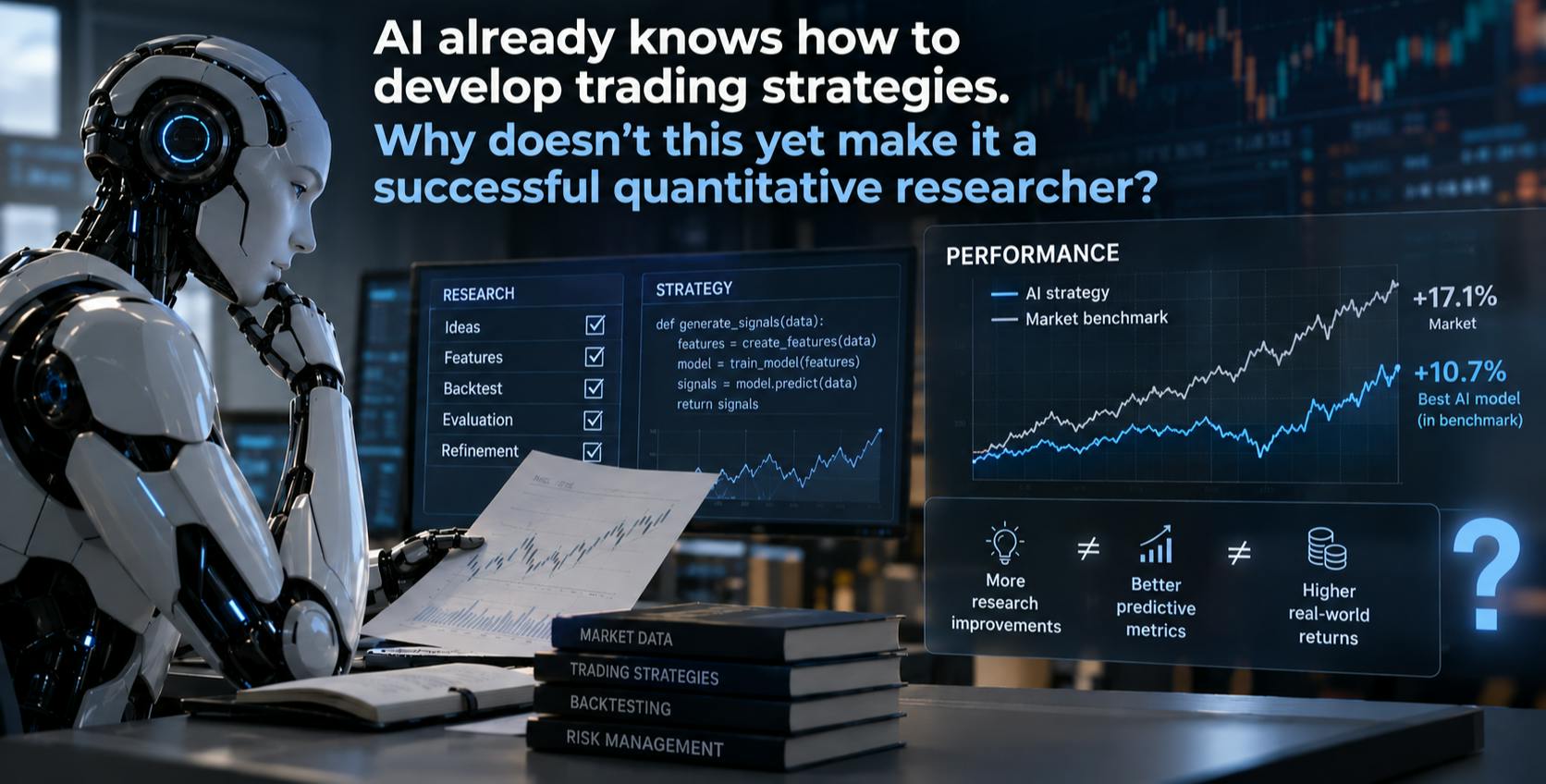
Why better research scores don't necessarily lead to better trading strategies AI models can generate trading strategies and improve research scores. But can they discover strategies that deliver meaningful out-of-sample returns? Artificial intelligence is moving beyond financial analysis into autonomous quantitative research. Modern large language models can formulate hypotheses, generate market features, write trading code, run backtests, and revise strategies based on feedback. But a critical question remains: Does becoming better at quantitative research actually make an AI better at discovering profitable trading strategies? A study published on October 21, 2026, offers new evidence. Quant-Arena: Benchmarking LLM Agents for Quantitative Trading Research, by Houde Qian and colleagues, evaluates nine language models across 38 configurations. Its central finding is that improvements in research capability do not consistently translate into stronger financial performance. 1. From Writing Code to Conducting Research Traditional financial AI benchmarks often evaluate isolated capabilities: predicting prices, calculating indicators, or generating code. Quant-Arena examines a more complete research process. Models formulate trading hypotheses, construct features, generate executable strategies, analyze feedback, and select candidates for final evaluation. The benchmark uses data from 3,042 Chinese A-share stocks, including daily market observations and detailed Level-2 trading records. Its evaluation process has three stages. Research: Models develop strategies using 2022–2023 data and receive limited feedback on up to five candidates. Commitment: Each model selects one final strategy. Its implementation is frozen. Evaluation: The strategy is tested on a withheld 2024 period using a cash-account simulator with trading constraints, transaction costs, and estimated market impact. This design separates strategy development from final evaluation. It also measures something more meaningful than code generation alone: whether an autonomous research process produces strategies that generalize beyond its development sample. 2. The Results: Better Research, Disappointing Returns During 2024, the equal-weighted market benchmark returned approximately 17.1%. Of the 38 configurations evaluated: Only 13 generated positive returns. One configuration, GPT-6 Sol at medium reasoning effort, achieved approximately 18.4%. The highest-scoring overall configuration, GPT-6 Astra, returned approximately 10.7%. The difference between the last two results is important. GPT-6 Astra performed best according to the benchmark's overall scoring methodology, yet substantially underperformed the market. Meanwhile, one lower-ranked configuration slightly exceeded the market return. The researchers state that no model outperformed the market when comparing each model's highest-scoring configuration. The full results include the single exception mentioned above. This distinction matters because research quality and investment performance are not interchangeable measurements. The market comparison also has a limitation: evaluated portfolios include trading costs, while the equal-weighted benchmark is reported before those costs. 3. Why Iteration Doesn't Guarantee Better Strategies Quant-Arena compares two research approaches. In one-shot generation, models produce a strategy without iterative feedback. In iterative research, they can examine results, identify weaknesses, and improve their implementations. Iteration improved the average research score from 36.47 to 43.55. However, financial outcomes were mixed. Returns improved for only four of the nine models. The remaining five performed worse. The average improvement in annualized returns was approximately 2.9 percentage points. Researchers also observed diminishing benefits from additional revisions. Much of the early progress came from correcting unsuccessful initial strategies. Later changes delivered smaller and less consistent improvements. This creates a fundamental evaluation problem. A model may improve its ability to use research tools, correct implementation errors, or optimize historical metrics without discovering a persistent market relationship. Repeated optimization can also increase sensitivity to sample-specific patterns. The benchmark does not prove that every unsuccessful iteration resulted from overfitting. It does demonstrate why improvement during research cannot be treated as evidence of improved out-of-sample performance. 4. The Ranking Paradox: Predictive Skill Without Portfolio Value Another revealing result concerns RankIC, a metric measuring the relationship between predicted asset rankings and subsequent returns. A positive RankIC suggests some predictive ability. But a portfolio does not necessarily invest in every ranked stock. Quant-Arena's evaluator targets a portfolio of 75 stocks, emphasizing those receiving the highest scores. For several models, stocks in the second or third highest score deciles subsequently outperformed those in the highest decile. The models could rank the broader market reasonably well while making weaker selections where their predictions directly affected portfolio construction. Across the 38 configurations, the Spearman correlation between average RankIC and trading returns was approximately 0.09. That is an extremely weak relationship in this experiment. The lesson extends beyond this particular benchmark. A useful predictive signal does not automatically produce a useful trading strategy. Economic outcomes also depend on portfolio construction, exposure, turnover, market conditions, and execution costs. Statistical prediction quality and financial utility must therefore be evaluated separately. 5. What Did the LLM Already Know? Quant-Arena withholds 2024 market data from the research interface. This is an important safeguard against direct look-ahead bias during strategy development. However, historical evaluation of modern LLMs introduces another challenge. Some models may have been trained on information published after the evaluation period. Even if the research interface prevents access to future prices, the model's pretraining data might contain market narratives, company events, or other information about subsequent outcomes. This does not establish that Quant-Arena suffered from such contamination. It means interface restrictions alone cannot prove its absence. A separate study, From Knowing to Doing: A Memory-Controlled Benchmark for LLM Trading Agents on Stock Markets, addresses this problem directly. The researchers introduced a benchmark that masks identifying information and calendar details to reduce reliance on memorized historical events. They also separated portfolio returns into market, investment-style, and stock-selection components. Their findings suggest that apparent financial success can reflect market exposure rather than persistent stock-selection ability. Together, these studies highlight two different requirements: Information control: Could the model access knowledge unavailable at the historical decision time? Performance attribution: Did the strategy demonstrate independent investment skill, or merely benefit from market conditions? A positive backtest does not answer either question automatically. 6. Executable Code Is Not Necessarily Correct Research Another methodological problem concerns the reliability of AI-generated financial code. A program may execute successfully while implementing an invalid trading hypothesis. For example, it might inadvertently use future information, mishandle time alignment, or calculate indicators incorrectly. These errors can generate plausible results without producing a valid experiment. The 2026 ACL paper ALPHAQT-BENCH: Diagnosing the Gap between Financial Code Generation and Quantitative Reasoning in LLMs examines this distinction. Its evaluation framework tests four properties: Executability. Causal correctness. Functional accuracy. Structural compliance. Across 12 language models, the researchers found a substantial gap between producing runnable code and satisfying quantitative correctness requirements. This complements Quant-Arena. One benchmark evaluates whether AI can conduct an end-to-end quantitative research process. The other examines whether the financial code produced by AI is methodologically correct. Together, they suggest that successful autonomous research requires more than generating code and reporting positive historical returns. 7. What Should We Actually Measure? These findings point toward three separate evaluation questions. First: Can the AI formulate and implement a trading hypothesis? This measures research capability. Second: Is the research methodologically valid? This requires correct calculations, causal information boundaries, and independent evaluation. Third: Does the strategy demonstrate economic value beyond its development sample? This requires financial evidence that accounts for market exposure, trading costs, and relevant execution assumptions. A positive answer to one question does not guarantee positive answers to the others. 8. What Quant-Arena Does—and Does Not—Prove Quant-Arena demonstrates that language models can perform substantial parts of quantitative research. They can generate features, write strategies, interpret feedback, and revise implementations. However, the benchmark does not establish that autonomous LLM researchers consistently discover profitable trading strategies. Several limitations matter. The experiments focus on Chinese equities rather than cryptocurrencies or derivatives. The financial evaluation uses historical simulation, not real-money execution. The withheld evaluation period covers one calendar year. And potential contamination through pretraining information remains a methodological concern. These limitations prevent broad conclusions about AI trading performance across markets. Nevertheless, the study reveals an important distinction. The ability to automate quantitative research is not equivalent to the ability to discover reliable investment advantages. As AI systems become faster at generating hypotheses and conducting experiments, independent validation becomes more important—not less. The next meaningful advance may therefore be less about producing additional strategies and more about determining which research results actually deserve trust.
Can LLMs Actually Do Quantitative Research? Here's What Quant-Arena Found
Full Article
Original Source
Read the full article at Hackernoon →KhanList aggregates and links to publicly available news content. We do not host full articles from third-party sources. Always verify important information with original sources.