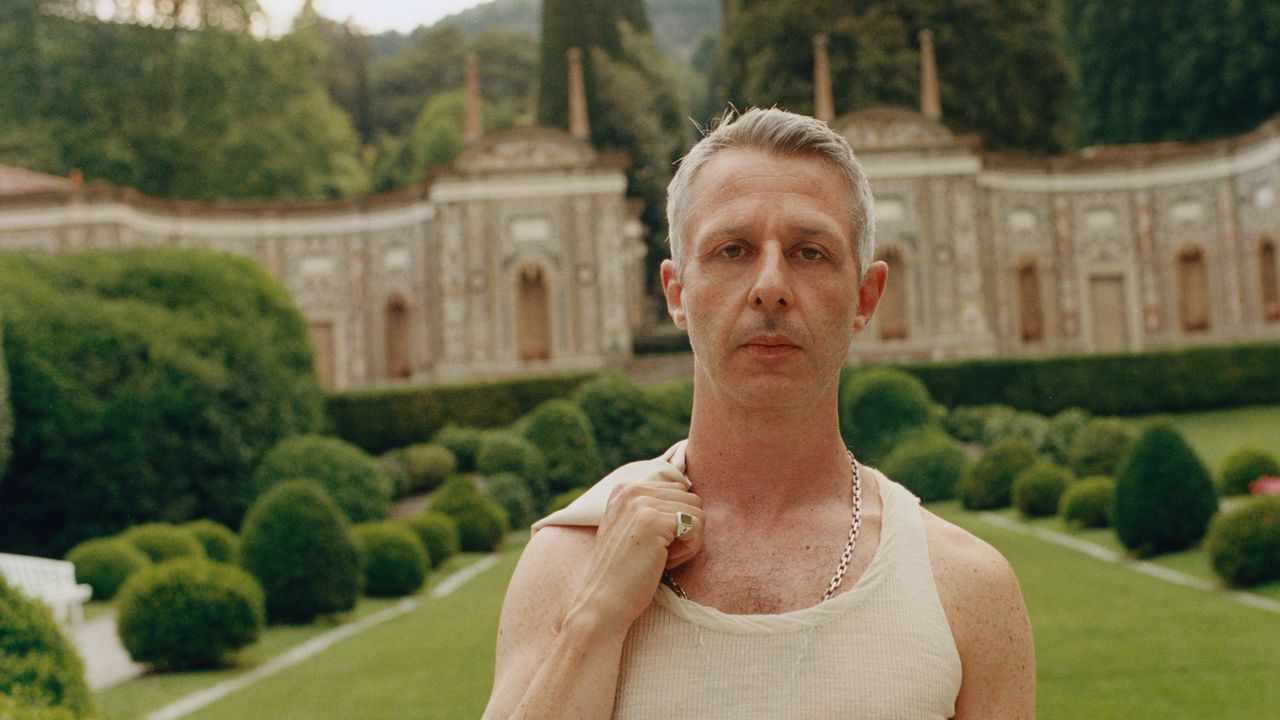
The instructions, when they come, are right out of a spy novel. Be at the Cheval Blanc hotel in Saint-Tropez at 3 p.m. on Monday. Look for a man with a mustache and a fake Polish accent.At 3:01, Jeremy Strong appears on the lobby stairs in the brownest South of France day-off fit you’ve ever seen, a walking earth-tone gradient from his no-logo baseball cap and sleeveless T-shirt right down to his shiny shorts and suede slip-ons. He looks a little like a UPS driver who delivers packages by paddleboard.Our latest issue is here. Subscribe now to secure your copy and get one year of GQ for $1/month. The mustache, a big old gray-flecked tickler, is for work, and so is the accent. He’s been pinging around Europe for seven months shooting a limited-series reboot of The Boys From Brazil, based on Ira Levin’s 1976 bestseller about a Nazi hunter who confronts the would-you-kill-Baby-Hitler dilemma in non-abstract terms.And because Strong’s character is Polish-born and German-educated—and because he’s Jeremy Strong, and would never dream of doing it any other way—he has spent the last seven months speaking like a German-educated Pole, because once he’s got a character’s voice dialed in he never turns it off until the project wraps. “I don’t want it to feel like an accent,” Strong says. “I want it to just be a person, and that’s their voice—and our voice is the most individual thing about us.”All clothing by Loro Piana. Bow, courtesy of Booster. Arrow, courtesy of CrossX. He doesn’t tell me this until I bring it up at our second meeting, though. Before our first meeting I’ve been notified that he’ll be “in accent,” and when we meet I don’t ask him about it because I want to see how long it takes him to mention it. In the course of that first meeting, he never does.“He called me six or eight weeks ago,” says Aaron Sorkin, the writer and director of The Social Reckoning, in which Strong delivers a similarly immersive performance as Facebook founder Mark Zuckerberg, “and without any introduction, he was just speaking as an Eastern European Nazi hunter, talking to me about the movie we had just made, without saying, ‘Hey, listen, this is going to sound strange, but.…’ ”“I enjoy very much talking to him when he’s in the throes of these other people,” Strong’s friend Bradley Cooper says. “I love it. I’ve talked to Mark Zuckerberg many times—I had a whole friendship with Mark Zuckerberg, and Mark Zuckerberg has no idea.”Strong is in Saint-Tropez to attend a regatta—“As you do,” he says with a knowing, how-crazy-is-this-life smile—sponsored by his friends at Loro Piana, the Italian fashion house that swaddled him and his Succession alter ego Kendall Roy in quietly luxurious wools. He’s not sure what differentiates a regatta from a regular boat race, although he’s pretty sure a regatta is a number of boat races over a period of time, which turns out to be correct. But, he adds, “If I was playing a sailor in a regatta, I would know the answer to your question—I would be, like, talking about the jib, and talking to you about how many knots, and all that.” This is funny, because of the accent, but—also because of the accent, and because he’s Jeremy Strong—I’m not sure it was supposed to be a joke.Shirt by Bottega Veneta. Scarf (at waist) by Hermès. Sunglasses by Jacques Marie Mage. Watch (throughout) by Richard Mille. His own ring (on ring finger, throughout) by Sidney Garber. All clothing by Balenciaga. Goggles, stylist’s own. We’re ushered to a Cheval Blanc villa, the kind of place where Kendall might have holed up to war-room some doomed C-suite power grab—high ceilings, crisp AC, a glass-wall view of moored yachts bobbing in the electric-blue Riviera. On the table in front of us there’s a tray of perfectly rough-hewn chocolate-chip cookies, which neither of us will touch. It’s a lovely day on the French Riviera, and he’s spent most of it in his room, reading a book about Operation Anthropoid, the Czech Resistance plot that killed Gestapo kingpin Reinhard Heydrich, because later this week he has to be back in Barcelona, in the headspace of a Holocaust survivor.“It almost, to be honest, feels grotesque to even talk about it in this context and in this setting,” Strong says. But he’s been submerged in this project, counting prep time, for a year and a half, so this is what he has to talk about when he’s asked what he’s been up to—sitting in five-star hotel rooms, tunneling into one of modern history’s darkest chapters, taking in The Rise and Fall of the Third Reich; the writings of Elie Wiesel, Simon Wiesenthal, and Primo Levi; Claude Lanzmann’s documentaries; and countless other source material, trying to let it all permeate him on a cellular level. Sometimes a man looks up and realizes he’s thought about almost nothing since November except World War II; for Strong, that time is right now. He’s read enough, The Boys From Brazil creator Peter Morgan told me in an email, that he “could now comfortably lecture on the subject,” before adding: “This is not a joke.”Morgan describes Strong as “Stakhanovite in his research,” invoking a legendarily hard-digging Soviet coal miner who became a mythic hero in Stalin’s Russia. Strong says he’s only being practical. “I have to say names of people who were real people who did abominable things,” he reasons. “I can’t say those names without understanding completely and to the best of my earthly ability who they were and what they did.”But he’s always been like this. He turns every page, until he’s ready to answer any question his character would know the answer to. “He came to work,” Sebastian Stan says of Strong’s first day as Roy Cohn on the set of The Apprentice, “and we were discovering the scene, and he went into this whole monologue about New York City in 1975. He was talking about the Mets game, and the mayor. I was like, Fuck.”“He somehow knows things no one has asked him to know yet,” says Jessica Chastain. In Zero Dark Thirty, the first of three films they’ve made together, Strong shows up in a couple of scenes as a CIA analyst; Chastain was surprised by his level of information awareness. “I remember thinking, That’s an oddly specific detail, and then realizing he’d probably spent a week reading classified-adjacent material from three different perspectives just so he could hand someone a file correctly. Most actors build the house. Jeremy somehow builds the plumbing too.”Vintage t-shirt, stylist’s own. Shorts and scarf by Hermès. Sunglasses by Prada. Shirt by Bottega Veneta. Swim shorts by Hermès. Sunglasses by Jacques Marie Mage. Watch by Richard Mille. And look, all this might sound crazy to you. Sometimes it seemed crazy to me. But it never sounded indulgent. There are those chair-chucking actors who’d rather torment their costars than go to therapy; Strong is just reading a lot of books and staying in a headspace by doing a voice all the time. He will eat a whole haystack in hopes of digesting a needle of truth, some detail that unlocks everything, even if it’s something the audience will never perceive. The work is studious, monkish, internal; the performances it breeds are implosive, all about the presence of a brain and an ocean of feeling behind those eyes.Could he have handed Jessica Chastain a file folder without all that intel in his brain? Probably. On the other hand: Can you imagine being an actor? Saying lines, pretending to be a different guy, trying not to take people out of the movie? And then doing that work at an incredibly high level, for Steven Spielberg and Kathryn Bigelow and Adam McKay, and you are, let’s say, an unusual-faced guy from Boston and none of this was probable for you at all? Wouldn’t you avail yourself of whatever process made you feel secure in having served the material, according to your own internal metrics?If you were about to play Mark Zuckerberg, one of the most powerful people on the planet, in a movie that touches so many third rails that you’re almost guaranteed to get yelled at by both Fox News and Jacobin no matter how good your performance is, wouldn’t you do whatever you could to take the fear out of that experience?Coat by Loro Piana. Shirt and swim shorts by JW Anderson. Because that’s what it’s really about, Jeremy Strong tells me. He describes himself as a “fearful person.” He feels “abject fear” on every job—and not just beforehand but every day on every job. “It’s almost an existential thing—a kind of despair that you won’t be able to unlock yourself,” he says, “that you won’t have the keys to your ignition, somehow.” This is distinct from anything like stage fright—Strong feels a “preternatural state of calm” when he finally steps onstage or in front of a camera. “But that feeling of readiness,” he says, “has to be earned and hard-won through an immense amount of preparation.”For what it’s worth, when I talked to Strong’s friends and collaborators about his process, none of them thought it was crazy, either. “Whatever you have to do to get there,” Bradley Cooper says, when we talk about the Polish accent. (On American Sniper, Cooper talked like Chris Kyle 24/7, even at dinner: “Clint Eastwood used to make fun of me.”)“He approaches his job the way I approach my job, which is completely all-in—viewing it as a psychological, spiritual, emotional, physical endeavor,” says Bruce Springsteen, who got to know Strong when he played Jon Landau, the Boss’s longtime manager, in Deliver Me From Nowhere. “You’re using your complete self to manifest something that’s basically magical.”Other friends described him as a lifeline call and a lodestar. “He’s sent me some of the most helpful thoughts around what it is that we’re doing,” his friend Oscar Isaac says—thoughts about acting as a calling, as opposed to a career.I can testify to his thoughtfulness. He’s a sender of multi-paragraph text messages, big blocks of considered words—addendums on things previously discussed, book recommendations, quotes from Joseph Campbell. (Strong is big on quotes—in the course of our conversations, he cited Bob Dylan, Robert Musil, Simone Weil, Al Pacino, Goethe, an email he got from Anthony Hopkins, and the Saturday Night Live sketch where Adam Sandler plays a travel agent warning depressed people that they’ll still be depressed in Italy. He feels his propensity to epigrammatize gets misconstrued as pretension. He’s just a magpie, he says. “It’s not about the shininess of the objects, but it’s about their usefulness. The magpie is just trying to build their nest, y’know?”)Vest by Versace.Back in 2017, a few months after Donald Trump was sworn in for the first time, I went to see the documentary filmmaker Adam Curtis do an onstage Q&A with Mad Men creator Matthew Weiner after a rep-theater screening of Michelangelo Antonioni’s The Passenger. As artists, Weiner asked Curtis toward the end of the night, what should we do now? Curtis answered: Go and tell us how the rich live. I wrote this down, and after my first meeting with Strong, I find it in my Notes app and send it to him—thinking of Succession, and all the other projects where he’s explored the spiritually impoverished inner lives of the one percent.Strong replies that he’s not sure he agrees with Curtis that this is all artists should be doing—that he thinks artists, in this historical moment, “should tell us what is irreducibly human and worth fighting for.” He sends me a picture of a quote he kept taped to his dressing room mirror when he did Henrik Ibsen’s An Enemy of the People on Broadway; it’s the line about “forc[ing] our brothers to see themselves as they are, to cease fleeing from reality and begin to change it.” It’s like Strong is saying, Don’t even try going quote for quote with the Quotemaster. (Just kidding: He is unfailingly polite and considered in his texts, and makes only an irreducibly human number of typos.)Bradley Cooper laughs when I mention Jeremy sending voluminous text messages. “Yeah, dude,” Cooper says, delighted. “He’s my friend. I can’t say I have that many in this business, but I consider him my friend.” Cooper sends Strong work-in-progress drafts of scripts and shows him cuts of movies he’s editing. They’ll watch, Cooper says, and they’ll talk, “and then the choice text, or the choice thought, will usually come [when he’s] on his way home on the subway, or he just got home [and] he has a second to meditate on it. He’s so insightful about story and character and truth.”They spent a bit of time together years ago, at the Williamstown Theater Festival, in 2012. The next time Cooper saw Strong was years later, on Succession. “I was like, I can’t believe that’s the guy I met. What a fucking actor this guy is.” He set up a meeting just to tell him this in person. Strong was getting ready to play Jerry Rubin in Sorkin’s The Trial of the Chicago 7 at the time, so he came over to Bradley Cooper’s house wearing a beaded headband. Cooper began praising Strong’s work and started to cry. They’ve been close ever since.This is kind of how everybody’s relationship with Jeremy Strong has evolved. People—even people who’d seen him in movies before—watched him on Succession and thought, What a fucking actor. He’d always been good, but in Succession he made us feel things. Kendall Roy, a corporate-media failson with eyes like a pair of open graves, was guilty of crimes ranging from involuntary vehicular manslaughter to rapping in public, but people loved and rooted for him anyway. TikTokers called him “babygirl,” claimed him as a parental-abuse survivor, and cut sad-Kendall montages to anguished Mitski songs.Jacket by Versace. Shirt by Loro Piana. Pants by Magliano. Forty hours of serialized television fosters a level of empathetic identification that movies just don’t. Top Letterboxd comment on Love Is Like Life but Longer, a 2011 short film about a nun who falls for a blind man played by Jeremy Strong: “cried one minute in when i realized i’ll never marry jeremy strong and have his children and see him when i wake up in the morning”—three and a half stars. Second-from-top Letterboxd comment on same movie: “You better fucking believe that I would give up being a nun for Jeremy Strong, no fucking doubt about it.” (Five stars.)His professional life has been different since Succession. You don’t typically get a career glow-up like this as a character actor. But Strong didn’t become the kind of famous person people would leave the nunnery for until he was almost 40. And by the time it happened, he and his wife, Emma Wall, a child psychiatrist and documentary filmmaker, had three young daughters, all born during Succession’s five-year run, now four and six and eight. He thinks a lot, these days, about trade-offs—when to chase after opportunities (because he’s 47 now, and understands that this moment, like life, is finite) even if it means time away from the kids.Shirt and tie by Dolce & Gabbana. Shorts by Ralph Lauren Purple Label. When they were shooting Deliver Me From Nowhere, Jeremy Allen White says, he and Strong talked frequently “about the balance of work and family life, and the importance of that.” White was playing the young Bruce Springsteen in a stage of creative isolation; those conversations, he says, helped him understand Springsteen as a man trying to make space in his life for a partner and a family. But he and Strong were also working their own stuff out. They were both riding career updrafts, asking themselves the same questions: What do you do when you have a family at home, and then the world opens up to you, after you’ve worked and waited so long for that to happen?Strong and Oscar Isaac talk about this stuff too, being committed to a vocation and to a family and how to navigate that with grace. In the beginning, Isaac points out, being an actor is exciting because actors are vagabonds: “It’s people who are running off to go into deeper, darker places, and are not necessarily conforming to a more conventional life. And then as these more conventional things start to emerge, the world’s not as narrow anymore, and that can cause a lot of conflict.”Plus, as an actor, you’re choosing isolation, if you do this job the way Strong does it. Isolation from other people, but also isolation from yourself. At one point Strong reckons that he hasn’t spoken in his own voice since September. He finished shooting his scenes for The Social Reckoning around Thanksgiving, and after that he took a ferry to the Wickaninnish Inn, out where Highway 4 terminates on the west coast of Vancouver Island, British Columbia. A beautiful ride—but he was about to get on a plane to Germany for The Boys From Brazil, and he didn’t feel ready yet, so he went down to the belly of the boat and sat in his rental car for an hour, practicing his Polish accent.If you’re going to do this to yourself, he’s figured out, it has to feel like the strain is worth it. It’s why he’s gravitated toward the most intimidating creative opportunities that have come his way, whether it’s Roy Cohn in a lightning-rod Donald Trump biopic, or doing Ibsen without a net eight times a week, or playing Mark Zuckerberg. “It’s not laundry-folding content,” Strong says. “And the things I’m developing and trying to manifest will continue to be those kinds of things. Otherwise, what am I doing away from my kids? Otherwise, I should just be home…. When I come home at night, or at the end of a 10-month odyssey, I just want to feel like, Yeah, I leveled up as much as I possibly could.”When we meet in France, it’s just over a week after the The Social Reckoning trailer drops, to wildly mixed response—some take-my-money enthusiasm, some guarded curiosity, a fair amount of why-did-they-bother skepticism. Insta-haters goof on Mikey Madison’s line readings and jeer the trailer’s use of Trent Reznor and Atticus Ross’s Social Network score as stolen valor. The reaction to this first glimpse of Strong with a Zuckerberg haircut, doing Zuckerberg’s voice, is equally split. One commenter suggests that Strong is either getting another Oscar nomination for this one, or a Razzie—“no middle ground.”There’s a fairly giant question mark hanging over the whole project. David Fincher’s The Social Network was always going to be a tough act to follow—it’s one of the best American movies of the 21st century and the best movie anyone’s ever made of an Aaron Sorkin script (with all due respect to A Few Good Men and Sorkin’s own underrated Molly’s Game, featuring Strong as a vividly unpleasant 2000s-vintage Poker Asshole), and you’d have to be a fool (or Aaron Sorkin) to step in to direct a sequel, especially a sequel starring a different guy as a seemingly even-less-likable Mark Zuckerberg. (Then again, people thought a movie about the founding of Facebook was a bad or at least inexplicable idea until The Social Network came out. Nobody knows anything.)Sorkin shrugs when I ask him about the inevitable comparisons. “It’s just a good story, and I wanted to tell it,” he says. “I think maybe I’ve gotten to the point in my life where I’m caring less about things like comparison.”All clothing by Loro Piana. He’s also confident that Reckoning is different enough from Network that it’ll carve out its own space in the conversation once people actually see it. The new movie is based on the true story of a whistleblower—Frances Haugen, a Facebook product manager and former member of the platform’s civic integrity team—and her decision to share a trove of internal Facebook documents with a Wall Street Journal reporter, Jeff Horwitz. In a series of stories based on these documents, the Journal scrutinized the platform’s response to everything from political polarization and vaccine hesitancy to ethnic violence in Ethiopia and the mental health struggles of teenage Instagram users; Facebook, the Journal wrote, “knows, in acute detail, that its platforms are riddled with flaws that cause harm, often in ways only the company fully understands.” (Zuckerberg, in a Facebook post at the time, said that the paper’s reporting painted “a false picture of the company”.)The Social Reckoning primarily tells the story of the leak, with Mikey Madison as Haugen and Jeremy Allen White as Horwitz. But in true Sorkin fashion, there’s also a backstage melodrama unfolding in a second timeline, in which Zuckerberg, prepping for a Congressional hearing, argues with an adviser (Bill Burr) about free speech—until the Journal’s story breaks and the two narrative trains collide.Strong remembers bumping into Sorkin at a party a few Oscar seasons ago, hearing what Sorkin was working on, and telling him, If Jesse Eisenberg doesn’t do it, call me. “Because it’s the kind of role that fascinates me,” Strong says, especially now that Zuckerberg is one of the most recognizable public figures of his generation. “It’s like Sebastian playing Trump,” Strong says. “You are wearing the cape. It’s like Jeremy [Allen White] playing Bruce. It’s like, the perils of that could not be greater. To commit to it, and to be free within it, is a great challenge.”Last year, Eisenberg told the BBC that being historically linked with Zuckerberg has been a source of frustration. “[It’s] not like I played a great golfer and now people think I’m a great golfer,” he said. “It’s this guy that’s doing things that are problematic.”But this—the fact that Zuckerberg has become such a polarizing figure in the years since The Social Network—was part of why Strong was eager to dive in. “Listen, I know that he is a reviled person and not a popular person in our culture,” Strong says, “but I do not think you should have an actor playing him who wants to set out to condemn him.” He also acknowledges “the unspoken thing, which is, like, it’s crazy to take this on at all. It’s crazy.”It’s crazy not just because it’s a sequel—by a different director, with a different star—to a highly regarded movie, or because Strong, 47, is playing a mid-30s Mark Zuckerberg, although it’s crazy for those reasons too. It’s crazy because—as Strong puts it—we live in a crazy, hyperpoliticized world, and the subject of Facebook is an “ideological minefield.” A movie like this one, which addresses the company’s response to the COVID-19 pandemic and January 6, is inevitably going to be read through a partisan lens. It’ll either get dinged for being insufficiently critical of Zuckerberg and his tech-overlord cohort, or for being irresponsibly biased against them—both, probably. And Strong clearly doesn’t want to screw the project over by saying anything on the record that would tip that scale in either direction.Robe by Tom Ford. Stylist’s own tank top by Frnkow. “It feels incredibly fraught,” he says, “to talk about the movie, to talk about Mark and being the person who is playing Mark and representing Mark in a sense to the world and to posterity; I feel an enormous sense of weight and responsibility. And listen, my job is to understand and defend his point of view and fight his fight.”Plus—and Strong says this was important—Zuckerberg is also a real person, a human being with children. They have been in the same room only once—Zuckerberg and his wife, Priscilla Chan, are cofounders of the Breakthrough Prize, a kind of Oscars for science, and they were at the ceremony last year, when Strong presented an award to the University of Washington biochemist David Baker. They didn’t meet that day, and they still haven’t. But when Strong took on Social Reckoning, he reached out to his subject.“I wrote to him—I’m probably going to give Sony an aneurysm—I sent him an email,” Strong says. “Just to say that I take this responsibility very seriously, and the veracity of it seriously, and I’m approaching it with respect.”He won’t speak to Zuckerberg’s response, but confirms that Zuckerberg wrote him back. He says if Zuckerberg had invited him to hang out at Meta’s offices, he probably wouldn’t have accepted. He’s played real people before—Jon Landau, Roy Cohn, Jerry Rubin, even Lee Harvey Oswald—and he’s done his share of in-person research, but he finds it easier to do the job from an objective distance, by reading and watching.Eisenberg’s “Mark,” from The Social Network, while compellingly caustic, is basically a fictional creation who only circumstantially resembles the Zuckerberg we’ve since come to know. Like Kendall Roy, whose father-wound made him emotionally legible despite his wealth and privilege, the character has a clean and comprehensible origin story—he invents a website that will reshape the world, toppling dictatorships and democracies alike, because Rooney Mara dumps him for being an asshole and there’s nothing he can do to change her mind.“But, of course, he was already with Priscilla at the time,” Strong notes. He didn’t want to play a fictional character in a Mark Zuckerberg–type situation. “I wanted to play Mark Zuckerberg,” he says.And from a research perspective, Strong says, Zuckerberg was “the mother lode.” He wanted to absorb everything he could—podcasts, magazine interviews, tech-summit talks, and ideas-festival conversations. He watched footage of Zuckerberg testifying before Congress “until my eyes fell out of my head,” trying to internalize it. He doesn’t do social media, but he signed up for a Facebook account to read through Zuckerberg’s posts from the beginning, a longitudinal record of Zuckerberg’s evolution, in the gap between the two films, into a “wartime CEO.”Even after all that preparation, Strong says, he found himself experiencing “a total crisis of faith,” worried that his performance would read as nothing more than Jeremy Strong in a hoodie, like some cheap-shot sketch-comedy impersonation.These days he’s less worried about how it’ll be received. Someone showed him the Oscar/Razzie tweet, and he took it as a compliment. “I thought that was the greatest endorsement,” Strong says. “Because to me, it was like—listen, I’ll be sad if I win a Razzie, but that’s the place you want to be. That’s the wager you have to make. To me, that means, Okay, I put it on the line enough.”Tank top by Maison Margiela. A week or so after we part company in Saint-Tropez, Strong walks into Ingas Bar in Brooklyn. He’s wearing what looks like the same brown sleeveless T-shirt. The mustache is gone; a trace of the Polish accent remains, but only a trace. Having wrapped The Boys From Brazil, he’s feeling “a million pounds lighter”—but he also feels the way he always feels when he’s finished something. A little discombobulated, a little lost, missing the sense of purpose that comes with giving everything to a project.More than once in the past, he’s compared his process to diving; the research becomes the psychic ballast that lets him sink into a part. There are procedures, in diving, for returning safely to surface. I ask how he goes about emerging from a completed project without getting the bends.“I wish I knew,” he says. “I wish I knew. I think it’s always a bit of a hard reentry, and a feeling of loss. You’ve invested so much into something on a deep level, and then all of a sudden it’s gone, because it’s just a dream. It’s not real.”We’re the only people in here—it’s one o’clock, and Ingas is closed until 5 p.m.—but Strong’s friend, chef Sean Remold, who co-owns the place with his wife, has opened up for us. Remold sets down a couple of plates—sliced tomatoes, the first of the season, and a little pile of mortadella dusted with pistachio and aged Gouda—and we talk about Strong’s last day on the Boys set in Barcelona.At the end of the day they needed to pick up some shots for a sequence they’d first filmed back in December—Strong’s character arriving by cattle car at a concentration camp. “So we had to jump back into that,” Strong says. “It was a crazy way to finish.”He had to shave off his mustache for continuity. “I shut my door. I was in my trailer. I did it alone. I was a bit overcome with emotion, because a part of you doesn’t want to shave it. A part of you doesn’t want to let go of it.”In Barcelona, he had no lines, so he put on the Polish composer Krzysztof Penderecki’s “Threnody for the Victims of Hiroshima”—pure modernist anguish scored for 52 strings, a sonic memorial to mass death, subsequently used in countless films as a shortcut to dread—to get where he needed to get to go, emotionally, and did the scene.After that, he says, “I think I said some words to the crew. I think I got pretty emotional. And then you just walk away from it, and you’re in your car going back to your hotel. I don’t know. I don’t know. You feel like you’ve just summited what for you is a class-5 ascent. For you, it is that. It might not be. Other people might look at it and just see a hill. But for you it is, for me it was. And there’s an emptiness, I guess, and a kind of vacancy where something a moment ago took possession of your whole universe.”He forks up a sliver of tomato—which is the first thing I’ve seen him ingest aside from water the whole time we’ve been together—and urges me to do the same. It’s a really fucking good tomato. Between our previous meeting and this one, the news breaks that Amazon won’t be releasing Luca Guadagnino’s Artificial, a nearly finished movie about OpenAI cofounder Sam Altman fighting for control of the company after being briefly removed as CEO in 2023. The company released a statement about how the movie will be better served by a different studio; the fact that Amazon recently signed a multibillion-dollar cloud-computing--services deal with OpenAI goes unmentioned.“It’s scary,” Strong agrees, when I bring it up. “It’s a harbinger. It’s scary.” But he’s been through something similar before, with The Apprentice, which got a standing ovation at Cannes but took months to find a distributor, due in part to the threat of legal reprisal from its subject.Slippers by Loro Piana. His own ring by Sidney Garber. “I’ve worked on a lot of things that are about contemporary or recent history,” Strong says, “and that speak directly to our world, and I feel comfortable in that place.”In the fall, he’ll start work on Tobias Lindholm’s 9/12, a Paramount+ limited series about ailing first responders suing the city of New York and other defendants after the 9/11 attacks; after that, he’s executive-producing and starring as a Boeing engineer in a movie about the Boeing 737 Max aircraft and the chain of error that led to two deadly crashes in 2018 and 2019.As he sits before me, visibly hollowed out by back-to-back class-5 ascents, I ask a question I already know the answer to: Does any part of him want to try an easy one? Maybe even something a little dumb, if only to see what it would be like to take his foot off the gas?“You know what?” Strong says. “No. I almost wish there were, but there isn’t. I don’t think I would know what to do, or how to do it.”He doesn’t have anything against dumb things: “I did a Dunkin’ Donuts commercial,” he points out. “That was pretty dumb.” (He played himself, seeking his motivation through literal immersion in a vat of Dunkin’ coffee—so it was really more smart-dumb.)But when I ask him to name the dumbest thing that makes him laugh—and it can’t have anything to do with his kids—he pauses, as if mulling a much harder question than I thought I was asking.Somebody else would take this as an opportunity to leaven and shade and complicate my (and eventually, your) impression of him as a guy who’s not too serious and actorly to get down with Fletch, or Billy Madison, or Jackass, or the Minions.Jeremy Strong does not do this. Jeremy Strong thinks about the question long enough that I feel a twinge of guilt for putting him on the spot, then says he can’t think of anything. Which, of course, is more impressive, because it shows he’s devoid of whatever calculating impulse makes actors want to seem like regular guys in magazine stories. Jeremy Strong is not a regular guy. Whatever the regular-guy actors are chasing, he’s after something different. And it doesn’t leave a lot of room. He’s reading about the forces that shape our world, the worst things that have ever happened, trying to push his empathy past where you’d think it would break. Or he’s reading Julia Donaldson books to the kids. She wrote the one where the mouse outwits the Gruffalo.“That’s been the diet,” he says. Then: “Do you want to walk?”I always do, so we walk. It’s a warm, perfect end-of-June day in Brooklyn. We keep talking; Strong raises his voice above the low hum of window air conditioners and midday traffic in what I assume is a stage-trained way, so that my phone can pick up what he’s saying. He gets a few looks from other passersby, although it’s not clear if they’re clocking a famous actor or just noticing a guy who’s talking loud.We’re walking in what I assume is the direction of his house, about to split up, and that’s when we finally talk about the Polish accent. I get the feeling that he’s worried I’m going to make too big a deal about it in this story. But also that he can live with the possibility that I might.“A big, big part, for me, of being an actor,” he says, “is just walking right through those fears. It’s just about committing to it. It’s like, I can tell if I have not crossed that Rubicon. And sometimes you have to be willing to be uncomfortable, or make other people uncomfortable. At the end of the day, the literal only thing that matters to me is what’s going to end up onscreen. That is the only thing. And I’ll take the hits in order to try to fully do that.”Shirt by Versace. Pants and shoes by Loro Piana. Watch by Richard Mille. A version of this story originally appeared in the September 2026 issue of GQ with the title “Strong Feelings.”PRODUCTION CREDITS:Photographs by David LuraschiStyling by Tobias FrericksSkin by Martina Bolis at greenappleagency.comHair by Ramona EschbachSet design by Michela CrociTailoring by Giacomo Viganó and Carmen ToviaProduction by Squalo ProduzioniLocation Agrostemma by Anticamera LocationSpecial thanks to La Villa D’este
Can Jeremy Strong Make Us Root for Mark Zuckerberg?
Full Article
Original Source
Read the full article at Gq →KhanList aggregates and links to publicly available news content. We do not host full articles from third-party sources. Always verify important information with original sources.