
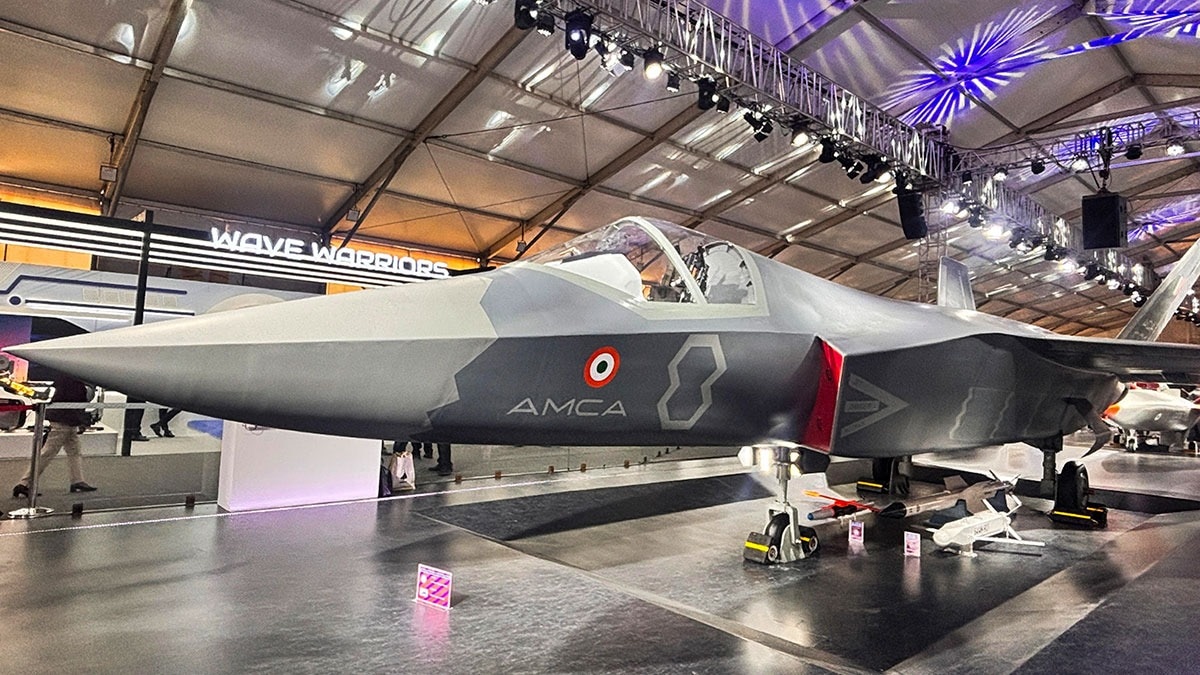
The next major contest in the skies over South Asia may no longer hinge primarily on which side fields more fighter jets. Instead, it could turn on who acquires genuine stealth capability first—and who builds the broader ecosystem needed to exploit it.Pakistan’s reported interest in China’s J-35 fifth-generation stealth fighter has brought this question into sharp focus. While the precise status, scale and timeline of any deal remain unclear, Islamabad’s pursuit of the aircraft carries strategic weight. Reports that Pakistani pilots are already training in China for stealth operations only heighten the urgency.For the first time, Pakistan could potentially induct a low-observable combat aircraft while India’s Advanced Medium Combat Aircraft (AMCA) remains largely on the drawing board. That asymmetry creates a potentially uncomfortable capability gap in which timing may matter as much as numbers.Indian Air Force (IAF) chief Air Chief Marshal A.P. Singh recently acknowledged that reports of Pakistan pursuing the J-35 and training pilots in China require close attention. He noted that the appearance of fifth-generation jets in India’s neighbourhood is monitored carefully while emphasising that India already possesses the capabilities to counter such threats. The global debate on stealth survivability has also intensified. Reports that a US F-35 sustained damage from an Iranian legacy air-defence system have prompted questions about the vulnerability of even advanced platforms. Experts stress, however, that effectiveness depends on far more than radar-evading shaping: advanced sensors, electronic warfare suites, secure data links and precision weapons form an inseparable package.Pakistan has already built much of its modern air-power architecture around Chinese technology. The JF-17 programme, Chinese-origin air-defence systems, weapons and sensors have produced a defence relationship deeper than a conventional buyer-seller arrangement. Induction of the J-35 would extend that partnership into a new domain, giving Pakistan a fighter jet designed around low observability, sensor fusion, electronic warfare and networked operations—and the potential to integrate it into an existing Chinese-origin ecosystem. That connectivity is what should most concern Indian planners.A stealth fighter jet does not need to shoot down large numbers of opposing aircraft to alter the operational calculus. Its lower probability of detection can complicate the defence of airbases, command centres, radar sites and other high-value assets. Even a modest fleet could force India to allocate greater resources to protection and accept higher levels of risk in certain scenarios. The ultimate impact, however, would still depend on how many aircraft Islamabad acquires, how quickly they become operational, the weapons they carry, pilot training, maintenance and the quality of the supporting network.This is where India’s AMCA programme assumes critical importance. New Delhi has chosen to develop its own fifth-generation fighter rather than seek an immediate foreign acquisition. The government has set a target of September 2028 for the first flight, yet significant milestones remain: the private-sector manufacturer has not been selected and the design has not reached freeze. The result is a difficult juxtaposition in which Pakistan could be preparing to induct a Chinese fifth-generation aircraft while India is still refining and industrialising its own.Ahead of Air Force Day (October 8), the IAF chief stated that if the AMCA programme faces delays, “we may have to look at other options”. He confirmed that Russia has offered the Su-57 but made clear that no decision has been taken.The defence ministry continues to emphasise on the indigenous path. Defence secretary Rajesh Kumar Singh has stated that India has not decided to pursue any global fifth-generation fighter programme; the focus remains on AMCA. The two positions reflect different clocks—one operational, the other developmental—rather than a contradiction.The IAF faces a longstanding numbers problem. It currently operates around 29 fighter squadrons against an authorised strength of 42.5 and needs to induct roughly 36-40 fighter aircraft a year merely to arrest further decline. At the same time, the air war of the 2040s will look very different from that of the 1990s or even the 2020s. Stealth, long-range weapons, autonomous systems, electronic warfare, sensor fusion and unmanned combat aircraft are reshaping air-power thinking.A well-upgraded fourth-generation fighter can remain highly capable, yet overall effectiveness is no longer determined by the aircraft alone. What matters is how it performs in airspace saturated with sophisticated air-defence systems and low-observable adversaries.If Pakistan acquires even modest fifth-generation capability before India fields the AMCA, the IAF will need to place greater emphasis on counter-stealth measures—long-range sensors, networked radars, advanced electronic warfare, airborne early-warning aircraft and missiles capable of exploiting fleeting detection opportunities. The result may not be a sudden reversal of India’s advantage, but it would raise the complexity and cost of maintaining it.The future Indian fighter jet fleet cannot be defined solely as Tejas Mk1A, Tejas Mk2, Rafale and AMCA. Those platforms will remain central, yet they will need to operate alongside an expanding family of unmanned systems ranging from inexpensive, attrition-worthy drones and decoys to sophisticated unmanned combat aircraft.A loyal wingman could carry additional weapons, extend sensor coverage, conduct electronic warfare or serve as a decoy without risking another pilot. Such systems alter the economics of air power: no country can afford hundreds of highly sophisticated manned fighters, but it may field far larger numbers of unmanned platforms. The air force of the future may, therefore, be judged less by the number of fighters it owns and more by the volume and quality of connected combat effects it can generate.India’s decision to develop an indigenous fifth-generation fighter is about creating the industrial and technological capacity to design, build, upgrade and sustain advanced combat aircraft within the country. That strategic autonomy is valuable, yet it comes with a price—time. Pakistan’s reported J-35 plans could place that resource under pressure, leaving India in a position where its long-term strategy is sound but its near-term timeline becomes uncomfortable.A foreign fifth-generation fighter could close the gap more quickly, but it would raise questions of cost, technology access, weapons integration and long-term dependence. The IAF chief’s reference to “other options” does not signal that India has decided to buy the Su-57 or abandon AMCA. It simply indicates that operational requirements cannot be placed on indefinite hold.The J-35, if it enters Pakistani service in meaningful numbers, will not by itself overturn India’s air-power advantage. India will continue to possess substantial strengths: Rafale fighters, upgraded Su-30MKIs, indigenous missiles, airborne early-warning capabilities, expanding electronic-warfare systems and a broader aerospace and defence-industrial base. Nevertheless, the aircraft could alter the equation of risk, compelling greater investment in protecting high-value assets, accelerating counter-stealth technologies and rethinking the integration of manned fighters, unmanned systems, sensors and long-range weapons.Air superiority in the coming decade will not be decided by which side fields the most impressive fighter on paper. It will be determined by who can see first, connect first, strike first—and sustain the fight longest. Pakistan is attempting a shortcut to fifth-generation capability through China. India is attempting to build its own. The strategic question is whether the indigenous route can move fast enough for AMCA to become operational before the regional balance begins to shift around it. For New Delhi, this is no longer simply a race to build a stealth fighter. It is a race against time.Subscribe to India Today Magazine- Ends
Can India's AMCA beat Pakistan's China shortcut to a stealth jet?
Full Article
Original Source
Read the full article at Indiatoday →KhanList aggregates and links to publicly available news content. We do not host full articles from third-party sources. Always verify important information with original sources.