
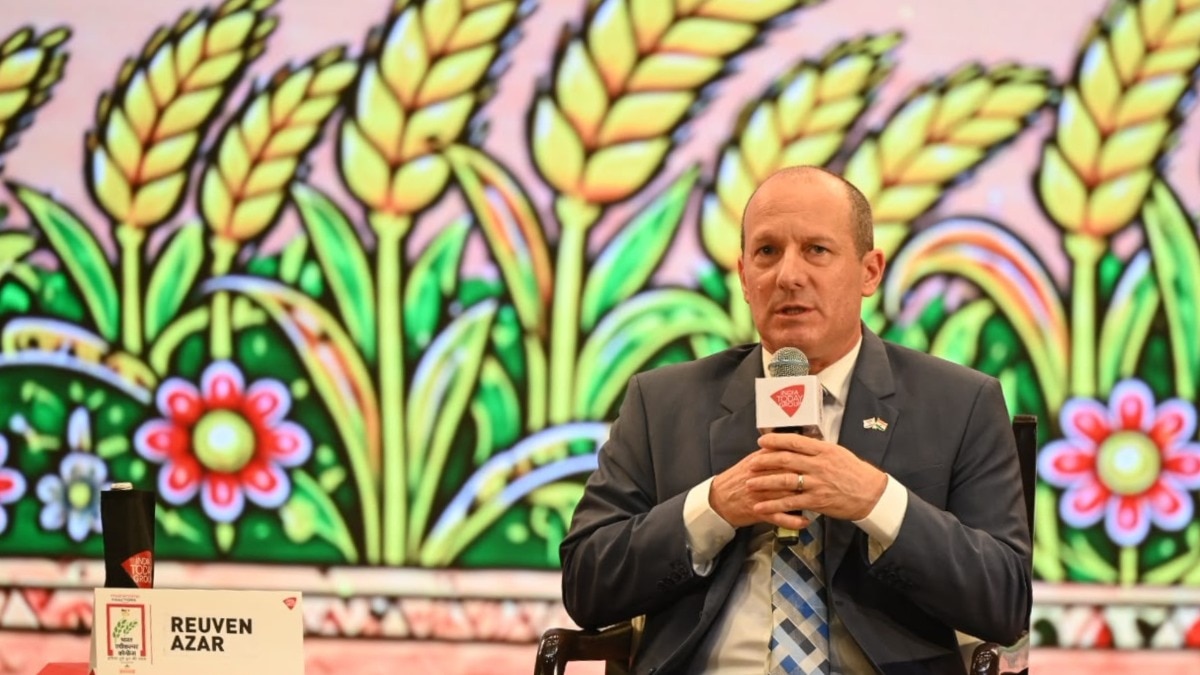
India's growing push for solar energy could create an unexpected problem for its farmers. As solar farms expand, agricultural land could be diverted towards electricity generation, which could threaten food security in the coming decade. Speaking about an innovative solution to solve the conflict, Israeli Ambassador to India Reuven Azar said that Israel is promoting a system that allows farmers to grow crops and generate solar electricity on the same land.Speaking at the India Today Group's Kisan Tak Bharat Agriculture Conference, Reuven Azar on Wednesday said Israel and other countries had developed technology that allows more than 50 crops to be cultivated alongside solar panels. The technology, called agrivoltaics, could help India pursue energy security without sacrificing agricultural production, while providing farmers with an additional source of income.The two-day Kisan Tak Bharat Agriculture Conference is being held at the Bharat Mandapam in New Delhi. Prime Minister Narendra Modi will be speaking at the India Today Group event on November 12 at 8 pm.India has already taken steps towards adopting agrivoltaics, with 36 operational projects generating 37.54 MW of electricity as of August 2025, according to an October 2026 Press Information Bureau report. The government has also established a Centre of Excellence for Agrivoltaics through the National Institute of Solar Energy and the Indian Agricultural Research Institute, while 10 other projects are in the pilot stage.The concern over agricultural land being diverted for energy generation arises from the growing competition between such non-conventional energy projects and farmland. Agricultural land in India has already seen a diversion because of demand for housing and infrastructure projects. Diversion for renewables could worsen that.Spain has already witnessed conflicts between agricultural production and solar energy expansion. In 2025, farmers in Andalusia protested against solar projects affecting thousands of olive trees.Azar warned that expanding solar farms could push up land prices and encourage farmers to lease their fields for electricity generation instead of cultivating crops. Agrivoltaics seeks to address this problem by allowing both activities to continue on the same plot. Israel, which has an arid and semi-arid climate, scarce water resources and limited fertile land, has made significant advances in agrivoltaic technology to address land scarcity and the competing demands of agriculture and solar energy generation. Its energy and agriculture ministries launched nationwide pilot initiatives in 2022, with over 140 sites approved by December 2024.Israeli-developed technology has also been tested in Germany, Austria, Italy and Greece under the EU-funded REGACE project, allowing greenhouses to generate electricity while growing crops. An illustration shows how agrivoltaic technology allows farmers to grow crops beneath solar panels while generating electricity from the same farmland. (Image: AI-generated) BATTLE FOR FARMLAND. SOLAR POWER PUT CROPS AT RISK?Iaraeli Ambassador Reuven Azar said India had already achieved food security, but its growing energy requirements and bids to harness non-conventional and clean sources, could present a new challenge over the next decade."Competition for land is growing as both solar energy projects and agriculture require large areas," Azar said at the Kisan Tak Bharat Agriculture Conference.Azar explained that as solar farms expand, farmers could face pressure to lease their agricultural land for electricity generation."Farmers lease the land for solar farming, and then they won't make enough crops," he said. "It could be a problem for food security, not now, maybe 10 years from now."The warning comes as India accelerates its transition towards renewable energy, particularly solar power, which requires substantial land for large-scale installations.India's installed solar power capacity crossed 150.26 GW by March 31, 2026. As India Today Digital reported in April, solar power contributed around 57 GW when India's peak electricity demand touched a record 256.1 GW on April 25. India's solar generation, including rooftop installations, had reached around 81 GW, meeting nearly one-third of the country's electricity demand at that moment. Solar power also generated 173.52 billion units of electricity in 2025-26, accounting for 9.46% of India's total electricity generation. India is experimenting with agrivoltaics at the Indian Agricultural Research Institute in New Delhi, where a 100-kW pilot project combines solar electricity generation with crop cultivation. (AI-generated) HOW CAN FARMERS GROW CROPS AND GENERATE ELECTRICITY ON SAME FARM?Azar highlighted agrivoltaics, a system in which solar panels are installed above or between crops, allowing agricultural production and electricity generation to coexist."In Israel and other countries, technology has been developed that allows more than 50 crops to be grown alongside solar panels on the same farmland," Azar said.The Israeli ambassador explained that some crops receive more sunlight than they require. Solar panels can reduce their exposure to excessive sunlight while simultaneously generating electricity."By reducing excessive sunlight exposure and generating solar power, farmers can earn income from electricity while also increasing their agricultural earnings," Azar said.He cited vineyards as an example, explaining that excessive sunlight could affect grapevines and that solar panels could potentially improve their quality.Israel is already working with Indian partners on the technology, he said, adding that delegations had visited Israel to study it.However, affordability remains a challenge. "We are already doing that, but this is still too expensive for the small farmer," Azar said. India had 36 operational agrivoltaic projects with 37.54 MW capacity as of August 2025, with vast potential to generate solar power while continuing crop cultivation. (Image: AI-generated) WHAT IS INDIA ALREADY DOING ON AGRIVOLTAICS?India has already begun experimenting with agrivoltaics. According to an October Press Information Bureau backgrounder, India had 36 operational agrivoltaic projects with a combined capacity of 37.54 megawatts as of August 2025. Another 10 pilot projects were under development.The government said elevated solar panels can protect certain crops from extreme heat, reduce soil moisture loss and allow farmers to earn revenue from electricity alongside agriculture.A nationwide study published by The Energy and Resources Institute (TERI) in March 2026, identified 47.35 million hectares of cropland potentially suitable for combining solar power generation with farming, after assessing soil quality, sunlight availability, terrain and flood risks.Of this, around 2.835 million hectares were found highly suitable for growing crops such as fruits, vegetables, spices and medicinal plants alongside solar panels, with Maharashtra, Rajasthan, Andhra Pradesh, Madhya Pradesh, Karnataka and Uttar Pradesh accounting for nearly 50% of India's estimated agrivoltaic power potential.In December 2021, Cochin International Airport expanded its agrivoltaic farming to 20 acres, allowing crops and solar electricity to be produced on the same land.IIT Guwahati has also introduced an agrivoltaic farming model in Assam's Hailakandi district.The issue was also discussed at the seventh Agrivoltaics World Conference, held in New Delhi from October 21 to 23, 2026. India's Ministry of New and Renewable Energy is exploring financial support for agrivoltaic projects, with the aim of making the technology accessible to farmers.Azar, however, also stressed that the real challenge was making such technologies affordable and accessible to farmers, rather than merely developing them. "The real test is not how many new technologies we introduce, but how many farmers actually adopt them," he said.With innovations available at commercial scale, Indian farmers will be able to use the same plot to harvest crop and the sun.- Ends
Can India grow food and solar power on same farm? Israel envoy shares a hack
Full Article
Original Source
Read the full article at Indiatoday →KhanList aggregates and links to publicly available news content. We do not host full articles from third-party sources. Always verify important information with original sources.