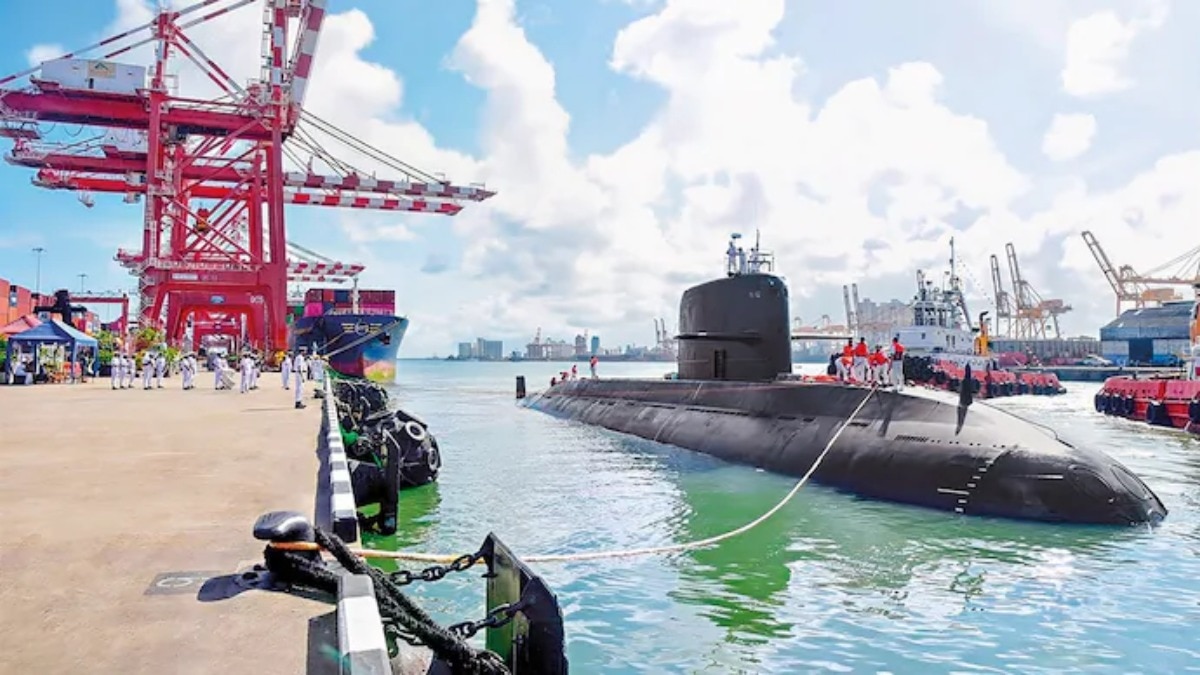
Pakistan's reach in India's eastern coastline got extended by a China-built submarine, raising concerns for New Delhi(NOTE: This article was originally published in the India Today issue dated August 3, 2026)India’s eastern flank has emerged as a geostrategic hotspot in recent years. China-Bangladesh defence deals in fighter jets and drones and upgrades of ports and airfields, as well as Pakistani defence and intelligence presence in Bangladesh all point to it. In fact, talking about a conflict scenario, Pakistan’s chief of defence forces, Gen. Asim Munir had stated in August 2025: “We will start from the east....” Now, Pakistan is hinting at tangible maritime moves at India’s secure eastern seaboard.In April, the first of eight Hangor-class diesel-electric submarines being built by China for the Pakistan Navy was commissioned. Last month, it completed its delivery voyage from China via Colombo and arrived in Karachi. During a naval event in Colombo, Commodore Omer Farooq, mission escort commander for PNS Hangor, stated that the new submarine would give Pakistan “the reach to maintain a presence in the Bay of Bengal”. New Delhi took note of the comment—if realised, this would mark Pakistan’s first naval presence in those waters since the 1971 war, when it lost its eastern maritime foothold.The waters of the Bay of Bengal, spanning approximately 2.6 million sq. km, remain central to India’s maritime security. The region hosts India’s Eastern Naval Command at Visakhapatnam and INS Varsha, India’s highly classified nuclear submarine base. A Pakistani submarine presence could pose surveillance challenges to these installations. Major sea lines of communication linking India with Southeast Asia traverse these waters, making any Pakistani naval presence here a positive threat. Naval observers note that the Hangor-class submarines—an export versions of China’s Yuan-class submarines—could enable Pakistan to engage in covert operations in the northern Indian Ocean and the Bay of Bengal. Crucially, they are equipped with air-independent propulsion (AIP) systems, which allow non-nuclear submarines to remain submerged for as long as three weeks at a stretch.Experts emphasise that, by projecting submarines eastward, Pakistan would force India to defend both western and eastern seaboards simultaneously. With China patrolling the waters of the Indian Ocean with increasing aggression, Pakistan’s Chinese-origin submarine fleet could improve interoperability with the People’s Liberation Army Navy (PLAN). Thus, for India, the greater concern is the emergence of a sustained Pakistan-China maritime footprint in the Bay of Bengal. In a conflict scenario, boats in the Bay could threaten merchant shipping and naval logistics, including routes to the Andaman and Nicobar Islands.Observers point out that Pakistani submarines have been confined to the North Arabian Sea since 1971, when PNS Ghazi deployed from Karachi to the Bay of Bengal, remaining on patrol off Visakhapatnam for several days before being sunk.PAKISTAN’S NAVAL MUSCLEPakistan is pursuing an ambitious naval modernisation to counter India’s maritime superiority and extend its reach. The programme includes new frigates, corvettes, long-range maritime patrol aircraft and cyber and space integration. The centrepiece remains the Chinese-made Hangor-class submarines. Pakistan has inducted the lead boat, PNS Hangor, with PNS/M Shushuk, PNS/M Mangro and PNS/M Ghazi to follow soon. These vessels feature AIP, as well as advanced sensors, heavyweight torpedoes and anti-ship missiles, and the nuclear-capable Babur-3 cruise missiles. The leap in endurance gives Pakistan the ability to operate far from home and delivers a second-strike option.Admiral Sunil Lanba (retd), former Chief of the Naval Staff, believes that if the Hangor submarine has the necessary range, a deployment in the Bay or the eastern Indian Ocean would be feasible. However, its effect would be limited unless it can undertake an operational turnaround at a port. “We would need to assess how many of these submarines are operationally available and the most likely areas of their deployment. If one considers the possibility of a Hangor being deployed off a harbour on the east coast, then anti-submarine operations would need to be intensified in that area,” says Adm. Lanba.Vice Admiral A.K. Singh, a former submariner, agrees with Lanba and observes that such deployments are possible only if Pakistan secures refuelling provisions in Bangladesh. However, he does believe that it would take the Pakistan Navy years to master the operational availability and reliability of the Hangor-class for long-range deployments.The port most likely to help the Hangors out, feel Indian military experts, is BNS Pekua, Bangladesh’s easternmost naval base, near Cox’s Bazar. If Pakistan were granted access to the base for turnaround, it would substantially extend the Hangors’ time on patrol. However, such a port visit would make it easy for India to track a sub’s movement. It would lose surprise and stealth—arguably a submarine’s greatest strengths.The possibility of Pekua being made available to Pakistan is not far-fetched, given the remarkable thaw in Dhaka-Islamabad ties since the fall of the Sheikh Hasina regime in 2024. Diplomatic and military exchanges have increased, along with broader defence cooperation. In November 2025, Pakistan Navy frigate PNS Saif docked at Chattogram—the first visit by a Pakistani warship to Bangladesh since 1971. Bangladesh and Pakistan also participated in the joint exercise AMAN, held in the North Arabian Sea in February 2025.Such exchanges suggest a gradual expansion of defence ties without implying a formal alignment. The strategy dovetails with China’s ‘String of Pearls’ approach to expand influence around India.THE MIGHTY MEDDLERChina is Bangladesh’s primary partner in naval modernisation. Under the Forces Goal 2030 initiative, Beijing supplied two Type 035G Ming-class diesel-electric submarines and built the BNS Pekua submarine base, which was inaugurated in 2023. Complete with maintenance and overhaul capabilities, it can accommodate up to six submarines and eight warships. Combined with Chinese upgrades of Bangladesh’s Chattogram and Mongla ports, Pekua forms part of Beijing’s broader Indian Ocean strategy. When viewed alongside China-Pakistan ties—most of Pakistan’s naval assets are of Chinese origin—this emerging naval axis adds new complexity to the regional maritime environment.In addition, Bangladesh is reportedly using Chinese investments to develop an air base at Lalmonirhat and a nearby hangar in north Bangladesh, just 16 km from the strategically sensitive Siliguri Corridor—India’s 22 km-wide land bridge linking the mainland to its eight Northeastern states—without regard for New Delhi’s sensitivities.Rear Admiral Anil Chawla, former chief of the Southern Naval Command, makes a distinction between such peacetime activities and those during a conflict, when they could draw Dhaka into a war—an unlikely development. Building strong ties with Bangladesh, therefore, is important for India. “We will have to divide attention between both coasts, which will mean more resources,” he says. “Even AIP-equipped subs have limited endurance, and the Bay of Bengal is a long way off from Pakistan. It is unlikely they will get support facilities in wartime. That is what we need to prevent.”INDIA’S CAPABILITIESIndia’s underwater warfare capability is one of the strongest pillars of its maritime deterrence architecture. The Navy operates a growing fleet of conventional and nuclear-powered submarines, supported by advanced surveillance networks, maritime patrol aircraft and strategically located bases. The Eastern Naval Command at Visakhapatnam provides India with the ability to monitor critical sea lanes, protect strategic installations and maintain a credible underwater presence in the Bay of Bengal.India’s security is reinforced by the Andaman and Nicobar Command, the country’s only integrated tri-service command. Located close to the maritime chokepoint of the Strait of Malacca, it monitors naval movements in the eastern Indian Ocean. Combined with satellite surveillance, long-range patrol aircraft, surface combatants and anti-submarine warfare capabilities, India maintains a layered underwater security network.At the centre of India’s underwater deterrence are the three Arihant-class nuclear-powered ballistic missile submarines (SSBNs), which form the maritime component of the country’s nuclear triad. India has plans to expand its conventional submarine fleet with platforms such as the French-origin Kalvari-class. Also, the plan to construct six diesel-electric submarines with AIP technology in collaboration with German shipbuilder ThyssenKrupp Marine Systems (TKMS) is also progressing.For now, Pakistan’s eastern foray is little more than a signal of intent. Yet the combination of new submarines, improving ties with Bangladesh and alignment with Chinese interests marks an evolution in Islamabad’s maritime thinking. How India responds—through diplomacy, enhanced surveillance and beefing up of its navy—will shape the security environment of the eastern Indian Ocean.- EndsPublished By: Yashwardhan SinghPublished On: Jul 31, 2026 20:58 IST
Can India defuse Pakistan's submarine threat in Bay of Bengal?
Full Article
Original Source
Read the full article at Indiatoday →KhanList aggregates and links to publicly available news content. We do not host full articles from third-party sources. Always verify important information with original sources.