
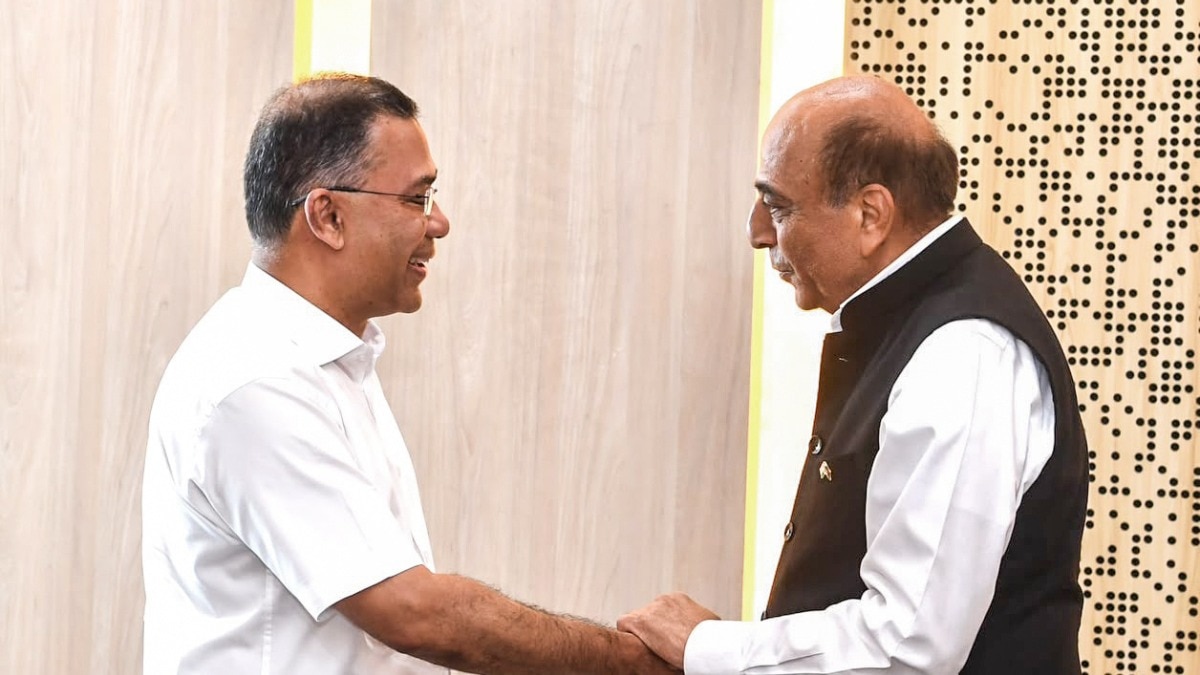
Indian envoy Dinesh Trivedi's talks with Bangladesh PM Tarique Rahman and key ministers signal both sides are keen to avoid Hasina from becoming a bilateral blockadeIndia and Bangladesh appear to be trying to pull their relationship back from the brink of another diplomatic confrontation, with Indian high commissioner Dinesh Trivedi meeting Bangladesh prime minister Tarique Rahman on August 10, days after former prime minister Sheikh Hasina used a virtual media interaction in New Delhi to sharply criticise his government.The meeting, Trivedi’s first with Rahman since taking charge as India’s envoy in Dhaka in June, comes at a sensitive moment. It also assumes significance ahead of Rahman’s possible visit to New Delhi in September for the BRICS summit. Prime Minister Narendra Modi has extended Rahman an invite in the latter’s capacity as chairperson of BIMSTEC (Bay of Bengal Initiative for Multi-Sectoral Technical and Economic Cooperation).The message from New Delhi was conciliatory. The Indian High Commission said Trivedi conveyed Prime Minister Modi’s greetings to Rahman and India’s intention to work with Bangladesh in a “positive, constructive and forward-looking manner”. The two sides discussed matters of mutual interest and ways to strengthen bilateral relations with a “people-centric approach”.For India, the meeting offered an opportunity to separate its engagement with the new Bangladesh government from the increasingly contentious question of Hasina, who has been living in India since fleeing Bangladesh on August 5, 2024, following the ouster of her Awami League government. Dhaka, however, made clear that Hasina remains central to its concerns. According to the Bangladesh Prime Minister’s Office, her extradition was among the issues raised during the meeting. Bangladesh foreign minister Khalilur Rahman had told reporters that Dhaka had urged India to expedite the process of extraditing Hasina, who has been sentenced to death in Bangladesh for “crimes against humanity”.Dhaka also sought the extradition of those suspected of murdering Inqilab Moncho convenor Sharif Osman Bin Hadi. “We have provided them with all the documents they requested for. This (Hadi case) is an extremely sensitive issue for us. We have asked them to extradite the killers as soon as possible,” Khalilur Rahman said.India, meanwhile, has sought to avoid allowing the Hasina controversy to overwhelm the broader bilateral relationship. New Delhi had clarified on August 7 that it did not endorse the remarks made by Hasina during her August 5 media interaction in New Delhi.“The government had no role in what was an event by a private media entity. The government does not endorse anything said at the forum, especially against the duly constituted government of Bangladesh,” ministry of external affairs spokesperson Randhir Jaiswal has said.That clarification appears to have helped create space for diplomatic engagement. Trivedi, who met Khalilur Rahman and Bangladesh home minister Salahuddin Ahmed during his two-day consultations in Dhaka, repeatedly stressed on dialogue as the way forward.“We had a good discussion. We have issues, and so does Bangladesh. But there is only one people's issue: good relations. There is no issue on which we cannot sit down and find a solution,” he said after meeting the Bangladesh prime minister.Trivedi described Rahman as a “man of the public” who was humble and down to earth. “It did not feel like I was meeting him for the first time. He is a very good person, very humble, and on the ground. We had a very good discussion. We are looking forward,” he said.Trivedi also offered a striking formulation on the relationship between the two countries: “We don't share borders. We share dreams. I think in the coming days, everything will be fine, and the issues will have to be sorted out on both sides.”The Indian envoy struck a similar note after his meeting with Ahmed. “There will be issues, and there will be solutions. But for the people of both countries, there is only one issue—that is, good relations,” Trivedi said. “Problems are solved when we talk to each other. I fully believe that the people are one. There will be a solution Everything is positive.”His comments are significant because India has several reasons to keep the relationship with Dhaka on an even keel. The two countries have unfinished business on trade, connectivity, security and water-sharing. The Ganga Water Treaty of 1996 is due to expire on December 31 after three decades.For New Delhi, the challenge is therefore to engage Rahman’s elected government without allowing differences over Hasina, border issues or other bilateral disputes to derail the wider relationship.Dhaka, on the other hand, wants India to create what it calls an “enabling environment” for the relationship to move forward. Khalilur Rahman said Bangladesh’s earlier objections to Hasina’s August 5 appearance had been conveyed clearly and that India had taken the concerns seriously.Asked whether India had expressed regret over allowing Hasina to address the media from New Delhi, Khalilur Rahman said the matter should not simply be reduced to an apology. He argued that Hasina, having been convicted by a Bangladeshi court, fell within the country’s judicial process, and accused India of allowing her to attack Bangladesh’s judiciary.At the same time, he acknowledged that his discussions with Indian officials had offered some reassurance. “Based on my discussions, I am somewhat reassured, and I hope there will be no recurrence of such an incident,” Khalilur Rahman said.The question of Rahman’s visit to India remains open. Khalilur Rahman said Dhaka had not yet taken a decision. “First of all, I am not a fortune-teller. Secondly, the prime minister was not invited to BRICS. He was invited as the chair of BIMSTEC. You should try to understand that distinction,” he said.The distinction may matter diplomatically, but the larger signal from the meetings was that neither side appears keen to allow the latest dispute to harden into another prolonged rupture. Trivedi’s meetings suggest that New Delhi is investing in direct political engagement with the Rahman government. His subsequent departure to New Delhi to brief the Prime Minister’s Office and the ministry of external affairs indicates that the consultations were part of a wider effort to calibrate India’s approach.The Bangladesh High Commission in New Delhi described the half-hour meeting between Trivedi and Rahman as one that could go “a long distance in cementing and advancing India-Bangladesh ties and engagements”.For India, the immediate objective appears less ambitious than resolving every outstanding dispute: keep channels open, establish working relations with the new government in Dhaka and prevent the Hasina issue from becoming the sole prism through which the bilateral relationship is viewed.Trivedi summed up that approach bluntly: “There are issues even at home. There is no issue that cannot be resolved.”The coming weeks—particularly the run-up to Rahman’s possible India visit—will test whether that optimism can survive the harder questions of extradition, border management, security cooperation and the future of the Ganga water-sharing arrangement. For now, however, Delhi and Dhaka appear to have chosen conversation over confrontation.Subscribe to India Today Magazine- EndsPublished By: Shyam BalasubramanianPublished On: Aug 11, 2026 20:22 IST
Can India-Bangladesh dialogue overcome Sheikh Hasina hiccup?
Full Article
Original Source
Read the full article at Indiatoday →KhanList aggregates and links to publicly available news content. We do not host full articles from third-party sources. Always verify important information with original sources.