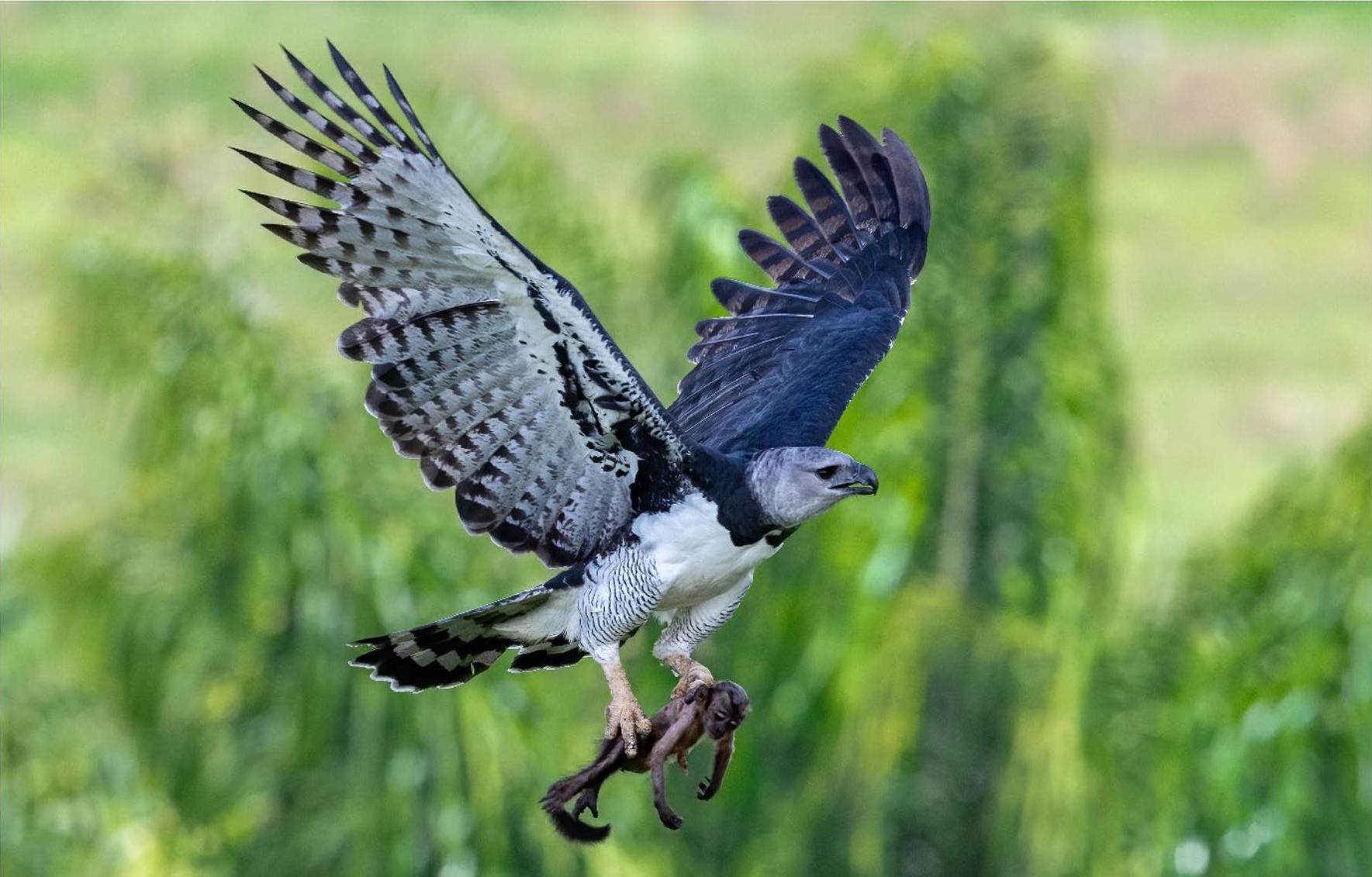
An attack by a harpy against a tourist in French Guiana has sparked a debate about interactions between humans and the world’s largest eagle.Field reports indicate that these episodes are uncommon and usually associated with defending prey, but they can result in serious injuries.Although rare, these cases expose a conservation dilemma: They may reinforce stigma against the species but also reveal real conflicts about which there is little public debate. In a remote area of French Guiana, a 29-year-old woman was attacked by a harpy, considered the world’s largest eagle, in October 2023. In an area with extensive tracts of preserved forest, such interactions between humans and wildlife are extremely rare but garner widespread media attention and scientific interest. A recently published study highlighted this incident. The attack took place about 35 kilometers (22 miles) from the closest village, near the Kourou River, as a group of 11 tourists and a local guide walked a trail. The harpy (Harpia harpyja) had perched about 6 meters (20 feet) high when it was spotted. Seeing no apparent signs of aggressive behavior, part of the group kept walking, while the woman and her partner stayed behind for a few minutes to photograph it. When the couple resumed their walk on the trail, the harpy dove and struck the back of her head. Since 2016, biologist Everton Miranda has been monitoring harpy eagles, considered a flagship species for Amazon conservation. He stressed how rare these cases are: “It’s extremely uncommon, just as it is for other large South American predators such as jaguars or crocodiles,” he explained. Miranda has co-authored a recent scientific article on the case, together with French-Guianan experts. This was the first harpy eagle attack ever recorded and described by researchers. In academia, there is resistance to publish cases like this, according to the biologist. “They fear that giving visibility to attacks will increase stigma, because we know there are many harpies killed because people fear they will attack domestic animals,” he said. The most common argument is that sharing stories of attacks against humans could trigger a hunting spree against harpies, whose population continues to decline mainly due to deforestation and forest fragmentation. Why tell this story, then? “Because there have been cases of dangerous interactions, and farmers do not read scientific articles,” Miranda said. Beyond that, he added that making these cases visible can also encourage public policies aimed at human-animal interaction. The wingspan of the Amazonian harpy eagle can reach 2.2 meters (7 feet). Image by Carlos Tuyama. Dangerous interactions? According to the researchers’ records, the tourist threw herself to the ground when she realized she was being attacked. With talons that can reach 12 centimeters (almost 5 inches), the harpy injured the woman’s head. Her partner tried to restrain the bird, pressing it against the ground by the neck, at which point it took flight, allowing them to escape. Seven hours later, the tourist was taken to the hospital, where she received antibiotic treatment. The wounds healed over a few weeks. Carlos Tuyama is a photographer and a biologist who has been working with harpy eagles in Brazil’s Rondônia state for 11 years. During that time, he has been able to document only one attack on humans in detail, in addition to hearing at least two other stories from community members, with partial evidence. The case documented by Tuyama is thought to have occurred about seven years ago, although the exact date has not been confirmed. At the time, an adult man saw a harpy while fishing but mistook it for a curassow. While climbing a bank to look for a nest, hoping to find some eggs for breeding, he was suddenly struck by the bird’s talons, which pierced his jaw and mouth area. The man was only released after a friend who was fishing with him intervened by swinging a machete. The animal was killed. Tuyama, however, never published the results of his investigation. Despite the stories, Tuyama has never felt threatened in the field and spends many of his days under harpy eagles’ nests. Obviously, there is risk: “A single talon strike is already a serious accident,” he said. But the cases are isolated and usually triggered by very specific causes, such as defense, which does not define the species’ overall behavior, according to Tuyama. “These attacks are probably an attempt to protect some nearby prey of which the person is not always aware. The person approaches, and the animal comes to defend its food,” Tuyama speculated. In fact, in the French Guiana case, the guides reported a dead monkey found near the attack site a few days earlier. In the case documented by Tuyama, decomposing prey was also seen in the area. Nest defense is also a possibility: In French Guiana, there are common, though unpublished, reports of crested caracaras (Rupornis magnirostris) charging at people in towns for this reason. In Brazil, in turn, the experience of installing observation towers for tourists to watch harpies at their nesting points to a different pattern: Not only are there no recorded attacks in these contexts, but the animals also show tolerance of human presence near their nests. Juvenile harpy eagle. Image by Carlos Tuyama. Does deforestation increase the risk? As apex predators, harpy eagles can subdue medium-sized monkeys or sloths. On the edges of the Amazonian Deforestation Arc, potential prey also include pets and livestock. That is when interactions become truly dangerous — not for humans, but for the harpies themselves. Currently, there is no consolidated data about harpy eagle killings in the Amazon, but the figures that do exist reveal some patterns. During a 10-year monitoring program in Ecuador’s Cuyabeno Wildlife Reserve, researchers tracked 53 birds, of which four were shot out of fear of predation on domestic animals or for trophy purposes. In the Brazilian context, there are records of at least five harpy eagles killed merely out of hunter curiosity in northern Mato Grosso state, plus another six reports linked to attacks on chicken or fear of predation. There are even killings caused by fear that harpies might prey on small children. Harpy eagles’ population density is low: Estimates range from three to six nests per 100 square kilometers (90 square miles), making any loss significant. Moreover, killings add to another, even larger risk: Deforestation. Areas with up to 50% deforestation rates cease to support the animal’s reproduction — at 70%, the nests are no longer viable. “The big issue is not just the killing of the eagles, but when they stop being born,” Miranda said. In Rondônia, Tuyama said that there are 31 known harpy eagle nests, of which eight are still viable, but none were active with chicks at the time of this report. “Not even the tops of Brazil nut trees are there for them,” he said. “Today, it’s all pasture or cropland.” As agricultural frontiers advance into the Amazon, reports of interactions between harpy eagles and humans may become more common, as shown in cases recorded on video that circulate on social media. The opposite could also happen: Eagles may be pushed ever further into more conserved forest fragments, and population decline could make these interactions even rarer. That is why Miranda sees sharing interaction stories — even those about attacks — as crucial. He said rural properties that comply with the Forest Code by dedicating 80% of their area to conservation in the Legal Amazon could become homes for harpy eagles. In these cases, the stigma against them must be overcome to prevent further killings. “I think that a nationwide reparation, compensation or prevention program is needed for those who lose domestic animals to wild animals,” Miranda said. Other countries such as the United States, India and Kenya have compensation programs for losses caused by wolves, bears, lynxes, tigers, elephants and other large animals. In Brazil, however, there are no structured programs of this kind — a void that could explain why conflicts between rural producers and large predators often end with the animals dead. A harpy eagle captures its prey in the state of Pará. Image by Carlos Tuyama. Debunking the myth: Do harpy eagles prey on humans? The question may sound absurd, but it would not be hard to imagine how the French Guiana case could have turned lethal if the eagle had struck the woman’s neck vertebrae or even her eyes. There are also recurring popular narratives, albeit geographically scattered across the Amazon, of harpies that carried children to their nests to devour them. From an evolutionary perspective, primate predation is considered a relevant factor in understanding the dynamics. There is evidence that, millions of years ago, large birds of prey used to target hominids. Extinct giants such as New Zealand’s Haast’s eagle (Hieraaetus moorei) or the Cuban giant owl (Ornimegalonyx oteroi) were reportedly big and strong enough to seize and kill human infants. The fact that small-bodied hominins coexisted with these predators suggests that, invarious ecosystems, large birds were directly related to human development. One possible outcome: Group living. Human social behavior may have been refined, at least in part, as a strategy against predation. And indeed, if that tourist had been alone, the consequence could have been tragic. But large birds as predators of human beings belong to a very distant past. And while popular stories continue to circulate, there is no evidence or record that Amazonian harpy eagles have ever preyed on babies. For Miranda, it is unlikely that it ever happened even millennia ago, when the first humans arrived in the Americas. According to his hypothesis, harpies began to coexist with humans when they were already larger, organized in groups and equipped with tools. In that context, the birds would hardly have been able to hunt people. Banner image: A harpy eagle carrying a newly captured capuchin monkey. Image by Jiang Chunsheng via Wikimedia Commons. (CC BY 4.0) This story was first published here in Portuguese on May 20, 2026. Citations: Epelboin, L., Mutricy, R., Pelletier, V., & Miranda, E. (2025). Unveiling the myth: Harpy eagle (Harpia harpyja) attacks on a human in the Amazon forest. Ecology and Evolution. 15(4), e71266. doi: 10.22541/au.172190539.97657538/v1 Miranda, E.B. P., Peres, C. A., Downs, C. T. (2021). Landowner perceptions of livestock predation> implications for persecution of an Amazonian apex predator. Animal Conservation, 25(1), 110-124.. doi: 10.1111/acv.12727 Miranda, E. B., Peres, C. A., Carvalho-Rocha, V., Miguel, B. V., Lormand, N., Huizinga, N., … & Downs, C. T. (2021). Tropical deforestation induces thresholds of reproductive viability and habitat suitability in earth’s largest eagles. Scientific Reports, 11(1), 13048. doi: 10.1038/s41598-021-92372-z Trinca, C. T., Ferrari, S. F., & Lees, A. C. (2008). Curiosity killed the bird: Arbitrary hunting of harpy eagles (Harpia harpyja) on an agricultural frontier in southern Brazilian Amazonia. Cotinga, 30, 12-15. Cite this articleTiago Mota e Silva (2026). Can harpy eagles attack humans? Amazon case rekindles scientific debate. Mongabay Conservation news. DOI: https://doi.org/10.66709/news-323731 Credits Topics
Can harpy eagles attack humans? Amazon case rekindles scientific debate
Full Article
Original Source
Read the full article at News →KhanList aggregates and links to publicly available news content. We do not host full articles from third-party sources. Always verify important information with original sources.