
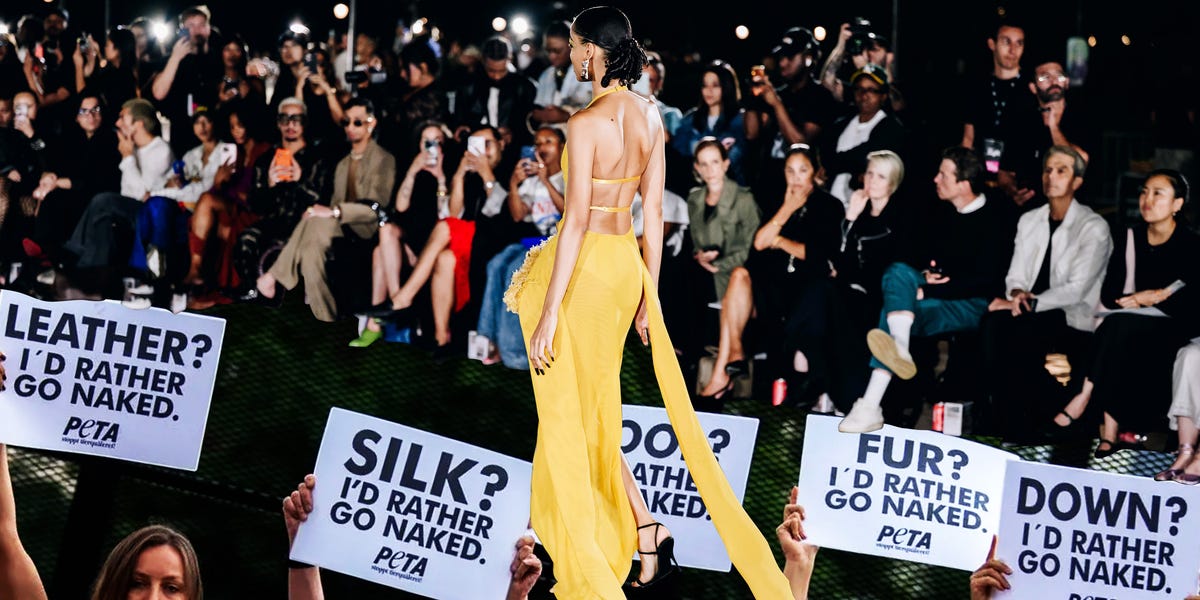
What are the clothes trying to say? What is the designer telling its audience? What can fashion say under fascism? It’s something we’re all seeming to wonder right now, dealing with our current administration shaped by far-right extremists and billionaire tech lords who’ve settled themselves in the arts and media spaces forcefully without rhyme or reason—or even an ounce of integrity or talent. Just last week, I asked if Mayor Mamdani and the euphoric New York he’s starting to build, putting the people and goodwill at the forefront of his work, could better shape New York Fashion Week into something worth believing in again.But that idea had other plans when Steven Kolb, president and CEO of the Council of Fashion Designers of America, went viral after physically restraining two PETA protesters at the COS runway show this past weekend. Fashion people and internet bystanders alike were appalled by the behavior, wondering why someone of that stature felt the need to silence the protesters in the manner he did. Security is there for this exact reason at runway shows. In many ways, it’s the perfect example of the times we’re living in.The CFDA announced yesterday that Kolb would be placed on leave while they do a full review of the incident. “The CFDA as an organization is committed to working with dissenting voices to find commonality and is engaged in efforts to move the American fashion industry forward while upholding the values of our membership, including respectful engagement with differing viewpoints,” the organization said in a statement to ABC News.Gilbert Flores//Getty ImagesThis instance, though, does not stand alone in the larger discussion of the fashion industry’s constant double standard, which exists in a gray area. But it begs the question of how fashion should look at itself in a post-COVID, current second-term Trump presidency (shelled in censorship), and in an era of social media accountability where nothing can stay hidden or be discarded from our murky pasts.Stylist and fashion writer Gabriella Karefa-Johnson posted to her Instagram about the CFDA incident saying, “You can buy the stuff, wear it, sell it. You can go to the show and celebrate the designer. You can drink champagne and look the other way. The system has made all of that acceptable…We gotta stop volunteering ourselves as enforcers for capitalism. The way we bow to money and power is so fucking sinister. We go crazy and feral protecting the people and institutions that have it. We will actually debase ourselves in defense of somebody else's money.”There’s no easy way around how uncomfortable it is to love something like fashion as it expands in every direction.It’s a complex dichotomy that exists in fashion...and also art more broadly. There’s an unsaid rule when creating art and leaning on the more morally progressive side: eventually, something has to give to expand, to further your brand, yourself, and your dreams. They don’t live without each other in corporate spaces. You’re either comfortable never giving up the morals at the foundation of your artistry and fading into the background because financial needs go unmet, or you cave when it feels cryptic and flimsy enough, hoping that no one notices you’ve lost your backbone.In some ways this has always been the setup. Art is funded by patrons. But with the access the internet affords to everyone’s past and viewpoints, it’s harder to ignore what “selling out” means for the artists and what they have to say. Fashion exists in a space that is confusing and contradictory, something filled with beautifully constructed clothes, but quietly backed and funded by large conglomerates overworking their employees in workshops, and according to PETA, some hiding their animal cruelty acts out back. Existing in fashion means constantly accepting that. It’s been the unwritten law for years. But in 2026, can the rest of the world accept it as they watch? Especially as social media now serves as this watchdog for moral policing?There’s no easy way around how uncomfortable it is to love something like fashion as it expands in every direction. It’s physically restraining a PETA protester at a runway show, frustrated that someone is disrespecting an art form while trying to silence another person’s rightful anger. It’s choosing to stay silent as you support a plus-size fashion creator who's doing more for representation than any luxury brand will ever do right now, even if half their wardrobe is fast fashion. It’s the Met Gala being the largest charity event to support fashion and art history, but being funded by a very polarizing Jeff Bezos, and until recently, platforming and honoring someone with a self-admitted problematic past.Fashion can no longer exist in this murkiness; the internet and our current world have pulled its contradictory ways from the shadows and into the light. But what does that even mean? I don’t have an exact answer, but it will be interesting to see how its insiders will be forced to address their slippery slopes as these times continue in their unprecedented trajectory.Aiyana Ishmael is the style editor at Cosmopolitan magazine. In her work, Aiyana focuses on the culture of fashion and how it intertwines and shapes the zeitgeist. She is an award-winning journalist from Miami, Florida, and a graduate of the historically Black university, Florida A&M. She is a 2024 Forbes 30 Under 30: Media honoree, and her debut romance novella PASSING GAME is set to release March of 2027 (831 Stories/Simon & Schuster).
Can Fashion Actually Be Revolutionary in 2026?
Full Article
Original Source
Read the full article at Cosmopolitan →KhanList aggregates and links to publicly available news content. We do not host full articles from third-party sources. Always verify important information with original sources.