
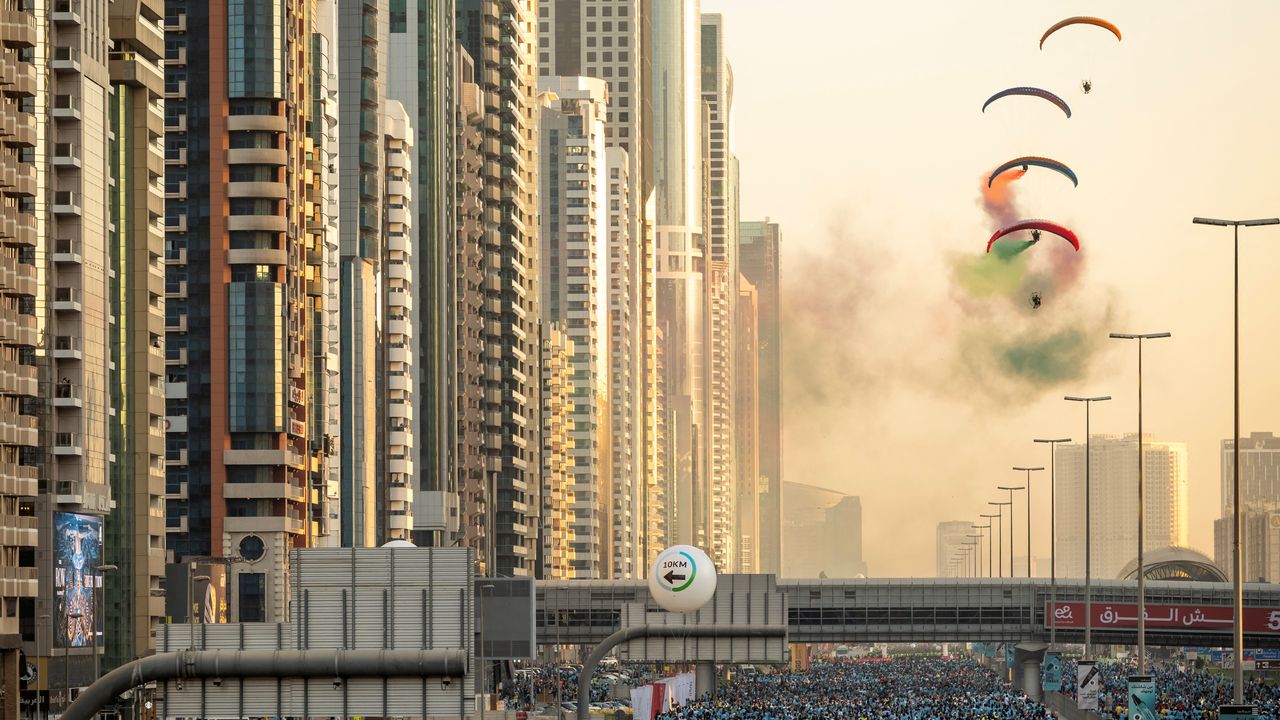
This November marks the 10th annual Dubai Fitness Challenge, one of the largest community fitness initiatives in the world. Here's how visitors can join in on the fun.FADEL SENNA/Getty ImagesAt 6 a.m. on Sunday, November 22, Dubai's Sheikh Zayed Road will fall silent. For one morning only, the city's six-lane superhighway—usually a blur of Nissan Patrols, taxis, and delivery scooters—will belong to tens of thousands of competitors as Dubai Run takes over the city’s skyline at dawn, following in the footsteps of a record 307,000 participants last year.Leading the charge is usually Dubai's Crown Prince Sheikh Hamdan bin Mohammed bin Rashid Al Maktoum, the driving force behind the Dubai Fitness Challenge (DFC) and one of the city's most ambitious experiments: to turn itself into the fittest city in the world."The people of Dubai have created an inspirational fitness movement, sending a powerful message that traveled far beyond our city,” Sheikh Hamdan said during a previous edition of the challenge. “Together, let us transform Dubai into the fittest city in the world.”An athlete himself, the Crown Prince has long championed cycling, diving, and long-distance running, but the challenge—now in its tenth year—is his most visible legacy. Launched in 2017, it calls on residents and visitors alike to commit to 30 minutes of exercise every day for 30 days each November. Since its inception, more than 16 million people have taken part, transforming what began as a simple invitation to get moving into one of the world’s largest community fitness initiatives.This year’s landmark edition is running until Sunday, November 29 under the theme What’s Your 30x30?, inviting residents and visitors to find their own way to complete 30 minutes of daily activity. With four flagship events, three free Fitness Villages, and more than 30 Community Fitness Hubs, the program is among the most ambitious yet, transforming everything from beaches and public parks to shopping centers and major roads into places to exercise.The first Dubai Fitness Challenge took place in 2017 Tom Dulat/Getty ImagesFour major events headline the 2026 calendar: Dubai Ride, which opened the challenge on Sunday, November 1 with thousands of cyclists taking over Sheikh Zayed Road; Dubai Run, the world’s largest free community fun run, on Sunday, November 22; Dubai Stand-Up Paddle, a two-day festival of paddle boarding, kayaking and yoga at Hatta Dam on Saturday, November 7 and Sunday, November 8; and Dubai Yoga, which returns for its second edition on Sunday, November 29, bringing thousands together for a mass sunrise session beneath the DIFC Gate Building.Three Fitness Villages—at Kite Beach, Zabeel Park and Al Warqa’a—act as free, all-day wellness hubs offering everything from boxing and beach volleyball to spin classes and meditation. More than 30 neighborhood Community Hubs have also been set up across the city, bringing fitness closer to home with pop-up runs, rooftop yoga, skateboarding lessons, padel tournaments, and family-friendly bootcamps.The calendar aligns with a packed line-up of international sporting events, from the Dubai Premier Padel P1 and T100 Triathlon to the DP World Tour Championship and Emirates Dubai 7s. This year also brings the return of the Dubai Sail Grand Prix, with high-speed catamarans racing off the city’s coastline, while HYROX Dubai will see athletes tackle a grueling combination of running and functional fitness challenges. Elsewhere, the program includes obstacle races, mountain trails in Hatta, and community running events across the city.It’s all part of what His Excellency Saeed Hareb, Secretary General of the Dubai Sports Council, describes as a lasting change in the city’s relationship with exercise. “It has helped establish a culture of active living, bringing communities together and making sport and physical activity an integral part of life in Dubai,” he said as the challenge marked its tenth anniversary.Ahmed Al Khaja, CEO of Dubai Festivals and Retail Establishment, says the anniversary is an opportunity to reflect on how far the initiative has come. Speaking at the launch of the 2026 program, he credited the collaboration between government bodies, private businesses, and local communities with making exercise increasingly accessible across Dubai. The aim, he said, is to inspire healthier habits that continue long after the 30-day challenge ends.The numbers suggest it’s working. Last year’s edition attracted a record three million-plus participants, up from 2.73 million in 2024. More than 307,000 people took part in Dubai Run alone, while Dubai Ride welcomed 40,327 cyclists. Since the challenge launched in 2017, cumulative participation has exceeded 16 million, a remarkable figure for an initiative that began with a simple invitation to exercise for half an hour a day.The Dubai Ride closes the city's busiest highway for one morning each year Anadolu/Getty ImagesEthan Matthews, Chief Operating Officer at Reset Fitness and a former professional rugby player and coach in Portugal and Italy, says that Dubai’s greatest fitness asset is its variety. “There are world-class facilities on every block now—not just gyms, but parks, cycling tracks, and sports complexes,” he says. “Try as many things as possible—team sports, group sessions, individual training. It’s about finding what challenges you physically but also what you actually enjoy. That’s how you stay consistent, especially on the tough days.”For Matthews, the social aspect is just as vital. “The moment you find something you like—padel, CrossFit, running, whatever—you meet people. It opens doors, both personally and professionally. That’s what keeps Dubai’s fitness culture alive.”Anthony Lee, a personal trainer and owner of Activ8 Lifestyle & Fitness who has spent nearly two decades as part of Dubai’s fitness scene, thinks the timing of the challenge is part of its success. “It’s clever,” he says. “It's just before Christmas, when everyone wants to feel a bit fitter before heading home for the holidays, and when the weather’s perfect for being outdoors.”He describes the month-long initiative as “a push that gets people back into routine,” and a rare opportunity to sample new workouts without cost or commitment. “You can try boxing on Kite Beach one day, yoga in Zabeel Park the next. It breaks the monotony.” What stands out most, he adds, is accessibility. “You don’t have to be an athlete. It’s about being a better version of yourself—you versus you.”For visitors, the challenge offers a very different way to experience Dubai as, during November, the city’s hotels, cafes and shopping centers adopt a surprisingly sporty rhythm. At Kite Beach, sunrise yoga sessions fill up fast, while the public running track buzzes with tourists and locals alike, and Zabeel Park hosts evening workouts beneath the skyline. There's no need to sign up—just show up on the day.Outside of November, the spirit of the challenge remains. Dubai has built more than 557 kilometers of cycle tracks, with a goal of 1,000 kilometers by 2030, and the urban planning department is adding shaded walking routes to make exercise feasible for longer stretches of the year.Lee, the personal trainer, believes Dubai’s fitness drive has found fertile ground because of the city’s demographic and design. “It’s a young place,” he says. “Most people are working-age expats, and with the beach and pool culture here, people want to look and feel good.”But vanity isn’t the whole story. “Every new residential tower has a gym and a pool, so exercise is built into daily life,” he says. “When I moved here 18 years ago, you had a handful of hotel gyms and a couple of Fitness First branches. Now every neighborhood has options, from boutique studios to outdoor circuits.” He has also noticed a social shift: “Fitness has become a way to meet people. For newcomers, joining a class or trying padel is how you find your tribe.”This year’s Dubai Fitness Challenge runs under the theme What’s Your 30x30? Getty ImagesThe fitness calendar's cleverest invention, however, might be the Mallathon. With summer temperatures soaring past 45°C, nine of the city’s biggest malls were converted into indoor running routes between June and September, attracting 100,000 participants.Dr Amir Firouzjaei, a general practitioner and traditional Chinese medicine expert who has lived in Dubai for three years, believes the movement taps into something deeper. “When a city moves, its energy moves,” he says. “It’s not only about training the body but refreshing the mind and spirit.”He explains that the city’s blend of high-intensity exercise and restorative practices “keeps the balance between energy and recovery,” preventing burnout and encouraging people to “stick with it.”The trend is filtering into Dubai's hospitality scene, too. New-generation hotels such as SIRO One Za’abeel pitch themselves as “fitness and recovery” spaces, complete with in-room stretching areas, altitude chambers and performance coaches. In Al Quoz, the Matcha Club—a blend of padel courts, co-working space, and cafe—has become the new social hang-out for the health-minded. Even Dubai’s famously indulgent brunches are getting lighter, with restaurants like Eat Well dishing up bowls, turmeric shots, and cold-brew coffee instead of the traditional Champagne towers.Matthews, who moved to Dubai in 2017—the same year the first Dubai Fitness Challenge launched—says he’s watched the city’s attitudes shift dramatically. “Post-Covid, the appetite for fitness just exploded,” he says. “Gyms, studios and open-air facilities have multiplied, but more importantly, people’s reasons for exercising have changed. They’re doing it to feel good, not just to look good.”He believes that’s partly because of education and access. “The government has played a big role through campaigns like 30x30, but accessibility is the real game changer. Whether it’s walking paths, beach gyms or purpose-built cycling tracks, there’s always somewhere to move.” For Matthews, that accessibility underpins a healthy, sustainable economy. “When people feel better, they perform better—at work, at home, everywhere. Fitness has become part of Dubai.”Residents and visitors alike are invited to discover new ways to move, connect and build healthy habits that last beyond the challenge's 30 days Getty ImagesFirouzjaei, the doctor, sees Dubai’s fitness boom as part of a wider cultural shift. “It’s a fast city, and that creates pressure,” he says. “People here work hard and compete hard, so they need ways to recharge and reset.”He points out that the city’s international mix has made wellness more mainstream. “Residents come from everywhere—Asia, Europe, the Middle East—and many already know yoga, acupuncture, or functional medicine,” he says. “They’re open to new ideas and they understand that health is an investment rather than a luxury.” In his clinic, he’s noticed that even patients who once focused purely on appearance now talk about sleep, stress, and balance.Behind the lifestyle messaging lies the emirate's urban agenda. Dubai wants to be a ‘20-minute city,’ where every resident can reach work, shops, and recreation within a short cycle or walk. The health argument is compelling. Obesity and diabetes are major public health concerns across the Gulf, and studies show only one in five UAE children meets recommended daily activity levels. City officials believe that building infrastructure—parks, cycle paths, open gyms—is the surest way to shift behavior.Already, habits are changing. Park footfall has risen 20% year-on-year, while corporate wellness participation has grown by 30%. The once-novel sight of commuters jogging to metro stations has become almost ordinary.According to experts, Dubai's mix of international residents has made wellness more mainstream Getty ImagesFor tourists, taking part couldn’t be easier. The Dubai Fitness Challenge app lists daily events, classes, and pop-ups across the city, most of them free.Looking back on 18 years in Dubai, Lee says the transformation has been “massive.” When he first arrived, “there were far fewer gyms, and fitness wasn’t part of daily conversation.” Now, he says, it’s as visible as the skyline itself. “Sure, some people join the big events just for the photos—you’ll always have that—but for others it’s the start of something lasting,” he says. “Even if they only do the challenge for a month, it plants a seed. And that’s what counts.”Matthews agrees, though he cautions against seeing Dubai’s fitness scene as something reserved for the elite. “The biggest misconception is that you have to be in peak shape to take part,” he says. “You don’t. Fitness here is for everyone, from people training for Ironman to those who just want to walk their dogs or join a weekend bootcamp.”Dubai has always been a city in motion, but now it wants its progress measured not by the height of its towers or the size of its megaprojects, but by footsteps, pedal strokes and heartbeats. It's a city that’s, quite literally, on the move—and inviting the world to keep up.Getty ImagesFive fun things to do during Dubai Fitness Challenge 20261. Run among Dubai’s gleaming skyscrapersDubai’s biggest community running event transforms Sheikh Zayed Road into a traffic-free running track, with participants choosing between a 5km route through Downtown Dubai or a longer 10km course finishing beneath the DIFC Gate Building. More than 307,000 runners took part last year.Where: Sheikh Zayed Road, starting near the Museum of the FutureWhen: Sunday, November 22, 6.30 a.m.How to take part: Register free at at dubaifitnesschallenge.com.2. Stretch beneath the DIFC GateMarking the finale of Dubai Fitness Challenge, thousands of yoga enthusiasts will gather beneath the iconic DIFC Gate Building for a mass sunrise session. The program includes guided breathwork, a sound bath and a 30-minute yoga session, with dedicated areas for families and women.Where: DIFC Gate BuildingWhen: Sunday, November 29, sunriseHow to take part: Register free at at dubaifitnesschallenge.com.Getty Images3. Keep fit at Kite BeachDubai’s largest beachfront Fitness Village returns with everything from spinning and yoga to padel, beach volleyball, basketball and cricket. There are dedicated activity zones, bookable courts and daily fitness classes, with the Arabian Gulf providing a rather spectacular backdrop.Where: Kite Beach, JumeirahWhen: Saturday, October 31 to Sunday, November 29; weekdays 3 p.m.–11 p.m., weekends 7 a.m.–11 p.m.How to take part: Register free on-site, with selected activities available to book at dubaifitnesschallenge.com.4. Sweat it out beneath the skylineZabeel Park’s Fitness Village returns with boxing, spinning, basketball, padel, and daily group workouts, alongside dedicated children’s activities. The village also serves as the official bib collection point for Dubai Run.Where: Zabeel Park, Gate 2When: Saturday, October 31 to Sunday, November 29; weekdays 4 p.m.–11 p.m., weekends noon–11 p.m.How to take part: Register free on-site, with selected activities available to book at dubaifitnesschallenge.com.5. Find your flow at Al Warqa’aSet among palm trees and parkland, this neighborhood-style Fitness Village combines outdoor exercise with family-friendly activities. There’s a 2.8km running and cycling track, bike rentals, daily fitness classes, dedicated ladies-only areas and courts for padel, volleyball, football, and basketball.Where: Al Warqa’a ParkWhen: Saturday, October 31 to Sunday, November 29; daily 4 p.m.–11 p.m.How to take part: Register free on-site, with selected activities available to book at dubaifitnesschallenge.com.This article was originally published on Condé Nast Traveller Middle East.Scott Campbell is a travel writer and photographer covering the Middle East, with a focus on Dubai and Saudi Arabia. He wrote his first article for BBC News at the age of 13, and since then has penned hundreds of pieces on everything from tyre factories in Tokyo to ultra-luxury ... Read More
Can Dubai Become the World's Fittest City?
Full Article
Original Source
Read the full article at Cntraveler →KhanList aggregates and links to publicly available news content. We do not host full articles from third-party sources. Always verify important information with original sources.