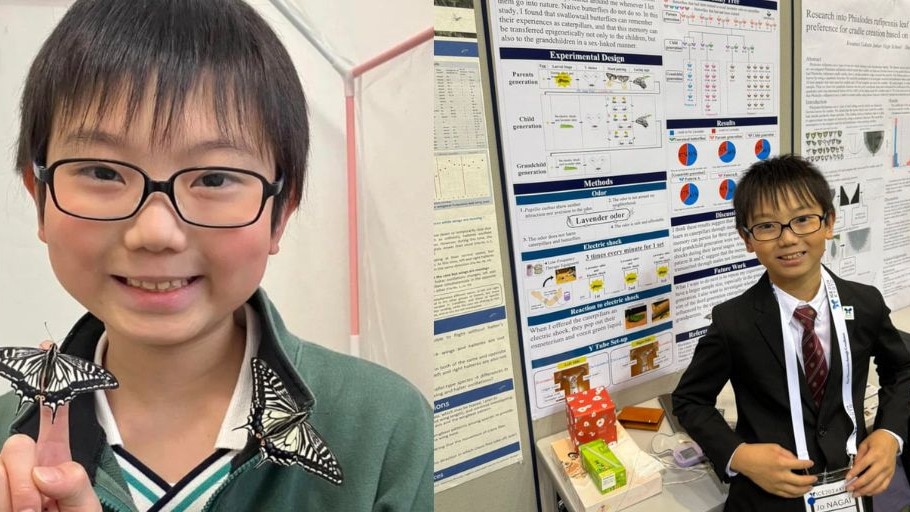
Jo Nagai, a 10-year-old Japanese student, is drawing global attention after his butterfly experiments suggested memories formed during the caterpillar stage may survive metamorphosis. While his findings remain unverified, they have sparked widespread scientific interest and renewed debate over insect memory.10-year-old Jo Nagai links butterfly memory to possible inherited behaviourWhat if a butterfly could remember its life as a caterpillar? That simple question has put 10-year-old Jo Nagai from Japan in the global spotlight. The elementary school student from Kobe conducted a series of butterfly experiments suggesting that memories formed before metamorphosis may survive the dramatic transformation into adulthood, challenging a long-held scientific belief.While his findings are yet to be independently verified and published in a peer-reviewed journal, Jo's research has already sparked worldwide interest, proving that curiosity and careful observation can lead to extraordinary discoveries, regardless of age.THE BOY WHO TURNED CURIOSITY INTO SCIENCEJo Nagai is a fifth-grade student at Ibuki East Elementary School in Kobe, Japan, and a scholar supported by the Son Masayoshi Philanthropic Foundation, which nurtures exceptionally talented young people across the country.Unlike most children his age, Jo has spent years carefully observing insects. His fascination with butterflies and other tiny creatures has led him to fill hundreds of handwritten pages documenting their behaviour, movements and habits. Despite earning international recognition for his butterfly research, Jo says his dream is to become a veterinarian, combining his love for science with his lifelong passion for animals.IT ALL STARTED WITH A BUTTERFLY THAT WOULDN'T FLY AWAYEvery scientific discovery begins with a moment of curiosity. For Jo, that moment arrived while raising Asian swallowtail butterflies at home. He noticed something unusual. Butterflies he had raised from caterpillars behaved very differently from wild butterflies. Instead of immediately flying away when he approached, many of them willingly returned to his hand, even after they had been released into the wild.That simple observation raised an extraordinary question. Could butterflies somehow remember experiences from their caterpillar stage despite undergoing one of nature's most dramatic transformations? Rather than dismissing the idea, Jo decided to test it.THE EXPERIMENT THAT TESTED AN IMPOSSIBLE IDEADetermined to find an answer, Jo designed a behavioural experiment of his own. While the insects were still caterpillars, he repeatedly exposed them to the scent of lavender while simultaneously applying a mild vibration using a muscle-therapy device. The vibration acted as an unpleasant but non-injurious stimulus, allowing the caterpillars to associate the lavender scent with discomfort.Once the caterpillars completed metamorphosis and emerged as butterflies, Jo tested them using a Y-shaped maze where they could choose between different paths.The results surprised even him. According to his observations, around 70 percent of the butterflies avoided the lavender scent, suggesting they retained memories formed before metamorphosis.If accurate, the findings challenge the long-held assumption that insects lose all previously learned experiences after their nervous systems are reorganised during metamorphosis.COULD BUTTERFLIES REALLY REMEMBER THEIR PAST?The possibility has fascinated scientists for years. Traditional biology has long suggested that complete metamorphosis effectively erases earlier memories because much of the insect's nervous system is rebuilt inside the chrysalis.However, a growing number of studies have hinted that some forms of learning may survive this remarkable transformation.Jo's observations add another intriguing piece to that puzzle. While his work alone cannot overturn decades of scientific understanding, it strengthens the growing interest in how insect brains preserve information during one of the most dramatic changes in the animal kingdom.THEN CAME THE BIGGEST SURPRISE OF ALLJo's research didn't stop with the butterflies that completed the experiment. He later bred the conditioned butterflies and observed their offspring.According to his findings, the next generation, and even the generation after that, also showed a greater tendency to avoid the lavender scent despite never experiencing the original conditioning.Jo suggested that this pattern could point toward transgenerational epigenetic inheritance, a biological process in which environmental experiences may influence future generations without altering DNA itself.Scientists, however, caution that this remains a preliminary observation. Much more research and independent replication will be needed before such conclusions can be accepted as established scientific evidence.WHY RESEARCHERS ARE PAYING CLOSE ATTENTIONWhat makes Jo's work remarkable isn't simply his age—it's the scientific approach behind it.His research has been presented before professional entomologists, including at the International Congress of Entomology in Kobe, where experts reviewed and discussed his findings.Researchers have praised his careful observations, thoughtful experimental design and remarkable dedication to scientific inquiry.At the same time, they emphasise that the study has not yet been published in a peer-reviewed scientific journal, meaning its findings must still undergo independent testing and replication before becoming part of accepted scientific knowledge.That careful process is how science moves forward.HOW A FIFTH-GRADER'S RESEARCH TOOK THE INTERNET BY STORMJo's story has resonated far beyond the scientific community. Millions of people have been inspired by the idea of a 10-year-old spending years observing butterflies, producing a detailed 33-page research paper, and confidently presenting his findings before experienced scientists.His journey has become a symbol of curiosity, patience and independent thinking.The research has also sparked conversations online. While many praised his dedication, others questioned the ethics of using an aversive stimulus during the experiments.Supporters note that the procedures were designed to trigger natural defensive responses rather than intentionally harm the insects, highlighting the importance of balancing scientific exploration with ethical responsibility.ONE YOUNG MIND, ONE BIG LESSON FOR THE WORLDJo Nagai's story is about much more than butterflies. It is a reminder that groundbreaking ideas often begin with careful observation and a willingness to ask questions that others may overlook.Whether his conclusions ultimately withstand years of scientific scrutiny or inspire entirely new lines of research, his journey has already become an inspiring example of how curiosity, patience and determination can contribute meaningfully to science.At just 10 years old, Jo Nagai has shown that age is no barrier to discovery, and that sometimes the smallest creatures can lead to the biggest questions.- EndsPublished By: Apoorva AnandPublished On: Aug 5, 2026 11:45 IST
Can butterflies remember being caterpillars? A 10-year-old Japanese boy thinks so
Full Article
Original Source
Read the full article at Indiatoday →KhanList aggregates and links to publicly available news content. We do not host full articles from third-party sources. Always verify important information with original sources.